Alik Griffin
San Clemente Sunset
Subscription Form
  • Reviews
    • Accessory Reviews
    • Calculators
      • Video Data Rate Calculator | Record Time Calculator
      • Diffraction Calculator
      • DoF Calculator | Lens Equivalent
      • Shutter Speed to Shutter Angle Calculator
    • Camera Reviews
    • Lens Reviews
    • Memory Cards Recommendations
      • Fastests SD Memory Cards
      • Fastest MicroSD Cards
      • Fastest CFExpress Type-B Card
      • Fastest CFExpress Type-A Cards
      • Best CFast Memory Card
    • List of Mics
      • Best Streaming & Podcast Mics
  • Camera Guides
    • List of all Blackmagic Cameras
    • List Of all Canon RF Cameras
    • List of all Fujifilm Cameras
    • List of all Nikon Z Cameras
    • List of all Panasonic Cameras
    • List Of all Sony E Cameras
  • List of Lenses
    • Canon RF Lenses
    • Fujifilm GFX Lenses
    • Fujifilm XF Lenses
    • L-Mount Lenses
    • Leica M Lenses
    • Micro Four Thirds Lenses
    • Nikon Z Lenses
    • PL Mount Cine Lenses
    • Sony E Lenses (FE and APS-C)
  • Store
  • My account
Alik Griffin
Alik Griffin
  • Reviews
    • Accessory Reviews
    • Calculators
      • Video Data Rate Calculator | Record Time Calculator
      • Diffraction Calculator
      • DoF Calculator | Lens Equivalent
      • Shutter Speed to Shutter Angle Calculator
    • Camera Reviews
    • Lens Reviews
    • Memory Cards Recommendations
      • Fastests SD Memory Cards
      • Fastest MicroSD Cards
      • Fastest CFExpress Type-B Card
      • Fastest CFExpress Type-A Cards
      • Best CFast Memory Card
    • List of Mics
      • Best Streaming & Podcast Mics
  • Camera Guides
    • List of all Blackmagic Cameras
    • List Of all Canon RF Cameras
    • List of all Fujifilm Cameras
    • List of all Nikon Z Cameras
    • List of all Panasonic Cameras
    • List Of all Sony E Cameras
  • List of Lenses
    • Canon RF Lenses
    • Fujifilm GFX Lenses
    • Fujifilm XF Lenses
    • L-Mount Lenses
    • Leica M Lenses
    • Micro Four Thirds Lenses
    • Nikon Z Lenses
    • PL Mount Cine Lenses
    • Sony E Lenses (FE and APS-C)
  • Store
  • My account
  • Viltrox 9mm f2.8 Air Review
    Viltrox 9mm f2.8 AIR Review & Sample Photos
    • January 14, 2026
  • Biker Bro
    Viltrox Spark Z3 Flash – Review & Sample Photos
    • January 14, 2026
  • Kalina Flower FIeld
    Nikon Z 50mm f1.4 Review & Sample Photos
    • April 13, 2025
  • TTArtisan 27mm f2.8 AF Front of Lens
    TTArtisan AF 27mm f2.8 Review & Sample Photos
    • March 8, 2025
  • TTArtisan 23mm f1.8 Product Shots
    TTArtisan AF 23mm f1.8 Lens Review & Sample Photos
    • February 5, 2026
  • Thypoch Simera 75mm f1.4 Review

    Thypoch Simera 75mm f1.4 Review & Sample Photos

    View Post
  • Cool Street In Nakasu Fukuoka

    Viltrox WCL-X100VI Review | A Budget-Friendly 28mm Upgrade

    View Post
  • Sony A7V Announcement

    Sony A7V – They’re Back In The Game

    View Post
Trending Posts
  • Nikon Zf Official Announcement 1
    Nikon Zf – The Fujifilm Killer?
    • December 25, 2024
  • Nikon Z 50mm f1.8 S Lens Review 2
    Nikon Z 50mm f1.8 S Lens Review & Sample Photos
    • April 11, 2025
  • Kamlan 50mm f1.1 II Product Shot 3
    Kamlan 50mm f1.1 II Review & Sample Photos
    • January 18, 2025
0
  • Blog
  • Lens Reviews

Nikon Z 35mm F1.8 S Review & Sample Photos

  • Alik Griffin
  • July 23, 2024
  • 33 comments
**This website contains affiliate links. We will earn a small commission on purchases made through these links. Some of the links used in these articles will direct you to Amazon. As an Amazon Associate, I earn from qualifying purchases.

The Nikon Z 35mm f1.8 S features a partly aluminum and plastic construction, combined with dust and weather-resistant design as well as a bright f1.8 aperture, that all come together to make this one of the best do-it-all lenses for travel or daily use.

This 35mm also features a nearly silent stepping motor and internal focusing system with practically no focus breathing which is great for videography as well.

Overall the Nikkor Z 35mm f1.8 strikes a delicate balance between form and function and delivers amazing results in any situation.

Nikon Z 35mm F1.8 S Sample photo of the Oniyo Fire Festival.
ISO 450, f1.8, 1/80

Table Of Contents

    • Check Price
  • Nikkor Z 35mm f1.8 S First Impressions
  • Nikkor Z 35mm f1.8 S Build Quality
    • Autofocus
  • Nikon Z 35mm f1.8 S Image Quality
    • Nikon Z 35mm f1.8 S Sharpness Charts
    • Distortion
    • Vignetting
    • Chromatic Aberrations 
    • LoCA Chart
    • Lens Flaring / Sun Stars
  • Art & Character
    • Bokeh Samples
    • Bokeh Balls
    • Focus Falloff
    • Contrast / Micro-Contrast / Color Rendering
    • SOOC Samples
  • Nikon Z 35mm f1.8 Sample Photos

Lens Specs

Focal Length: 35mm
Aperture: f1.8 – f16
Aperture Blade:
9 Rounded
Optical Design: 11 Elements in 9 Groups
Elements: 2 ED / 3 Aspherical
Coatings: Nano Crystal & Super Integrated Coatings
Autofocus: Stepping Motor, Internal
VR: No
Weather-Sealed: Yes
Minimum Focus Distance: 9.84″ / 25 cm
Filter Threads: 62mm
Weight: 13.05 oz / 370 g

Pros – Sharp, very smooth focus falloff, no focus breathing, great contrast, great color rendering, great bokeh, fast autofocus.

Cons – Some CA in the corners with some fringing in the bokeh in high contrast situations, some vignetting wide open, not a lot of micro-contrast, a little big compared to other f1.8 lenses.

Notes: Nikon could have probably made a better lens, in terms of perfecting the image quality, but it likely would have had to be much bigger and heavier. After using the lens for quite some time now, the balance between the artistic characteristics, size, weight, and image quality is pretty impressive. I highly recommend it if you need a do-it-all fairly small and fairly lightweight 35mm lens. I use it for everything and its close-focusing abilities are great for product shots and when shooting video.

It’s very hard to find flaws with this lens when it comes to daily shooting but when put under some stress testing there is some fringing and textured bokeh that can be seen.

Check Price

Nikon Z 35mm f1.8 S – Amazon / Adorama / B&H

Nikon Z 50mm f1.8 S Review

Nikon Z 85mm f1.8 S Review

List of all lenses for Nikon Z mount

Nikkor Z 35mm f1.8 S First Impressions

I picked this lens up in late 2019 when it was on sale. It’s a bit on the expensive side, at its regular list price, but the performance and overall package are pretty impressive. The lens is just great for everything, street, landscape, family, and lifestyle. I’ve used it in the rain, at the ocean shooting beach photography, with my kids, and on the streets and nothing has yet to challenge the lens for multi-use.

When talking about the Z 35mm f1.8, we sort of need to look at this lens for what it is – a very high-quality f1.8 lens. This is not some cheap 35 f1.8 like we’ve had in the past from Nikon and Canon, and I think a lot of DSLR shooters are still confused by what Nikon is doing here.

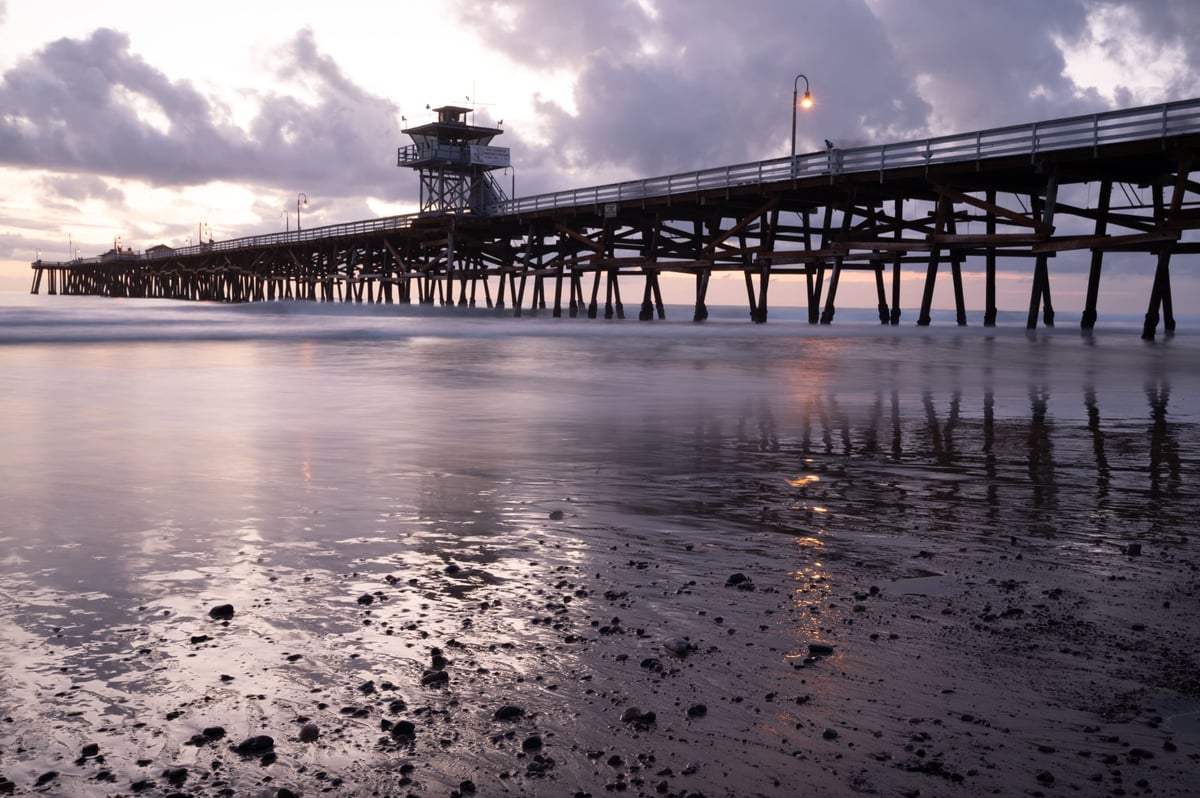
Nikon 35mm f1.8 Landscape Photography Sample, Sunset at the San Clemente Pier

f1.8 lenses are now considered amateur or enthusiast-focused cheap lenses and even Canon is still doing that with their RF system. Sony has a few great 35mm lenses now but, so far, none of them can match the overall performance of what this lens offers, which I’ve seen anyway. The new Sony 35mm f1.8 is a touch smaller and lighter than this lens and it might be a little more manageable for the full-time street shooter.

For a do-it-all 35mm lens, the Nikon Z 35mm f1.8 S might be the lens to beat right now in terms of raw performance, though the Sony 35mm f1.8 looks like a solid contender. Both lenses have an internal focus design, and both have no issues with focus breathing.

Little Girl Sits at dinner.
ISO 100, f1.8, 1/1000

For me personally, and the way I shoot, I don’t usually need anything faster than f1.8 at this focal length. On a full-frame camera, it produces a very acceptable and shallow depth of field. I would probably be just as happy with an even smaller 35mm that’s an f2 and less expensive, but it looks like Nikon is pushing the limits of what you can shoot outdoors in daylight with that 1/8000 shutter speed without needing an ND filter.

Of the three Z prime lenses I have now, the 35mm f1.8, the 50mm f1.8, and the 85mm f1.8, the 35mm is probably the lens that’s on my camera the most. This is great for indoor shooting, or traveling around with kids and family and then I throw on my 50 or 85 when I want to plan or shoot something specific.

The 35mm focal length is incredibly versatile. There is a reason some of the greatest candid photographers, ie; David Alan Harvey or Bill Cunningham, have heralded this length for street and documentary photography. It gives you that in-between length that can still capture the feeling as well as the story without being too wide or too close. Sometimes, the lens can be a little wide for video, but the Nikon Z6 also shoots great video in the DX crop mode which gives you a 50mm field of view. Yes, I use the DX crop mode for video all the time because it allows me to get two different focal lengths out of the same lens and nobody can tell the difference. As someone who shoots APS-C half the time, I definitely don’t mind taking advantage of the super 35mm modes of our full-frame cameras.

Oniyo Fire Festival Sample Photo
ISO 2000, f1.8, 1/80

Nikkor Z 35mm f1.8 S Build Quality

I love the build quality of these Nikkor Z lenses. Am I the only one? – I’m not sure. But I love the feel of the Z lenses overall. Every time I pick up the Z6 with these lenses it just makes me excited to shoot. The whole system is just so balanced and solid. Not too heavy and not too light but always premium feeling in my hand. I’m also glad the 35mm looks great without the lens hood since I don’t like using hoods when shooting street photography. Unfortunately, I can’t say the same about the Z 20mm and 24mm lenses look a little weird without the hoods with the way they flair out.
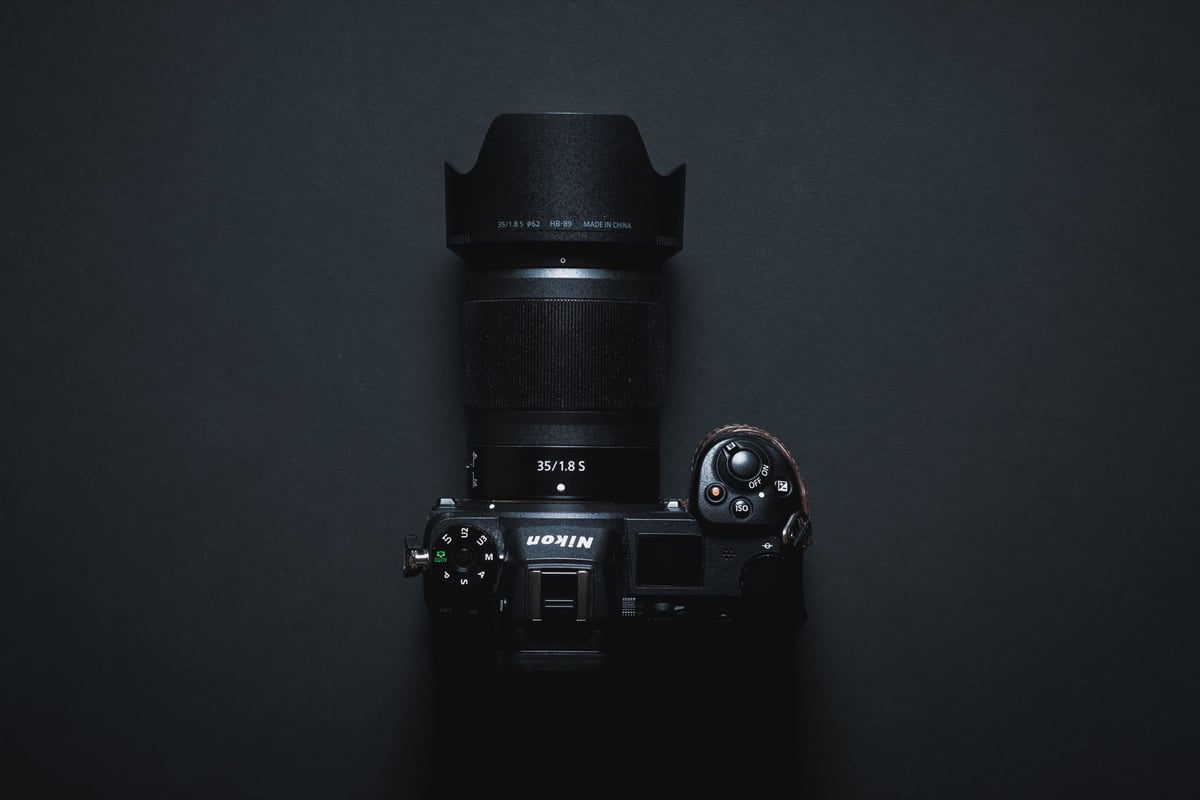
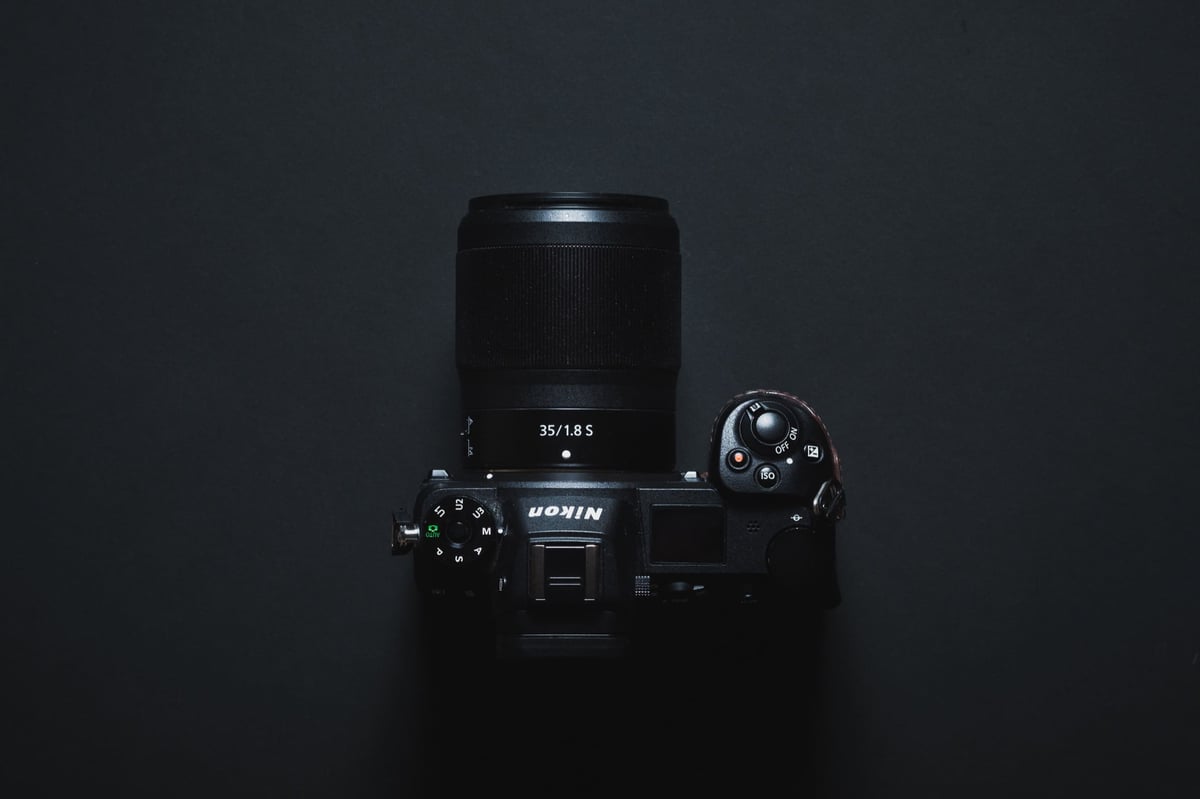
Nikon Z 35mm f1.8 Product Shot

I love how all the Z f1.8 lenses have consistency in their design language where they feel like they are part of the same family. They are also relatively similar in size and weight so they always feel familiar when switching between them.

I love the aluminum focus ring, but there are a few rings of plastic between the metal outer metal components. I’m not sure why Nikon chooses to use some plastic with these lenses but I imagine it’s for durability and performance in the heat.

On the lens, there is only one focus ring. There is no aperture ring. There is only one switch that allows you to choose between auto and manual focus.
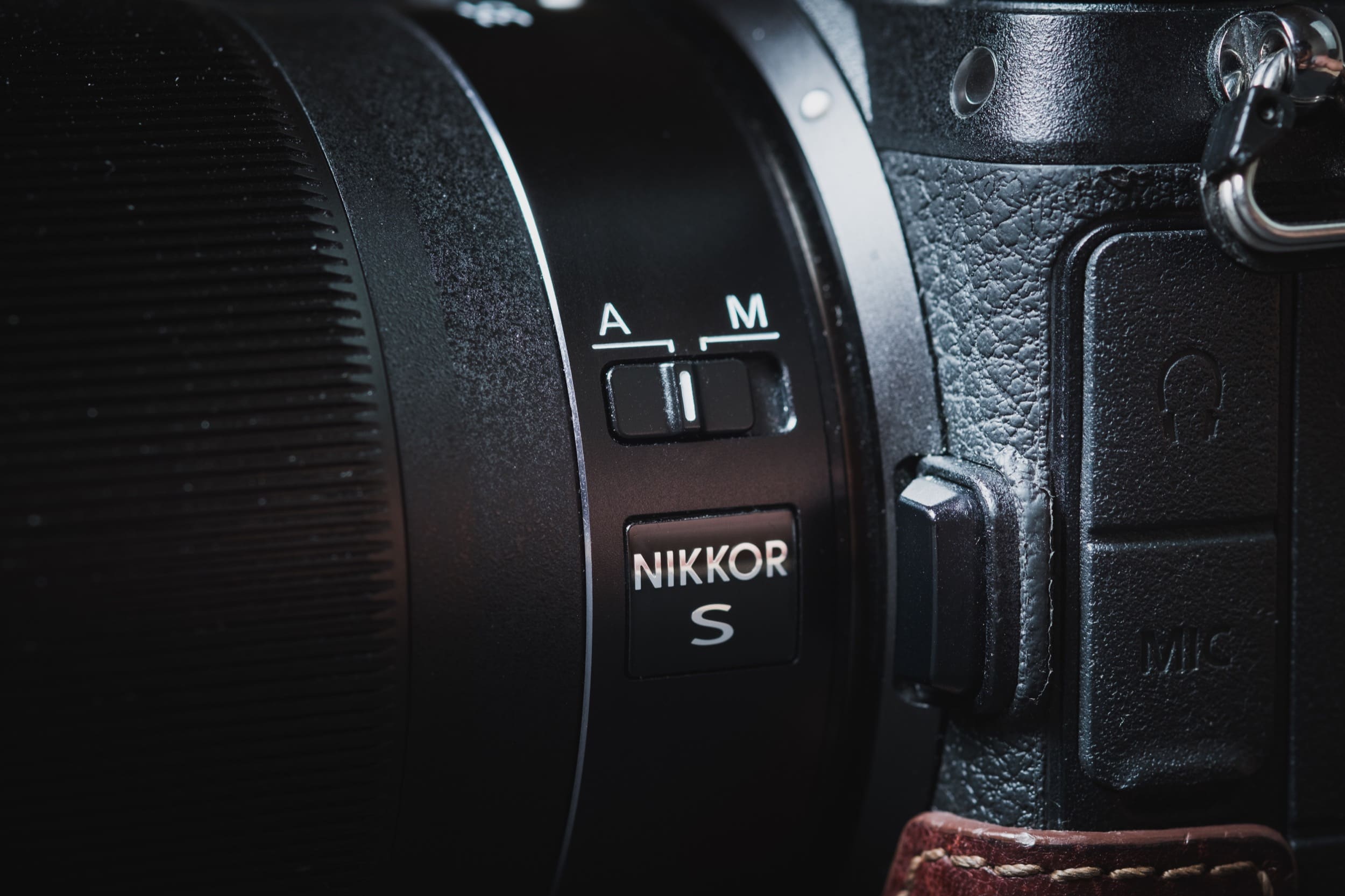
Nikon Z 35mm f1.8 Product Shot showing the A/M switch on the side.

Still with the latest firmware of the Z6 and Z7, if you turn off the camera, the focus position will not be retained.

The lens hood is made of plastic and is a good size. Not too big like we have on the 85mm f1.8. The lens hood also clicks on firmly and remains very tight, with no rattling or loose action.

The rear element goes all the way up to the great lens mount, it shows us this wasn’t some old DSLR design adapted to mirrorless which we see so commonly with third-party lenses.
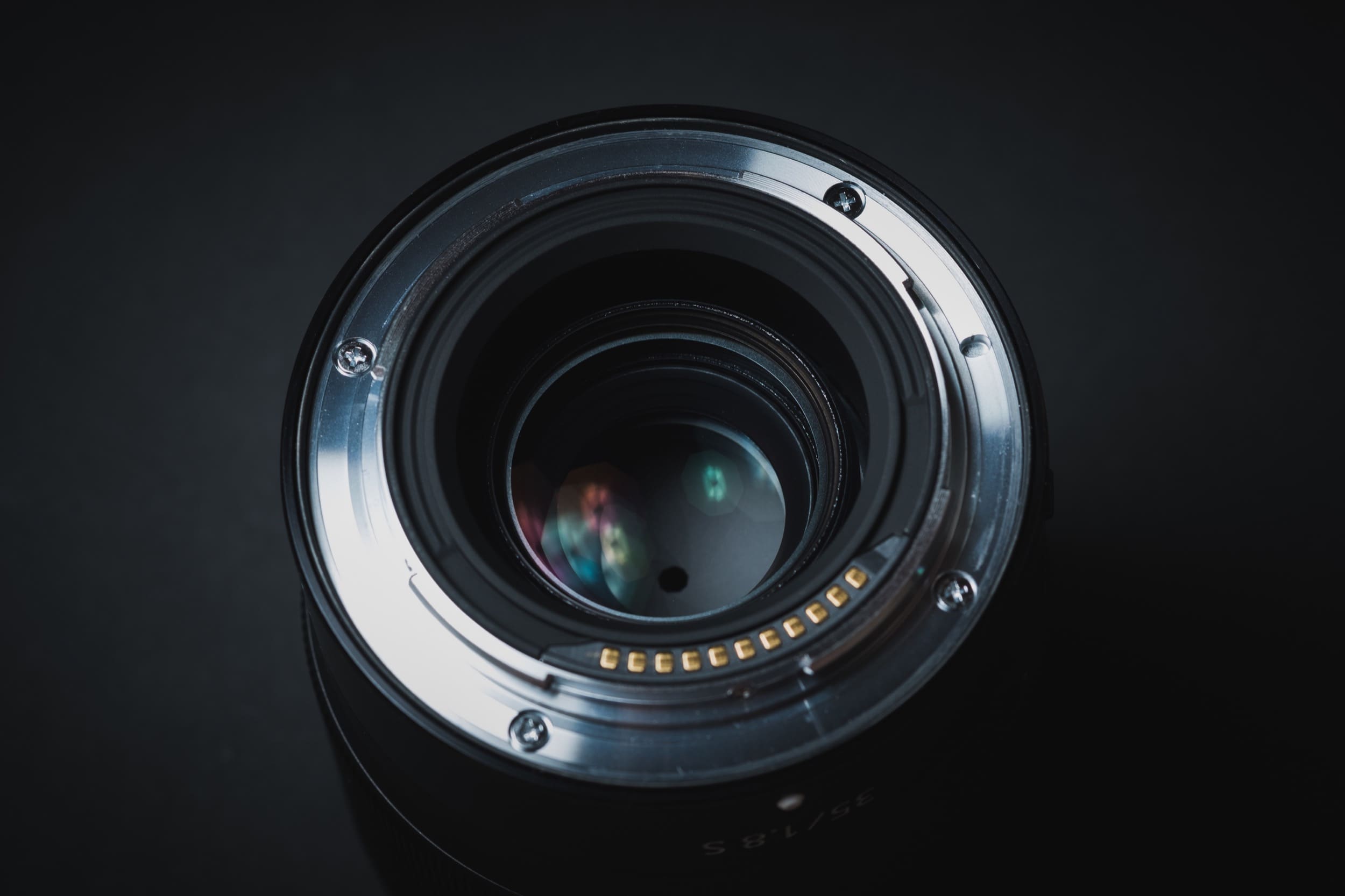
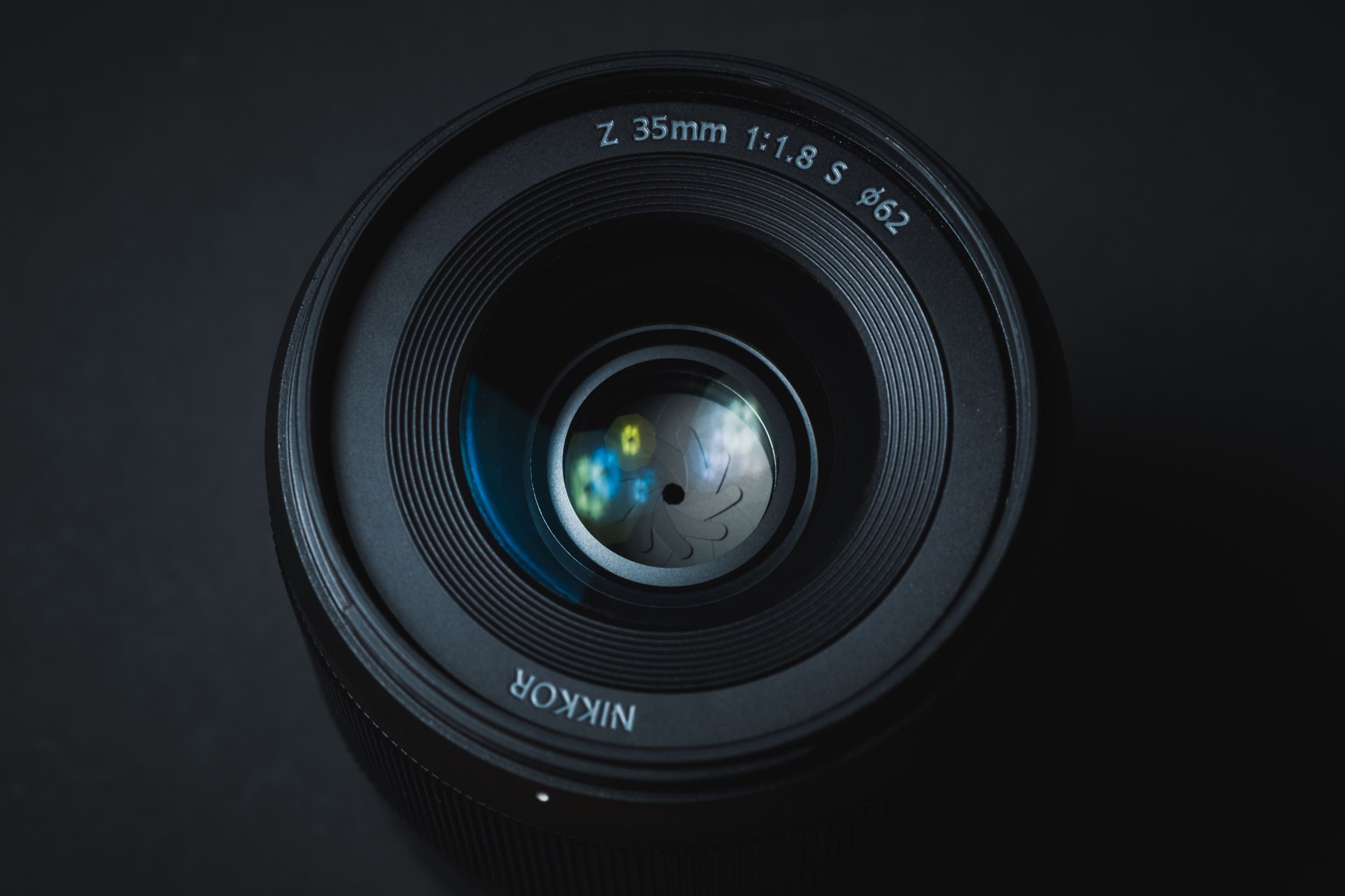
Nikon Z 35mm f1.8 Product Shot of Rear Element
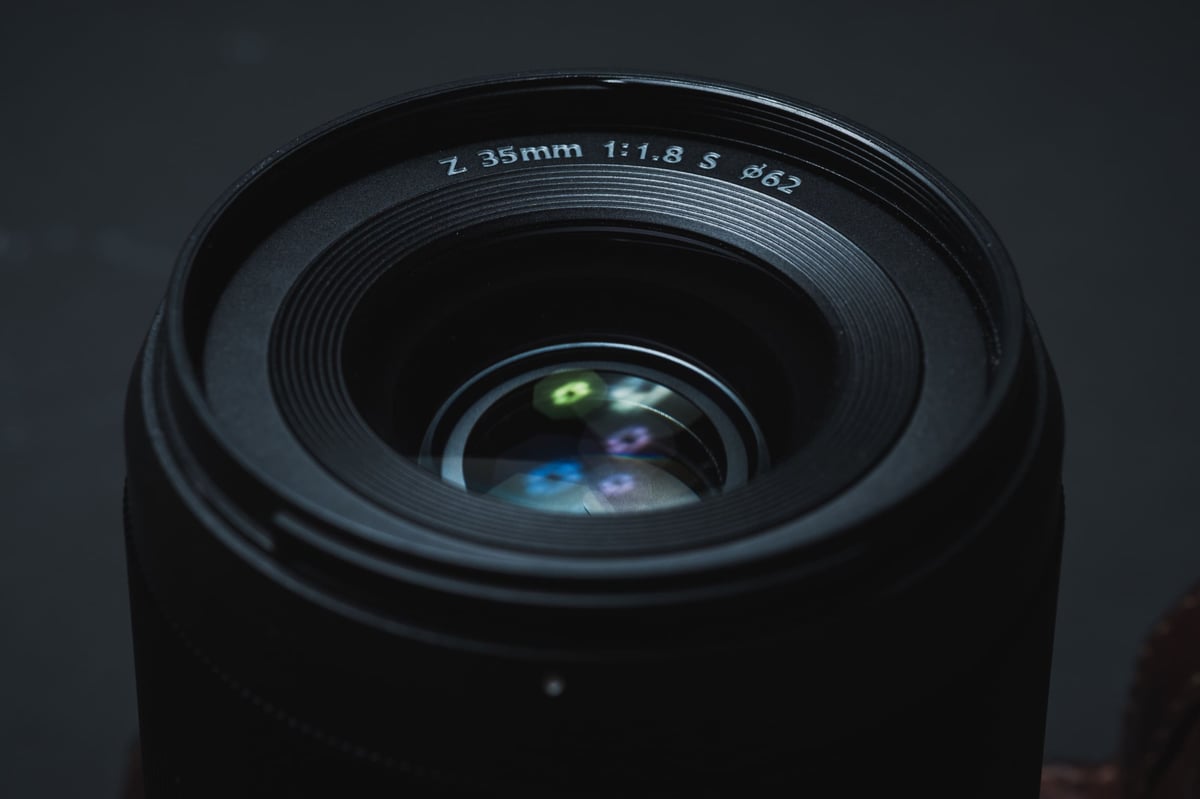
Nikon Z 35mm f1.8 Product Shot of Front Element.

The design of the lens is 11 elements in 9 groups. That’s a little high for an f1.8 lens but that seems to be where lens designers are going with their optics these days as the Sony 35mm f1.8 is also 11 elements in 9 groups.

The aperture has 9 blades that are rounded. This is pretty typical for an autofocus lens. This allows the lens to maintain some smoothness in the bokeh at those higher apertures. You’ll still get geometry in the bokeh balls at around f4 and f5.6.
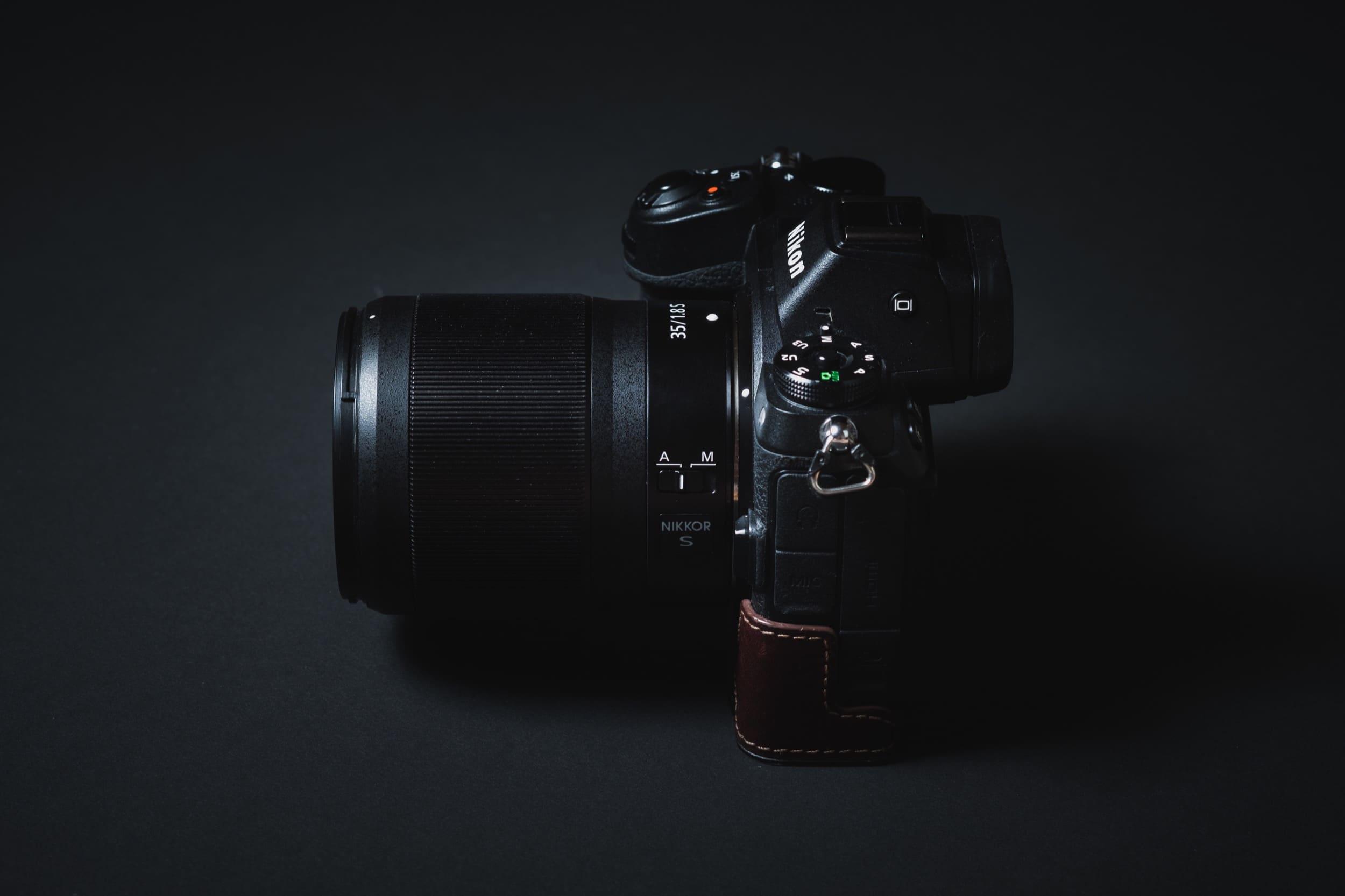
Nikon Z 35mm f1.8 Product Shot on the Nikon Z6.

Autofocus

Like with the other stepping motor lenses by Nikon, there is a slight almost humming to the lens as it’s working with Continuous AF.

The 50mm seems like it’s a touch quicker and more accurate than the 35mm or the 85mm. But with the 35mm I tend to shoot a lot closer, which is harder for the tracking, and on the 85mm the depth of field is much thinner, which is also harder for the tracking. So it could be all these lenses are pulling focus with similar results, but just the characteristics of the different focal lengths are making the comparisons show different results.

Nikon Z 35mm f1.8 S Image Quality

Image quality is sometimes a tough metric to weigh into the reviews because there is a character to every lens, and some lenses can produce amazing results aesthetically while having poor technical image quality scores, and some lenses have perfect image quality but render incredibly boring and flat.

The Nikkor Z 35mm f1.8 is well-balanced here.

It’s got great image quality but still maintains nice dimensional rendering and I actually like the way it renders more than the Z 50mm.

Nikon Z 35mm f1.8 S Sharpness Charts

I only have the Nikon Z6 so all I can do is show you what the sharpness is with this body which has an AA filter.

Center Sharpness

Center Sharpness is very good all around. Sharpness is still very good at f1.8 but there is slightly less contrast when wide open and at f2. By f2.8 contrast picks up and the lens produces a more ‘crisp’ image.

When shooting at those faster apertures like f1.8 or f2, sometimes contrast and saturation have a nicer more calming quality, almost a softness to the tones. You can see on the charts here, there is almost this glow at f1.8 and f2.
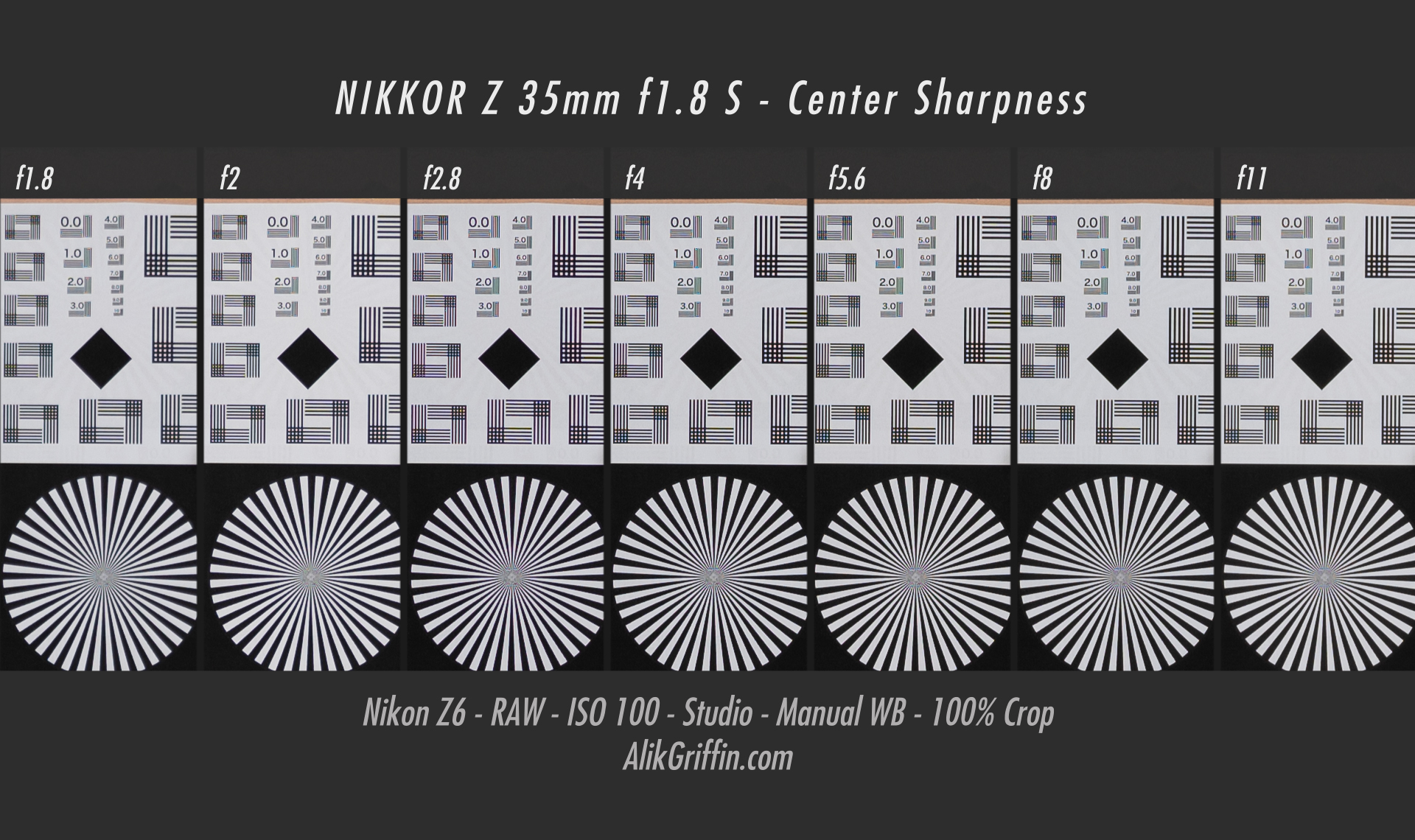
Nikon 35mm f1.8 S Center Sharpness

Corner Sharpness

I do not focus on the corners when I do my corner sharpness tests. This lets us see what the spherical aberrations are doing, and this is often why stopping the lens down cleans it up.

Even focusing on the center, the corners here are very good, and they only get better by f5.6. I will say the corners at f5.6 are better than a lot of lenses I have in the center at f5.6.
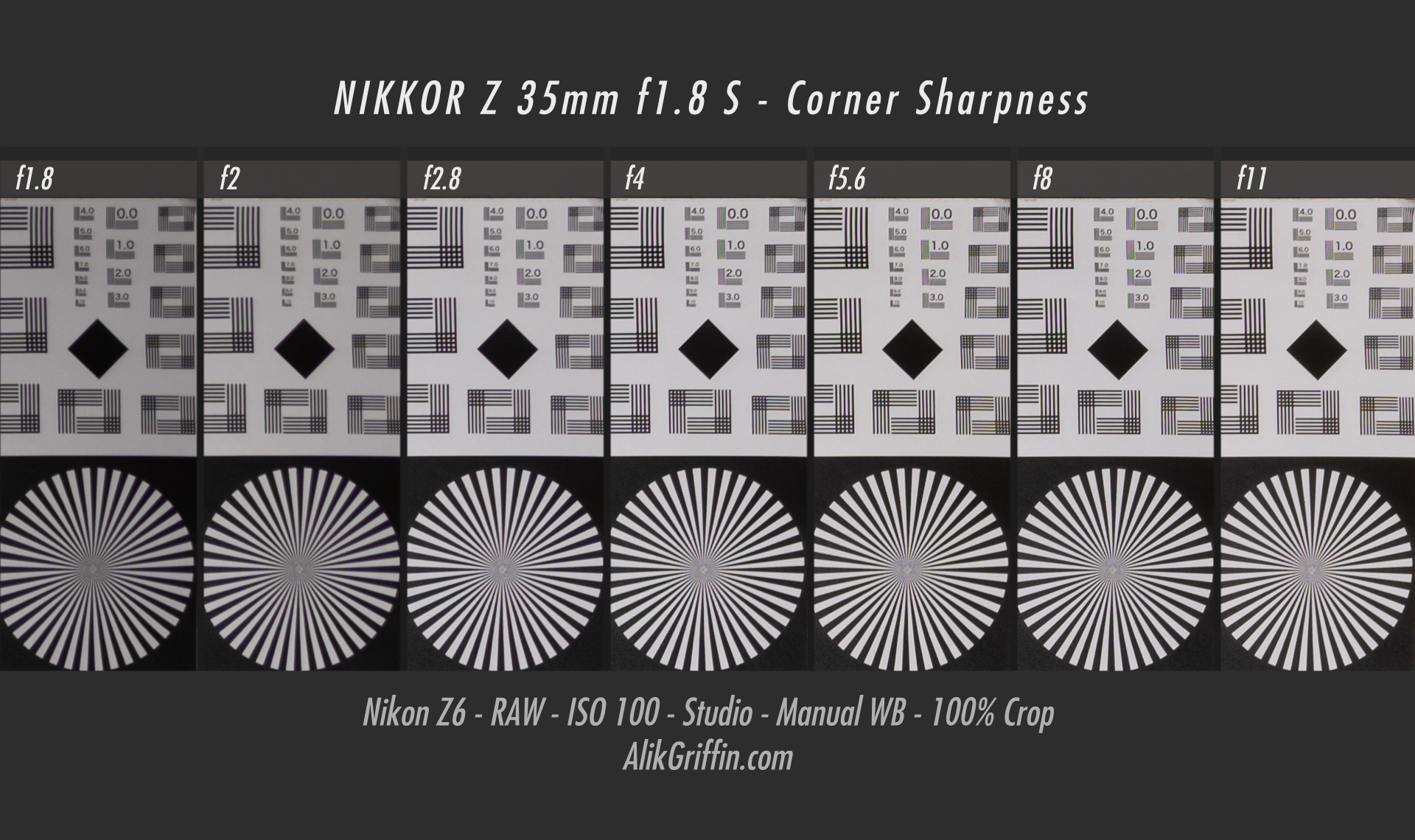
Nikon 35mm f1.8 S Corner Sharpness

Edge Sharpness

Edge sharpness is also very good and improves by f4 to f5.6. 
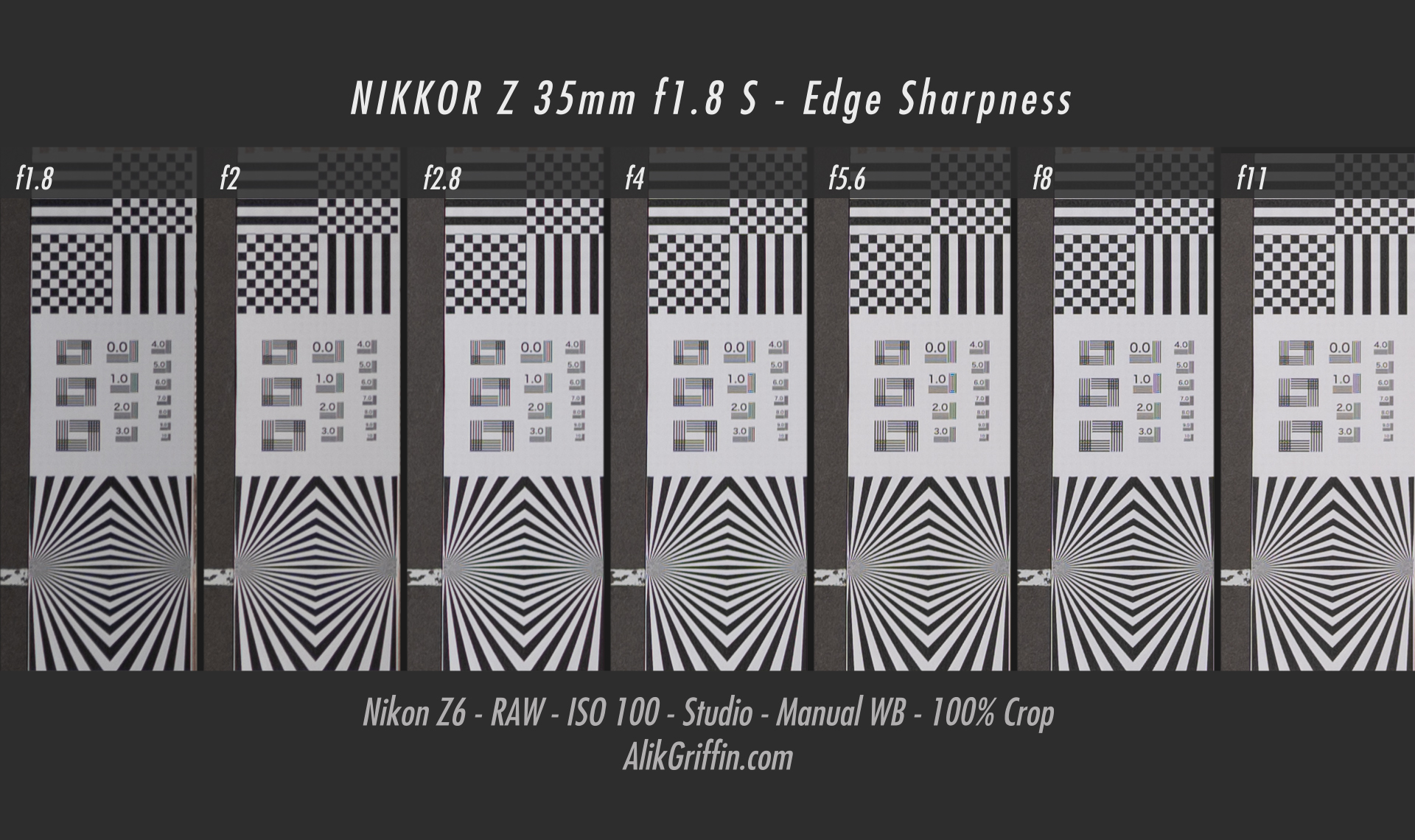
Nikon 35mm f1.8 S Edge Sharpness

It’s probably safe to say that the Z 35mm f1.8 resolution outresolves what I can pull in on the Nikon Z6 and overall the sharpness is very good but you might notice a bigger difference between apertures if you’re shooting on a Z50 or Z7.

Distortion

There is a very slight distortion if you use the camera as default with the distortion controls turned on. This correction is baked into the RAW so you’ll never see distortion if you keep those settings turned on.

In the sample below, I took the Nikon RAW file and stripped all profile corrections from it in Iridient Developer. Now you can see there is some distortion. It’s not terrible but there is definitely some barrel distortion. This again is corrected with the in-camera options even on the RAW files so make sure that also stays on when shooting video.
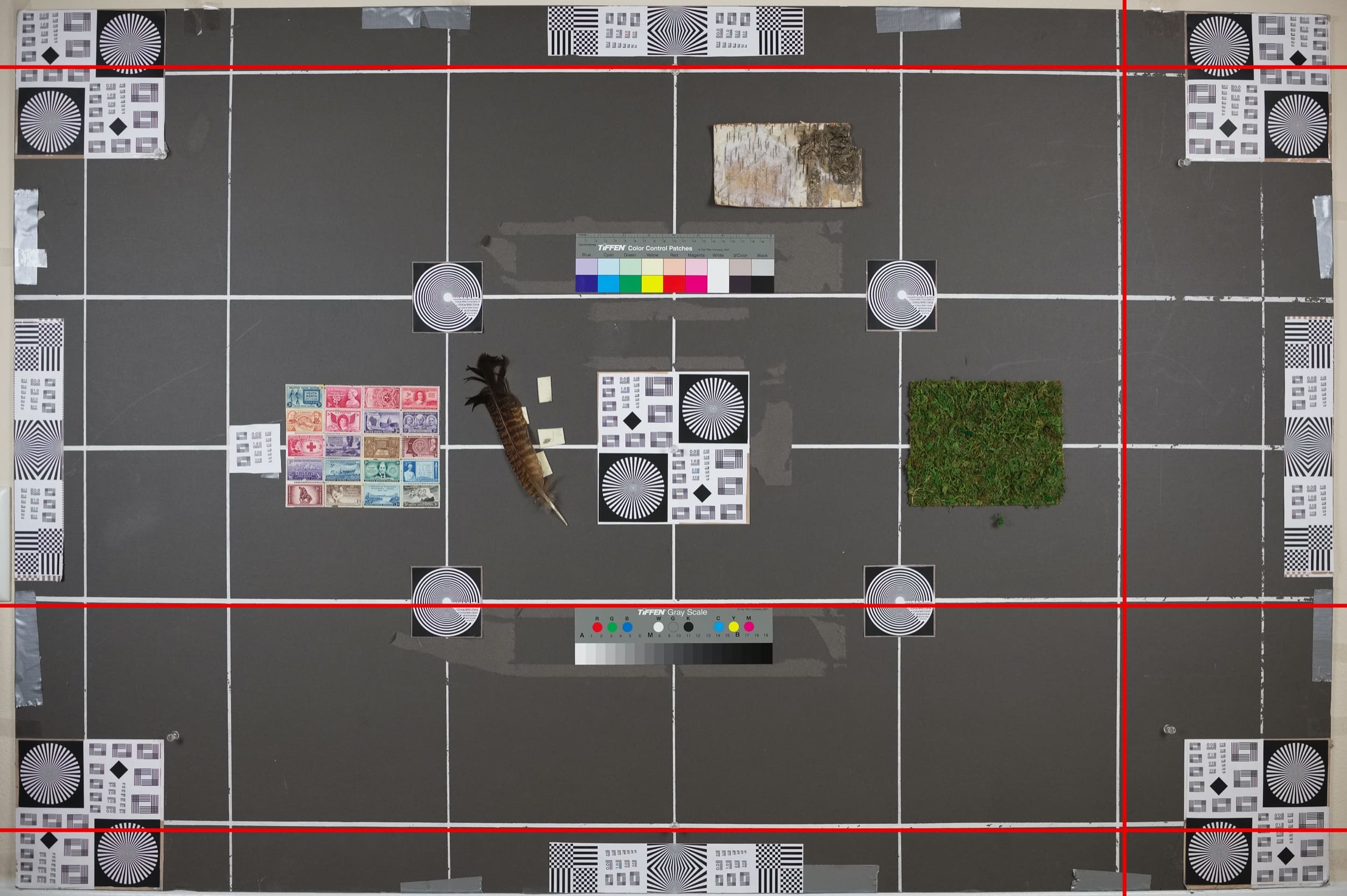
Nikon 35mm f1.8 S Distortion

Vignetting

There is some vignetting at f1.8 you will for sure see it. If you’re shooting video or JPG, you may want to engage the vignetting controls on the Z cameras to reduce it.
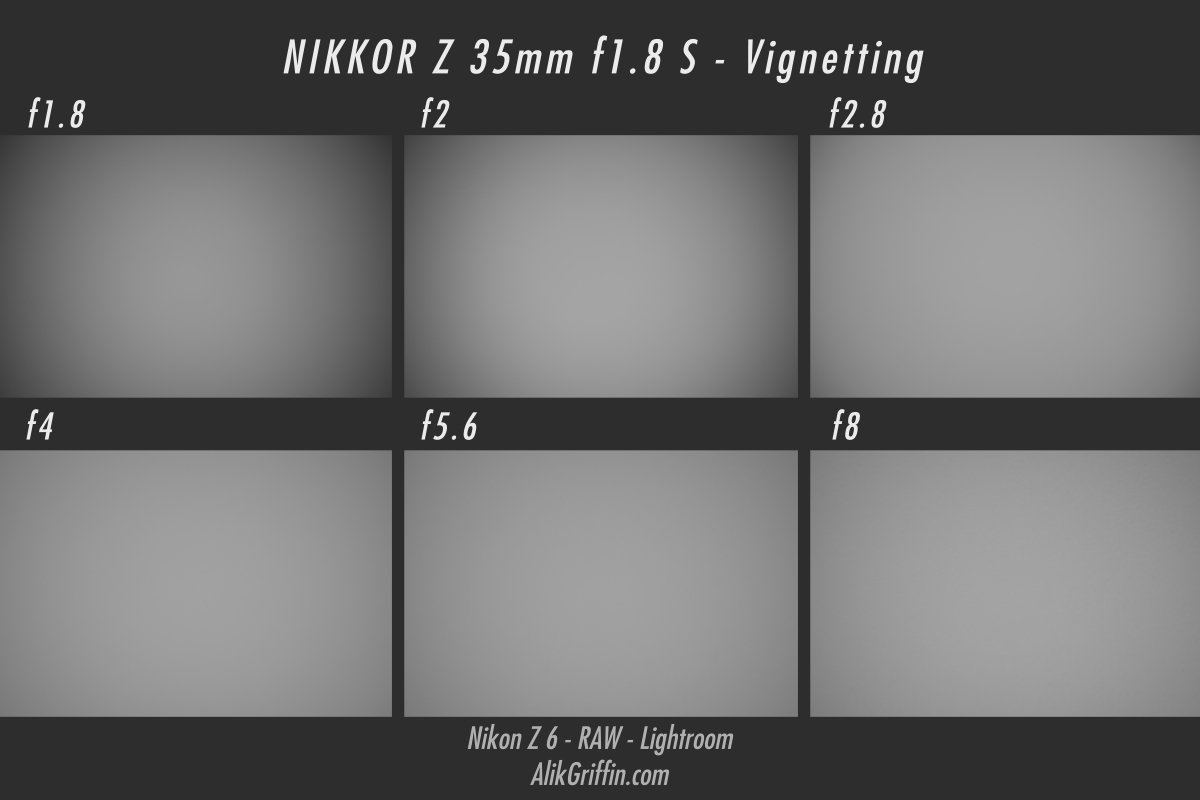
Nikon 35mm f1.8 S Vignetting

Chromatic Aberrations 

In real-world shooting, I rarely run across a situation where I’ve seen any serious CA. Longitudinal CA or even lateral CA.

Occasionally you’ll see fringing out the out-of-focus high contrast areas. Like in the first show below, you can see some in the top right.

Here are a few real-world samples that would kill a lens if it had bad CA. As you can see, you’ll only get a little bit at f1.8. Stop down and it’s corrected.
But then in this shot of my daughter wide open with the blown-out background, you can see quite a bit of fringing in that particular sample.

Nikon Z 35mm f1.8 Flaring Sample
ISO 100, f1.8, 1/2000
Nikon 35mm f1.8 Flaring Sample stopped down to f4.5
ISO 100, f4.5, 1/160
Sample showing CA in background bokeh.
ISO 800, f1.8, 1/125

At first, I never noticed this fringing in the bokeh because it’s typically not good practice to shoot with blown-out backgrounds. If you don’t shoot with blown-out backgrounds, you’ll rarely have any issue with this.

LoCA Chart

When cropping in 100% to look at the text center frame you can see some longitudinal CA when at f1.8. This amount of LoCA is fairly normal when shooting wide open but some lenses will perform slightly better than this.

LoCA 100% Crop, f1.8 Nikon Z6

Lens Flaring / Sun Stars

It’s sometimes nice to have lenses that flare but with software tools, it’s very easy to add that in on your own. Lens flares are bad for the image quality because they can reduce the contrast and clarity if you’re shooting towards the sun, sometimes it can be so bad they even strip a lens of its sharpness.

Most of these modern lenses by Canon, Fujifilm, Sony, and Nikon rarely flare or create any ghosting unless the sun sits just out of the frame.

Here are some samples of what the flaring can do to your image, as well as a shot of how the sun stars perform at f8. I’ve seen better sunstars, but at least we are getting some nice consistency to the pattern.
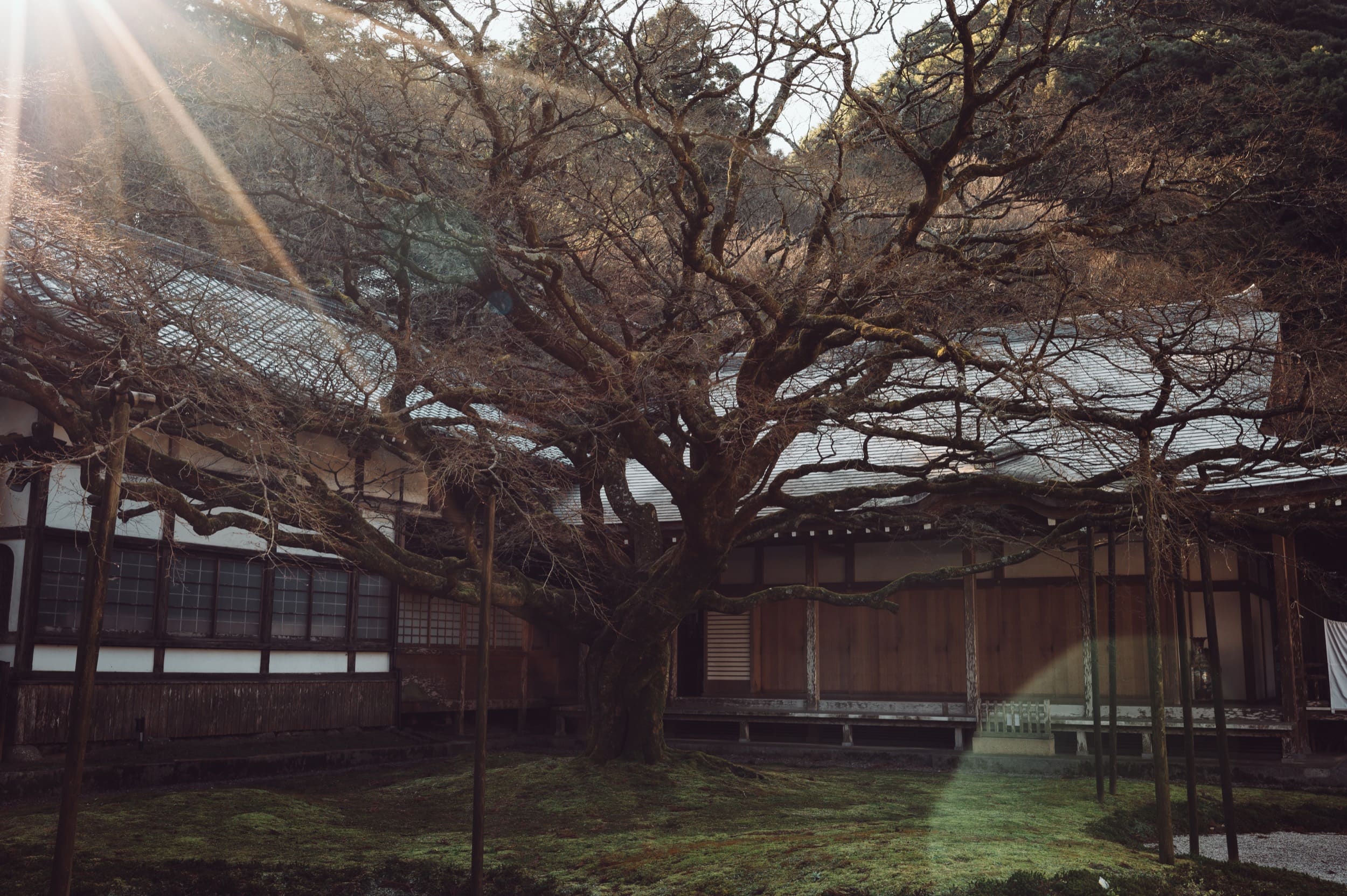

Nikon 35mm f1.8 Flaring Ghosting Sample
ISO 220, f6.3, 1/125
Nikon 35mm f1.8 Sun Stars
ISO 800, f8, 1/125

Art & Character

Nikon 35mm f1.8 Lifestyle Sample Photos

The Art & Character of the lens is a metric that I find to be very important but is something a lot of people often miss.

If a lens has terrible distortion, or soft corners but still renders an amazing image, then for me, it’s a very valuable lens. Some lenses have absolutely perfect Image quality but incredibly boring renderings. 

At the end of the day, it all depends on what you’re doing which is why I like to include this section. Architecture and even landscape photographers might not need a lens with a lot of character, but a wedding photographer will. 

Clinical is the term we like to use for lenses that have very little character with boring and flat rendering. Unfortunately, a lot of the big lens companies are making very clinical lenses these days. This is not always a bad thing though because, if you’re capable of doing a lot of post-processing, you can still create some nice styles and looks with a flat rendering. It really depends on the photographer.

The three Z lenses that I have are a little on the clinical side but there is magic you can still find with them and this Z 35mm f1.8, in my opinion, has the best rendering of the three I own. The others being the 50mm and the 85mm. My second favorite would be the 85mm.

The 35mm has such a nice smooth focus falloff. Yes, there are better ones, but this one is absolutely lovely. Images come out so smooth and buttery when shot at f1.8 when you shoot in the lens’s sweet spot.

Bokeh Samples

Bokeh for the most part is good. Like with most 35mm lenses, the closer the subject the creamier the bokeh. If your subject gets further from the lens, around 15 feet or so, the bokeh does get a bit busy. This is pretty common with 35mm lenses and this lens definitely has a sweet spot that it likes.

If you’re shooting headshots, full-body kid shots, or mid-body grown-up shots, then you won’t have any issues with the bokeh, but things can get a little busy in the bokeh as you move back.
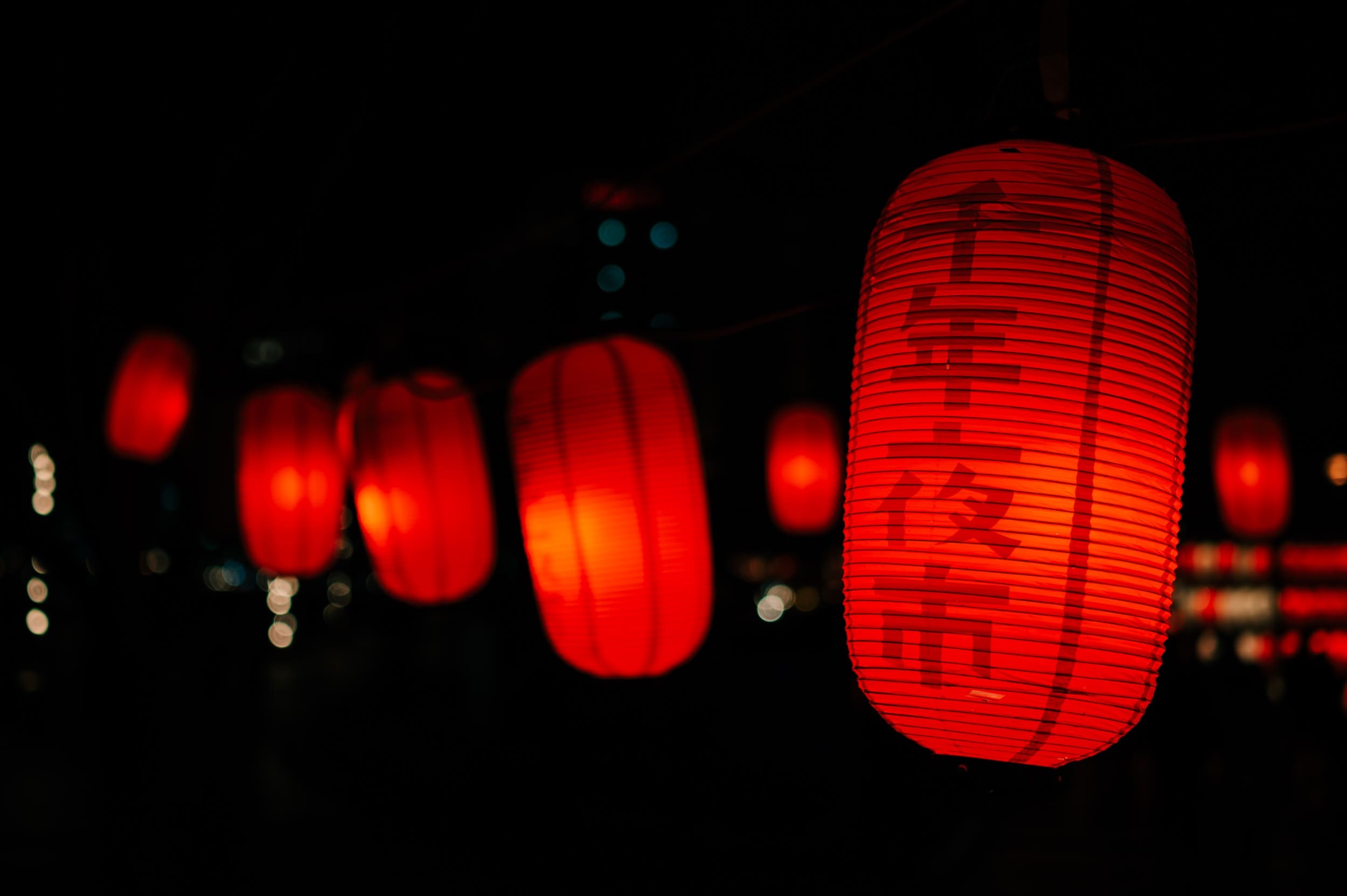

Japanese Lanterns
ISo 100, f1.8, 1/250
Japanese Lanterns
ISO 100, f1.8, 1/640
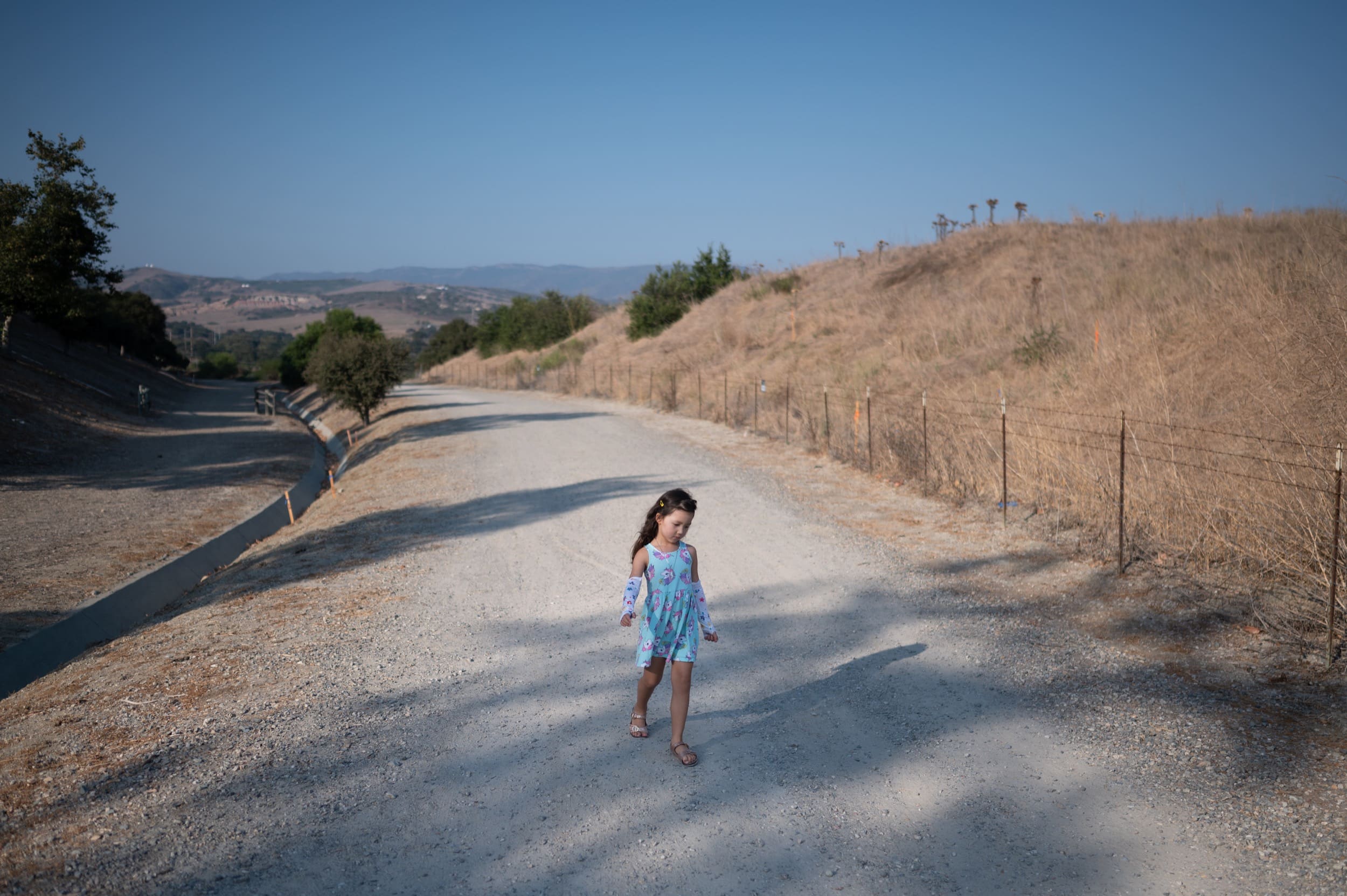
Kalina walks in San Clemente
ISO 110, f1.8, 1/8000
Nikon Z 35mm f1.8 Lifestyle Sample Photo
ISO 140, f1.8, 1/8000
No Trespassing Sign
ISO 125, f1.8, 1/8000
Bokeh Sample
ISO 110, f1.8, 1/8000
Bokeh Sample
ISO 320, f1.8, 1/5000

Bokeh Balls

The shape of the bokeh is pretty consistent with the other Nikkor Z lenses. It starts round and very circular and it begins to swirl with a cat’s-eye shape as you move away from the center.

Some photographers hate cat’s eye bokeh, some don’t mind it, and some even like it.

There is some texture to the bokeh balls. Closer to the center frame you’ll get an onion-ringing pattern, further out you get a slight texture.

This is pretty normal when dealing with lenses that use aspherical elements. Every Fujifilm lens also does this. This is actually not as bad as some of the other lenses I have.

The specs on the top right of the frame are just from me having a dirty sensor, ignore those.

Nikon Z 35mm f1.8 Bokeh Balls Sample
ISo 200, f1.8, 1/200

Focus Falloff

This is kind of the special secret sauce of fast 35mm lenses.

Here is an example of what you can expect from the falloff from what’s in focus to what’s out of focus. This lens has a very, very pleasant feel to it. It feels very organic and calming. I absolutely love it.

You have to be a little careful with 35mm lenses though, it’s very common for the focus falloff to get a little gross as you increase the distance between yourself and the subject. Once you get out to about 20 feet or so, you won’t get the magic and the bokeh can get a little ridge, but this is kind of obvious since you’re not going to be very shallow at those distances with an f1.8 35mm lens anyway. This is when you would want something more like a 35mm f1.2.

I would say, as long as you keep the subject of focus within 15 feet, you’ll get absolutely incredible results when shooting wide open.

The Nikkor Z 35mm f1.8 is better than most but there are still some other lenses that also have a great focus falloff like the Voigtlander 35mm f1.7 which also has a very special one-of-a-kind look.

Nikon Z 35mm f1.8 Lifestyle Photo Sample

Contrast / Micro-Contrast / Color Rendering

This is not a super high micro-contrast lens. None of the Z lenses are. It does look to be a little nicer than the 50mm and the 85mm though.

Typically when lenses don’t have a good micro-contrast, there is a little bit of a plastic feel to skin tones. You get that a little with all these Z lenses, but it’s not as bad as some of the f1.4 lenses that are out there.

Contrast however is still very good, and so is the color rendering but you can see the images do feel a touch on the plastic side.

SOOC Samples

Here are some straight-out-of-camera images.

I tried to pick a nice blend of images showing both good and bad images from various situations making sure to also include some of the technical issues that this lens often presents.

For example the first image here with Kalina eating, you can see the LoCa issues.

Nikon Z 35mm f1.8 Straight Out Of Camera Sample
ISO 800, f1.8, 1/125
Nikon Z 35mm f1.8 Straight Out Of Camera Sample
ISO 640, f1.8, 1/125
Nikon Z 35mm f1.8 Unedited Sample
ISO 100, f16, 3sec
Unedited Sample
ISO 100, f16, 3sec
Unedited Sample
ISO 35mm f8, 1/320
Unedited Sample
ISO 1250, f1.8, 1/160

Nikon Z 35mm f1.8 S Bottom Line

In terms of image quality, this lens is up there with some of the best, and it is also very light and very fun to use.

While some might complain that f1.8 is not fast enough, I actually like f1.8 on these Z cameras as a general do-it-all lens. With a 1/8000 shutter limit on the Z cameras, f1.8 is the max you can shoot outdoors without needing an ND filter. So while faster lenses with an f1.2 and f1.4 aperture are nice in some situations, you can run into exposure issues if you want to always shoot wide open without ND filters.

Black and white lifestyle photo of a little boy being silly, pressing his nose up against glass.
ISO 3200, f1.8, 1/250

The Nikkor Z 35mm f1.8 S is all about versatility.

I’m using it now as my primary video lens, and I use it a lot for landscape, street, events, and any low light shooting where I need a 35mm, and it’s fantastic for that. The size and weight are really nice paired with the Z6 and the Nikon-grade weather sealing of course is always a nice bonus.

Just watch out for blown-out backgrounds in your out-of-focus highlights or you will get some fringing in that bokeh and remember that this lens loves being up close and personal, that’s where it shines.

If I could only have two lenses for the Nikon Z system, it would be the Z 35mm f1.8 S and the Z 85mm f1.8 S. I still love the 50mm f1.8 S, but I feel like having a 35mm and an 85mm gives me a little more versatility.

Nikon Z 35mm f1.8 Sample Photos

These photos are all shot with the Nikon Z35mm f1.8 and colored with the Core Presets.

These are all shot with the Nikon Z6. It’s taken me a while to get my presets tuned well for the Nikon colors. They are very different from Sony and Fujifilm but I think I have them in a pretty good place now. So check those out if you like these colors!


Beach Photo Sample
Little Girl Posing
ISO 100, f1.8, 1/320
Little Girl Posing
ISO 100, f1.8, 1/800
Lifestyle portrat at the beach
ISO 100, f5.6, 1/1250
Lifestyle portrait at the beach
ISO 100, f5.6, 1/1250
Lifestyle portrait at the beach
ISO 100, f3.2, 1/2000
Oniyo Fire Festival
ISO 640, f1.8, 1/80
Oniyo Fire Festival
ISo 4500, f1.8, 1/80
Oniyo Fire Festival
ISO 320, f1.8, 1/15
Portrait of Oniyo Fire Festival Patron
ISO 800, f1.8, 1/15
Men work together to move giant torch.
ISO 160, f1.8, 1/15
Shot of flames and sparks
ISO 800, f1.8, 1/25
Men move giant torch at the Oniyo fire festival.
ISO 320, f1.8, 1/25
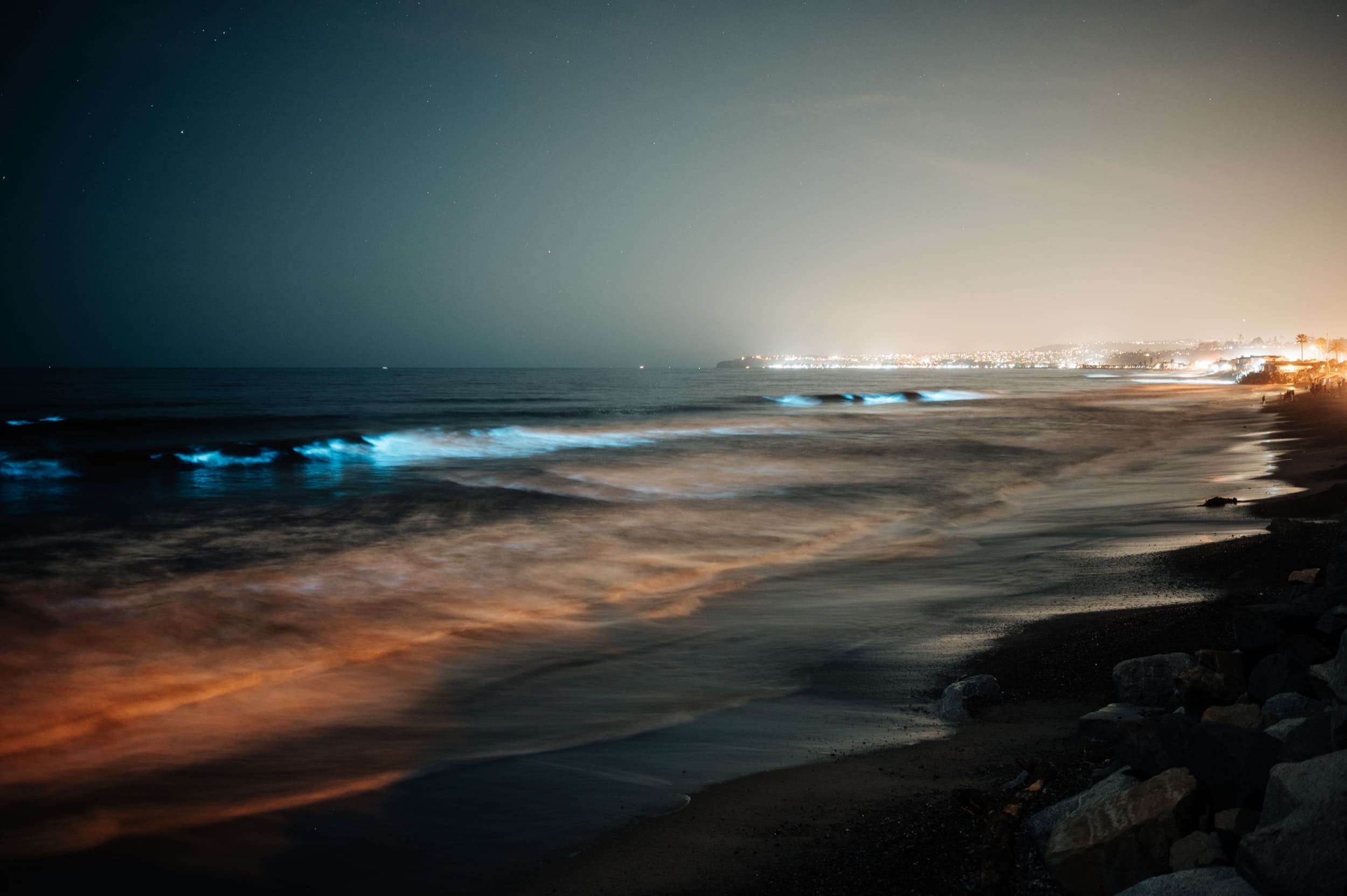
Sample photo of red tide at night.
ISO 800, f1.8, 3sec
Sunset landscape photo of sun setting above clouds.
ISO 100, f7.1, 1/500
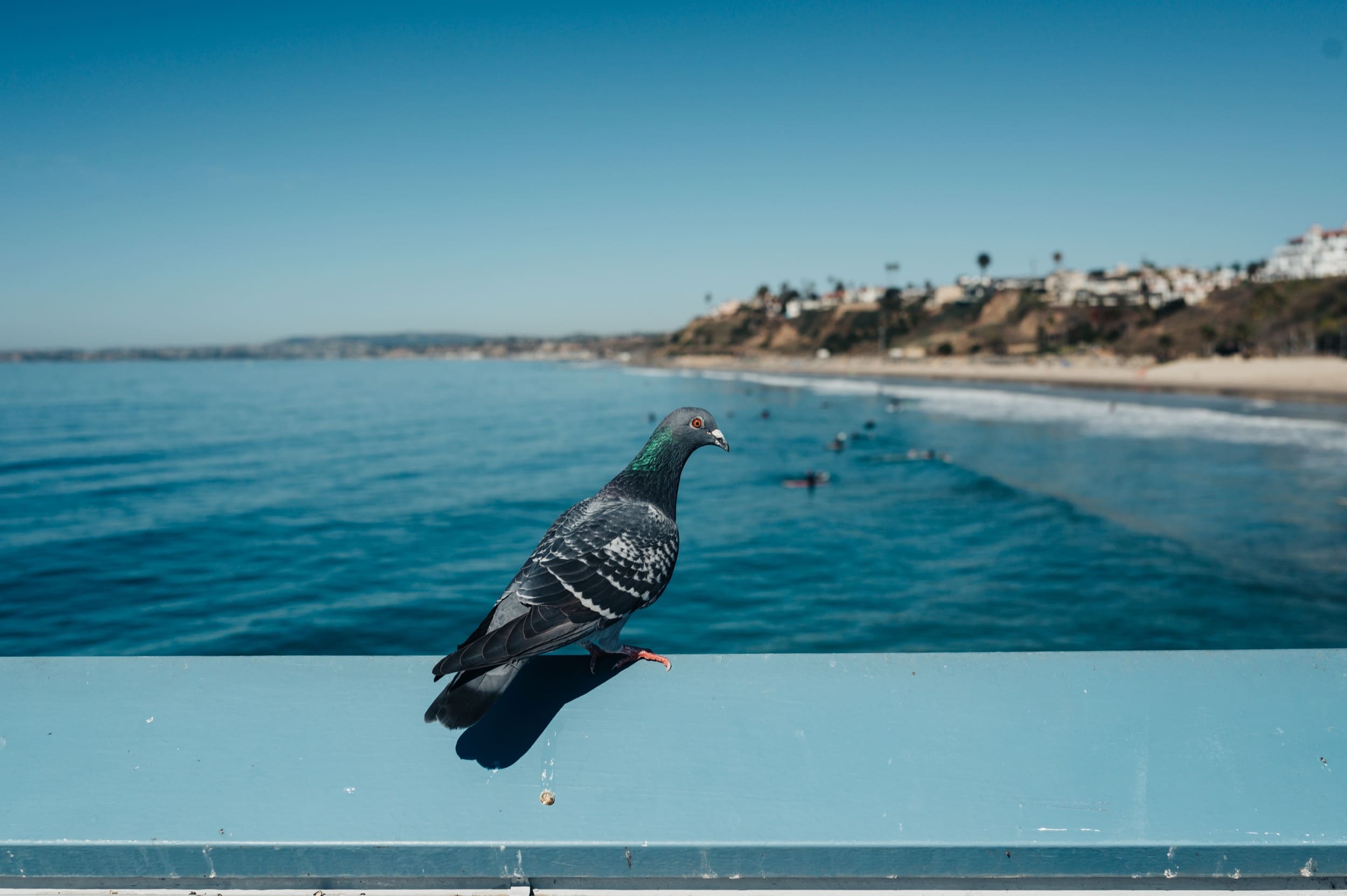
Pigeon hangs out at San Clemente Pier.
ISO 100, f5, 1/4000
0
0
5
0
0
Alik Griffin

A professional video editor, and photographer with a Bachelors in Film studies from UCSD. Based in Los Angeles, I have created commercials, trailers, and other video content for various clients and platforms since 2005. I also love to write about my passions and share my insights on my blog.

Related Topics
  • Lens Reviews
  • Nikon Z 35mm f1.8 S
  • Nikon Z6
Previous Article
  • Blog
  • Lens Reviews

Nikon Z – The Best System For Manual Lenses?

  • Alik Griffin
  • December 26, 2024
View Post
Next Article
Canon R5 Mark I Accessories
  • Accessory Guides

7 Must-Have Accessories Canon R5

  • Alik Griffin
  • February 3, 2026
View Post

Subscribe

Subscribe now to our newsletter

You May Also Like
Thypoch Simera 75mm f1.4 Review
View Post
  • Blog
  • Lens Reviews

Thypoch Simera 75mm f1.4 Review & Sample Photos

  • Alik Griffin
  • January 28, 2026
  • No comments
Cool Street In Nakasu Fukuoka
View Post
  • Blog
  • Lens Reviews

Viltrox WCL-X100VI Review | A Budget-Friendly 28mm Upgrade

  • Alik Griffin
  • January 18, 2026
  • 2 comments
Sony A7V Announcement
View Post
  • Blog
  • What's New

Sony A7V – They’re Back In The Game

  • Alik Griffin
  • December 30, 2025
  • 4 comments
Viltrox 9mm f2.8 Air Review
View Post
  • Blog
  • Featured
  • Lens Reviews
  • Reviews

Viltrox 9mm f2.8 AIR Review & Sample Photos

  • Alik Griffin
  • January 14, 2026
  • 2 comments
Subscribe
Notify of
guest
guest
33 Comments
Inline Feedbacks
View all comments
mariano giusti
mariano giusti
5 years ago

I always like your shots and post production. Thanks.
Would love some hints on how to achieve that “blue but not cold” look 🙂

Reply
Alik Griffin
Alik Griffin
Reply to  mariano giusti
5 years ago

The blue but not cold look is so challenging. I’ve been working on trying to really dial in some presets that can do that, but they often end up being so situational. When I get back to Japan in Oct, I’ll add that to the list of videos to make.

Reply
Yuriy Naidyon
Yuriy Naidyon
Reply to  Alik Griffin
5 years ago

If only there was a way to limit the max saturation per channel without creating a full blown 3D LUT.

Reply
Kamgusta
Kamgusta
Reply to  mariano giusti
5 years ago

it’s called proficiency and experience, see you back in some years.

Reply
jason
jason
5 years ago

I love reading your lens reviews. They appear informed, balanced, honest, and trustworthy. You have great images to demonstrate what you are talking about. It shows that you actually use the lenses….not just review then for ‘views’. Keep up the great work!

Reply
Alik Griffin
Alik Griffin
Reply to  jason
5 years ago

Thanks Jason!

Reply
Anh Pham Viet
Anh Pham Viet
5 years ago

What lenses would you describe as incredibly boring lens? Any examples?
I own a Nikon 58mm 1.4g which is really special rendering wise, but also have a Sigma 35mm 1.4 and Nikon Z 85mm 1.8s.While the latter are indeed more clinical, I don’t think they are boring… only pictures can be truly boring. I find the Sigma kind of special in its own way. With your photography and post-processing skills the rendering of a lens is a very small part of the equation.

Reply
Tim Kamppinen
Tim Kamppinen
Reply to  Anh Pham Viet
5 years ago

I agree and I would love to see some side by side comparisons… I’ve heard this sort of thing a lot but it’s never accompanied by visual examples. It all seems subjective to the point of being imaginary. If my photo is boring, it’s because the light, perspective, composition, or moment is boring… a lens being “too clinical” is never going to cancel out those aspects of an image. I get stuff like weird or harsh bokeh being a distraction, or a lens that just doesn’t flare in a pleasing way, but the whole “sharp but boring” thing doesn’t make a lot of sense to me.

Reply
Alik Griffin
Alik Griffin
Reply to  Tim Kamppinen
5 years ago

I can do a writeup and comparison when I get back home next month. But check this out. Yannick does a lot coverage of micro-contrast. https://yannickkhong.com/blog/2016/2/12/extra-credits-applying-the-micro-contrast-test-onto-an-otus-lens
He would probably get even better results if he was outside (better light coherency in sunlight).

Usually the higher micro-contrast lenses just feel like there is more depth and life to the image.
Here is a sample from my Industar 50-2. One of the best micro-contrast lenses out there. It give me such great tonality, none of my Z lenses can compare in this regard, and my Z lenses often feel a bit flat. This was shot on the Z6.

https://uploads.disquscdn.com/images/ad2f7ffc44364c43d5623f5a0087e903359556a4569263b968bd0fe89701a2f2.jpg

And another sample on the Canon R, same lens. You can see the almost 3D feel to it. I’ll produce some side by sides later.

https://uploads.disquscdn.com/images/a651e793dc41b6834179b63cd43ec683653250b4780f89c0fc7cfbddc8061946.jpg

Reply
Tim Kamppinen
Tim Kamppinen
Reply to  Alik Griffin
5 years ago

Ok, I read that article, looked at the images… two photos in bad light where the subject turned her head relative to the light source and also changed her expression. I don’t see any significant difference between the images that I would attribute to the lens. The minor differences when pixel peeping at 300% are probably more due to the change in lighting (due to change in head angle) and/or slightly different focal plane. In any case that article did not even come close to converting me to being a believer in microcontrast, “3d pop,” or whatever other magical properties old lenses supposedly have.

For the two images you posted, they are taken in good light at a wide aperture… so yeah, they have “3d pop,” I guess. Lighting that creates highlights and shadows on the face will convey depth regardless of what lens you are using, and the subject being separated from the background by shallow DoF does the same. Lens vignetting will also make the subject more prominent to some degree, provided they are not on the edges of the frame.

But again, looking at these (very nice) images I don’t see anything that makes me think there’s something special about the lens. Maybe a little bit of “swirliness” to the bokeh in the second shot but nothing about how the subject is rendered.

I look forward to your side by side comparisons to see whether they are more compelling than the ones you linked to. I hope it’s an actual controlled test – put the camera on a tripod, make sure your subject does not move their head or change their expression between shots, SOOC images, etc.

Reply
Alik Griffin
Alik Griffin
Reply to  Tim Kamppinen
5 years ago

I’ll keep you posted.
Check out this video. He talks a little about this magic some lenses have or don’t have..
https://www.youtube.com/watch?v=yk4woeP08LI&ab_channel=MagicOfLight

Reply
Tim Kamppinen
Tim Kamppinen
Reply to  Alik Griffin
5 years ago

Watched the video. He seems to be making the point that high contrast gives the impression of sharpness, even if a photo is technically soft or low resolution… which I definitely agree with. Of course, that is true with any lens.

Other than that, he talks about the supposed unique properties of Leica lenses, without any concrete examples (no side by side comparisons to demonstrate the difference between the “Leica look” and the same photo taken with a “science lens”). So… just more unsubstantiated claims.

Reply
Alik Griffin
Alik Griffin
Reply to  Tim Kamppinen
5 years ago

But it’s pretty easy to understand the balance of lens design here. Lower element lenses that are usually smaller with less glass but have more flaws but better micro-contrast. Higher Element lenses can correct for most issues, but they’ll have less tonal details ( a milkier look ). To understand this all you have to do is look at the best UV filters which have 99.8% light transmittance. Throw 20 of those in front of a lens and now you’re at a 4% light loss. This will also heavily impacting the coherency considering much of that light is lost due to scatter. So the actual frequency of the light that hits the sensor has had all this “data” removed due to all the little imperfections of the glass, both on the surface and with the composition of the materials down to the atomic structure, plus a lot of that scatter inside the lens also makes its way to the sensor further degrading the image. A lot of lenses even have thicker elements than UV filters plus 20 of them. Leica lenses typically are around 8 elements or less. Same with older Zeiss lenses for that “Leica Look” or the “Zeiss Pop.”

Glass does get better over the years as well as the coatings. LIGO is supposedly upgrading the glass in their mirrors which is pretty close to perfect with its atomic arrangement.

Reply
Tim Kamppinen
Tim Kamppinen
Reply to  Alik Griffin
5 years ago

All of what you say may be true but I still don’t know what “better microcontrast” or “a milkier look” means. Still haven’t seen any side by side examples that illustrate these differences.

Reply
Alik Griffin
Alik Griffin
Reply to  Tim Kamppinen
5 years ago

Yeah, I once and for all want to do a side by side with a few lenses too. Now that I have enough lenses I should be able to see how noticeable this actually is. Usually it’s just something where I throw on a low element lens and it’s like. hmm why does this look so much more punchy even though global contrast and sharpness are not that great. Then I’ll throw on a Z lens and it’s super crisp, and high contrast, but lacks that midtone grit. Or like my Canon 70-200mm f2.8 was always so milky I felt. Skin tones always seemed like it was plasticky, and I kinda hated using it for landscape photography because the images felt like they were lacking life or something.

And believe me, I would question this topic a lot too. Like, everyone always complains about these fast lenses have no micro-contrast, but is an f5.6 that’s 11 elements really that much different than one that’s 5 when stopped both down to f5.6. And I will say with these Z lenses, they do improve a little at around f2.8. But I still feel like something is missing, compared to some of my other lenses.

I can probably do these tests right when I get back to Japan, since i’ll be locked in my apartment for 2 weeks. So we can get to the bottom of this. 🙂 And I think the big question is, how much does it really matter. Does stopping down your fast lens get you mostly there. . .

Reply
Roman J
Roman J
Reply to  Alik Griffin
7 months ago

A side by side comparison would be great! The light and everything else except the lenses must be equal to convince me that elements count make any difference.

No believer yet!

Reply
luke
luke
5 years ago

Hi Alik, just wondering if you have tried this in apsc mode/with a Z50. I’m more interested in a z50 than the full frame options at the moment, and want a 35mm prime to use on it. But expensive, but would work as a nice combo with the tidy kit zoom for my needs. Would appreciate any thoughts!

Reply
Alik Griffin
Alik Griffin
Reply to  luke
5 years ago

I actually have used it on the Z50 but not a lot. It’s still a nice lens, although expensive and large for what becomes a 50mm APS-C lens. I would probably only consider that if you ever plan on moving into a Z5 or something. Although it is still $150 off until this weekend which makes it not such a bad deal. AF seems to be a touch slower than the actual 50mm f1.8 though.

So you could do Z5+50mm for $1900 or the Z50+35mm for $1560. So you still come out with a cheaper system with the z50. So actually, $1560 for that camera and lens is actually not a bad deal at all. It ends up being the exact same price if you were to go with a Fujifilm X-T30 + 35mm f1.4. And you would have the option of migrating into full frame in the future.

Reply
lyrklaunavan
lyrklaunavan
5 years ago

Great review. If you were in youtube this review would get thousands of views.

Reply
Paul Q
Paul Q
3 years ago

Great review, as always. If I’m looking at a lens and you’ve reviewed it, I’ll check yours first. Beautiful photos too.

Reply
Keaton
Keaton
3 years ago

Since you appear to own this lens and also the 40mm f2, my question is which do you find yourself teaching for and under what circumstances? I’ve found myself really loving the compactness of the 40mm and so have largely been leaving the 35 at home, even though it’s an excellent lens and I do still love it.

Shoot, sorry, was trying to post this in the 40mm discussion …

Reply
Alik Griffin
Alik Griffin
Reply to  Keaton
3 years ago

I generally almost always use the 35mm for portrait photography, especially with kids. The bokeh renders cleaner and less distraction and can really help isolate the faces in a busy background, even though the 40mm renders richer skin tones. Also I take the 35mm over the 40mm if I’m shooting landscape photography. Otherwise I’ll take the 40mm for everything else.

Reply
Roman J
Roman J
Reply to  Alik Griffin
7 months ago

So there is good reason to own both?
I got the 40/2, but would like the smoother bokeh of the 35/1.8.

Reply
magpieD
magpieD
3 years ago

Hey,

I found your blog a few weeks ago and just wanted to drop a note to say how great your writing and images are. I am a Nikon shooter going back to the D750 and recently jumped into the Z6ii and your lens reviews and commentary have been so helpful to me.

I also love the look of your images and was so happy to see that your presets are available, and I will be investing into them in the near future.

Thank you and please, keep it up!
Cheers,

Dom

Reply
Alik Griffin
Alik Griffin
Reply to  magpieD
3 years ago

Thanks Dom!
Have fun with that Z6 II. Such an amazing camera. 🙂

Reply
magpieD
magpieD
Reply to  Alik Griffin
3 years ago

😊👍

Reply
Tin
Tin
2 years ago

Without a doubt, I haven’t enjoyed lens reviews until I’ve stumbled on your website. You describe lenses with characteristics that I haven’t seen in other reviews.

Reply
Alik Griffin
Alik Griffin
Author
Reply to  Tin
2 years ago

Thanks Tin! 🙂

Reply
Mike
Mike
2 years ago

Thanks for your reviews. I appreciate that you have a segment in your review about rendering. I’m in the believer group of 3D rendering. I shoot a ton with my Rolleiflex 6×6 – 3,5T for personal work – and somehow that old Tessar gives me beautifull 3D Images that I cannot seem to recreate with my Z7II. I’m always on the lookout for lenses for my Z to get this feeling, a somehow 3d artistic rendering but then with modern optics (clean sharp images) – is it possible? I rented this lens to see if it could be something…but as far as rendering I’m not convinced in that respect (as you pointed out also) – But as a versatile lens for low light situations and enviromental portraits in a compact and affordable package…this thing is kinda hard to beat it seems.

Reply
Alik Griffin
Alik Griffin
Author
Reply to  Mike
2 years ago

The closest thing to the 3d rendering you get with the Z system is the 28mm, the 26mm or the 40mm. Otherwise, it’s adapting Zeiss M lenses or something.
Some of those more classic 3d lenses like the Zeiss lenses have that deeper contrast in the shadows that really helps the images pop, along with slightly punchier colors. Z lenses are very well balanced with the way they render contrast. But the 26,28,40 do get you closer to that sort of more classic rendering.

Reply
Daniel
Daniel
1 year ago

Alik, I know that you also enjoy the 40mm f/2 lens. Just out of curiosity, since the 35 and 40 lenses give a very similar field of view, when do you chose one over the other (other than, I presume, that the 35 is better for video)?

Also, at first, I thought Alik was a Russian name, but then Griffin doesn’t sound very Russian.

Anyhow, love your website. You presets are phenomenal and I’m studying them to under how to develop a look.

Last edited 1 year ago by Daniel Bykhovsky
Reply
Alik Griffin
Alik Griffin
Author
Reply to  Daniel
1 year ago

Yes, my mom chose the Slavic spelling of my name for some reason, but I’m mostly Norwegian.

It does seem like 35mm and 40mm are similar, but they feel quite different. If you’re used to 35mm, the 40mm will feel slightly more claustrophobic. So, it’s a good middle ground between 50mm and 35mm. It’s hard to describe, but it’s kind of its own thing.

And even though 40mm seems closer to 35mm, remember that the wider the lens is the more extreme the field of view becomes just by a few mm focal length change. For example, you won’t notice the difference between 85mm and 87mm, but 14mm and 16mm will show huge differences in the field of view.

For video, like Youtube stuff, I always favor the wider lens. I would probably favor the longer lens for Filmmaking, like a short film or feature.

I personally really like the 17-28mm f2.8 lens for shooting run and gun Youtube videos if you’re looking for something like that. Then you can use the digital zoom feature on some of the Nikon cameras like the Z8 to give a 50mm crop out of that 28mm end.

Reply
Roman J
Roman J
7 months ago

Nice review! I like the non technical focus and the actual experiences using this lens.

Considering this lens myself over the 35/1.4 with its funky bokeh.

Reply
San Clemente Sunset

Join The Newsletter

Featured
  • How To Edit Photos To Look Like Film
    • 4 comments
  • On Board
    Fujifilm X100VI Review & Sample Photo
    • 4 comments
  • Mud Face
    Nikon Z 35mm f1.4 vs Nikon Z 35mm f1.8 S – Sample Images
    • 28 comments
  • What is Micro Contrast
    Micro-Contrast, Is It Real? – Samples With Lens Comparisons
    • 17 comments
  • Nikon Z 26mm f2.8 Review – A Little Miracle
    • 24 comments
  • Zeiss Planar 50mm f2 on the Leica M11
    Zeiss Planar 50mm f2 Review & Sample Photos
    • 5 comments
  • Nikon Z 28mm f2.8 Review & Sample Photos
    • 18 comments
  • Tiffen Black Pro Mist Filter At Night. Streets Of Tenjin Japan
    Tiffen Black Pro Mist Review – Is This The One?
    • 10 comments

Subscribe

Subscribe now to our newsletter

Privacy Policy | Ethics Statement | Licensing | About Me | Contact

Copyright © Alik Griffin Inc. 2025

Input your search keywords and press Enter.

Manage Consent
To provide the best experiences, we use technologies like cookies to store and/or access device information. Consenting to these technologies will allow us to process data such as browsing behavior or unique IDs on this site. Not consenting or withdrawing consent, may adversely affect certain features and functions.
Functional Always active
The technical storage or access is strictly necessary for the legitimate purpose of enabling the use of a specific service explicitly requested by the subscriber or user, or for the sole purpose of carrying out the transmission of a communication over an electronic communications network.
Preferences
The technical storage or access is necessary for the legitimate purpose of storing preferences that are not requested by the subscriber or user.
Statistics
The technical storage or access that is used exclusively for statistical purposes. The technical storage or access that is used exclusively for anonymous statistical purposes. Without a subpoena, voluntary compliance on the part of your Internet Service Provider, or additional records from a third party, information stored or retrieved for this purpose alone cannot usually be used to identify you.
Marketing
The technical storage or access is required to create user profiles to send advertising, or to track the user on a website or across several websites for similar marketing purposes.
  • Manage options
  • Manage services
  • Manage {vendor_count} vendors
  • Read more about these purposes
View preferences
  • {title}
  • {title}
  • {title}