
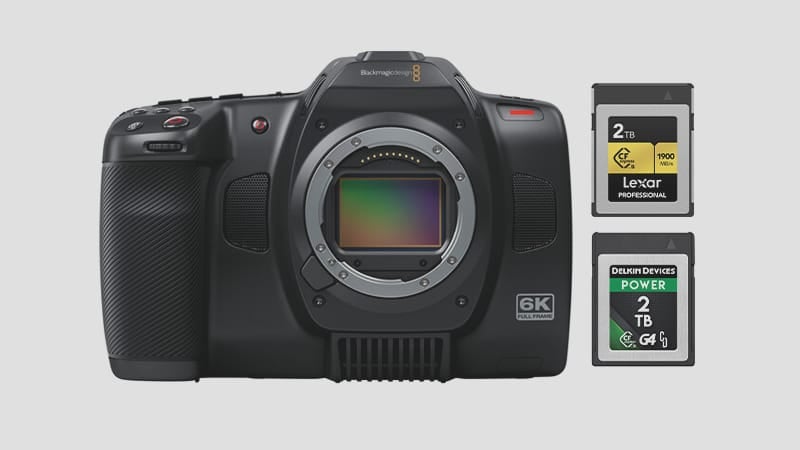
Blackmagic disrupted the cinema camera market by making raw video recording affordable — before them, that was a $30,000+ proposition. Today the lineup has grown into three lines: the Cinema/Pocket Cinema line for indie filmmakers and run-and-gun shooters, the URSA line for professional broadcast and cinema productions, and the Studio line for live production environments.
Blackmagic does not have an official lens mount but often uses a micro four-thirds mount or one of the PL-Mount or Canon EF-style mount configurations. However, its latest Full Frame Blackmagic Cinema 6k camera incorporates the L-mount for the first time.
When looking at the sensor, we also see a mix of sensors as small as about 1″ up to FF frame size, although most of their cameras are still Micro Four Thirds or Super 35mm.
Blackmagic has also been one of the few brands to incorporate a Global Shutter in some cameras, such as the Blackmagic Production 4k camera, the Blackmagic URSA Mini Pro 4.6k G2, and the Blackmagic URSA Mini 4k.
My Top Picks for 2026
Best for Run-and-Gun: Blackmagic Pocket 6K Pro — Super 35, built-in ND filters, CFast and UHS-II slots. The NDs are what make it the most practical handheld option in the lineup. You’re not stopping to swap filters between exterior and interior shots, which matters more than almost any spec on the sheet.
Best Full-Frame Cinema Body: Blackmagic Cinema 6K — full-frame, L-Mount, CFexpress Type-B. The first time Blackmagic went full frame in a Pocket-style body, and the lens mount choice is smart — you get access to the full Leica, Panasonic, and Sigma L-Mount ecosystem.
Most Modern: Blackmagic PYXIS 6K — dual CFexpress Type-B slots, full-frame, box-camera form factor. The box body is a deliberate choice for rigging — no protruding grip to work around when you’re building out a full cage setup. Their newest and most capable cinema body as of 2024.
Best Value Entry Point: Blackmagic Pocket 4K — Micro Four Thirds, CFast and UHS-II, and available used for well under $1,000. The most accessible way into the Blackmagic ecosystem with a massive accessory and community base built up since 2018.
Best for Large Productions: Blackmagic URSA Cine 17K — full-frame, the highest-resolution camera in the Blackmagic lineup. Built for productions where resolution headroom in post matters and you need a shoulder-mount form factor that an AC can operate properly.
List Of Every Blackmagic Camera
Here is a list of all the cameras Blackmagic has made.
| Camera Links | Sensor | Speed Class | Release Date | |
|---|---|---|---|---|
| Blackmagic PYXIS 6K Cinema Box Camera | FF | CFxB / CFxB | Mirrorless | 2024 |
| Blackmagic Cinema 6k | FF | CFxB | Mirrorless | 2023 |
| Blackmagic Pocket Cinema 6k G2 | S35 | CFast / UHS-II | Mirrorless | 2022 |
| Blackmagic Pocket 6k Pro | S35 | CFast / UHS-II | Mirrorless | 2021 |
| Blackmagic Pocket 6k | S35 | CFast / UHS-II | Mirrorless | 2019 |
| Blackmagic Pocket 4k | M43 | CFast / UHS-II | Mirrorless | 2018 |
| BlackMagic Micro Cinema | S16 | SD | 2016 | |
| BlackMagic Production 4k | S35 | CFast / UHS-II | 2014 | |
| BlackMagic Pocket Cinema | S16 | SD | 2013 | |
| Blackmagic Cinema | Between S16 and S35 | CFast | 2012 | |
| URSA Cameras | ||||
| Blackmagic URSA Cine 17k | FF | 2024 | ||
| Blackmagic URSA Cine 12K | FF | 2 CFast / 2 SD UHS-II | 2023 | |
| Blackmagic URSA Broadcast G2 | S35 | 2 CFast / 2 SD UHS-II | 2021 | |
| Blackmagic URSA Mini Pro 12k | S35 | 2 CFast / 2 SD UHS-II | 2020 | |
| Blackmagic URSA Mini Pro 4.6k G2 | S35 | 2 CFast / 2 SD UHS-II | 2019 | |
| Blackmagic URSA Broadcast | About 1″ | 2 CFast / 2 SD UHS-II | 2018 | |
| Blackmagic URSA Mini Pro 4.6K | S35 | CFast / CFast | 2017 | |
| Blackmagic URSA Mini 4.6K | S35 | CFast / CFast | 2016 | |
| Blackmagic URSA Mini 4k | S35 | CFast | 2016 | |
| Blackmagic URSA | S35 | CFast | 2014 | |
| Studio Cameras | ||||
| Blackmagic Micro Studio 4k G2 | M43 | SD | 2023 | |
| Blackmagic Studio 6k Pro | S35 | — | 2023 | |
| Blackmagic Studio 4k Pro G2 | M43 | — | 2023 | |
| Blackmagic Studio 4k Plus G2 | M43 | — | 2023 | |
| Blackmagic Studio 4k | M43 | — | 2021 | |
| Blackmagic Micro Studio | M43 | — | 2015 | |
| Blackmagic Studio | S16 | — | 2014 |
Blackmagic Memory Card Compatibility
Blackmagic cameras use different types of memory cards depending on the model. Until recently, their cameras always supported CFast and UHS-II memory cards, but today, they’ve started using CFexpress Type B cards, which are much faster. Some cameras can use USB-C SSD drives as recording media, but on cameras like the Blackmagic Cinema 6k, this will not be as fast as using CFexpress Type B cards, and you will have to record at slightly lower bitrates.
Buying Memory Cards For Blackmagic Cameras: What You Need To Know
Blackmagic cameras have supported several types of memory cards over the years: SD, CFast, and CFexpress, depending on the camera you’re using and the bitrate you want to record at. You don’t always need the fastest memory cards for your Blackmagic camera if you don’t need to record at the best bitrates.
CFexpress Type B – CFexpress Type B cards don’t always report their speed class with obvious ratings posted on the cards as we get with SD cards. The speeds of these cards and their sustained speeds can vary widely, and often memory card companies don’t publish their sustained speeds. Today’s best cards, supported by most CFexpress cameras, can deliver sustained speeds of 1600 MB/s. However, the new CFx Gen 4 cards post sustained speeds of up to 2800 MB/s.
CFast Memory Cards – CFast cards are only slightly faster than today’s SD v90 cards, but the new CF2.0 cards are posting sustained speeds of 480 MB/s, equivalent to a bitrate of 3,840 Mbps.
UHS-II V90 Cards – These are the fastest SD cards available. Consider purchasing them only if you require rapid buffer-clearing speeds. These cards will sustain speeds of up to 90 MB/s or 720 Mbps.
UHS-II V60 Cards – The V60 memory cards are the best value for filmmakers who don’t always need the fastest possible bitrates. These cards still support bitrates up to 60 MB/s or 480 Mbps.
UHS-I v30 U3 Cards – These cards will work with any video bitrate of 240 Mbps or slower.
Understanding the Blackmagic Naming System
Blackmagic’s naming is genuinely confusing — the “Pocket” branding especially. Here’s how it actually breaks down:
- Pocket Cinema Camera (BMPCC): Misleadingly named — the original 2013 model was actually small, but current 4K and 6K models are not pocketable. The “Pocket” label just means it’s the compact, handheld cinema line as opposed to the URSA shoulder-mount line. Numbers indicate maximum resolution: 4K = MFT sensor, 6K = Super 35 or Full Frame depending on the variant.
- Cinema 6K (no “Pocket”): Their 2023 full-frame L-Mount body. Blackmagic dropped the “Pocket” from the name to distinguish it from the Super 35 Pocket 6K line. If you see “Cinema 6K” without “Pocket,” that’s the full-frame L-Mount version.
- PYXIS: Their 2024 box camera line. Same cinema specs as the Cinema 6K but in a box form factor designed for rigging. No grip protruding from the body — better for cage builds and gimbal work.
- G2: Second generation of an existing model. Usually means improved codec options, better codec performance, or minor hardware revisions. The G2 is always preferable over the original if you’re buying new.
- Pro: Higher-spec variant within a line. On the Pocket 6K Pro, this means built-in ND filters (1.8, 2.4, 3.0 stops). Worth the premium for any shooter who works in mixed lighting.
- URSA: The professional shoulder-mount line. Built for broadcast and cinema productions where ergonomics, I/O, and durability at the camera-department level matter. “URSA Mini” is a smaller-bodied URSA; “URSA Mini Pro” adds more codec and mount options. “URSA Cine” is the newer cinema-focused URSA with significantly higher resolution.
- Studio Camera: Fixed-body design for live production environments — think broadcast studios and live events. Not for field shooting. The sensor stays fixed; you add lenses via the appropriate mount.
Resolution numbers (4K, 6K, 12K, 17K) indicate the sensor’s horizontal pixel count, not a capture mode. A URSA Cine 17K shoots natively at 17K — though most productions downscale for delivery.






Leave a Reply