
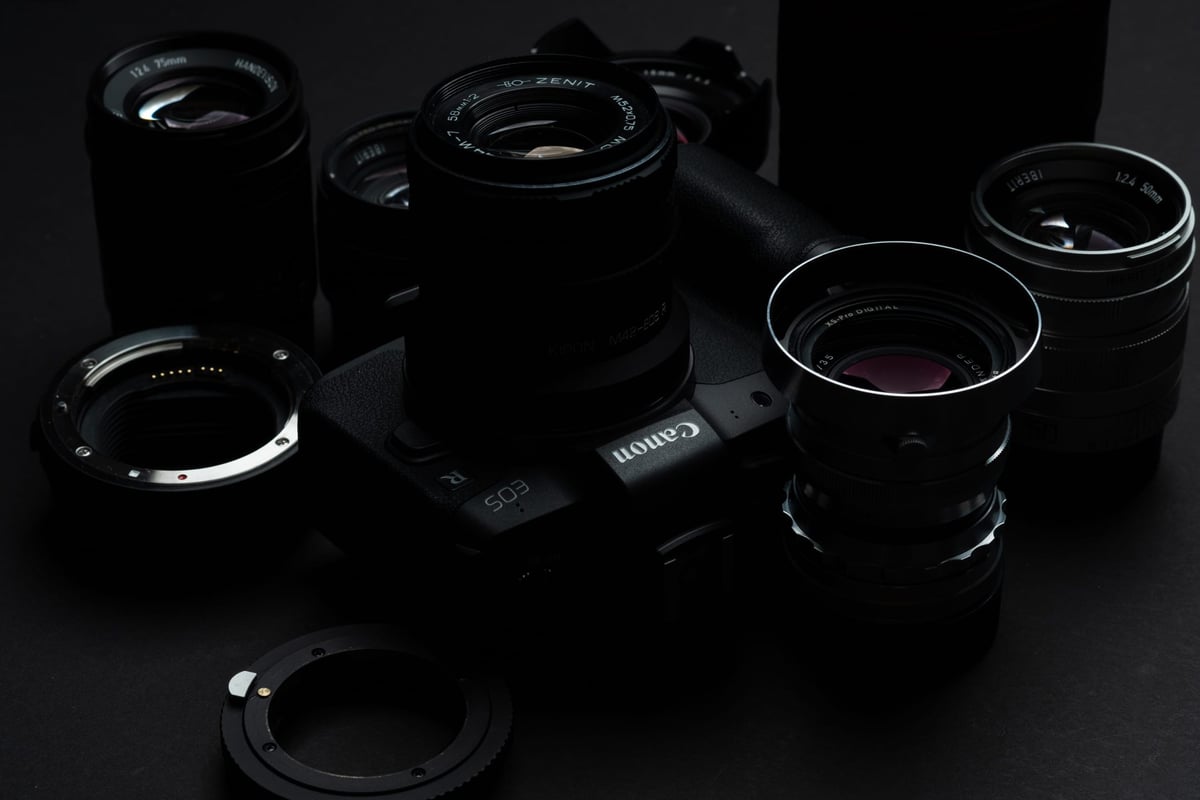
Canon transitioned fully to the RF mount when they launched the EOS R system in 2018, and EF lens production for new releases ended in 2022. If you’re shopping for Canon lenses today, RF is what you’re looking at. This is a complete list of every Canon lens available for the RF mount — all official native Canon RF glass plus RF-S APS-C options, and every third-party lens currently on the market. Lenses from Canon’s active roadmap are added as they’re announced.
Canon also makes a series of PL lenses that can be adapted to the RF mount. See the complete list of PL Mount lenses if you need more of that type. PL-mount lenses can be easily adapted to Canon RF bodies.
Table of Contents
Official Canon RF Lenses
This section covers all available official Canon RF lenses. See the list of Canon RF cameras for body options.
Canon RF Prime & Zoom Lens List
Check out the Canon RF Lenses from the Official Canon USA store for full specs and current pricing.
Canon Prime Lenses:
L-series primes: The Canon L lenses are the pinnacle of image quality, crafted with top-tier elements, coatings, and mechanics. Weather sealing adds another layer of protection for challenging environments.
Non-L primes: Ideal for casual photography, these lenses offer good value and often possess unique characteristics.
Canon Zoom Lenses:
The Canon Zoom lenses also come in L and non-L builds. Their range of zooms, including f/2 zoom lenses, stretches from an ultra-wide 15mm to a telephoto reaching 800mm.
Beyond the Plastic Stereotype:
The latest Canon RF lenses have a fresh design philosophy: lighter weight and enhanced customization. While some critics have raised concerns about a “plasticky” feel, after shooting on these lenses for a few years, they’ve become some of my favorites, specifically the 24-105mm. I love that lens more than my Nikon Z 24-120mm. You can read the full Canon RF 24-105mm f/4L review for real-world impressions and sample photos.
Mastering Manual Focus:
The electronic manual focusing on these lenses is exceptional. You can achieve high precision and a natural feel, surpassing other brands, in my opinion (and I shoot with all the brands). Customizing focus ring sensitivity in some new cameras further enhances the experience. Choose between rotation sensitivity and degree adjustments, mimicking a true manual lens. Additionally, the direction of rotation is adjustable to suit individual preferences.
While I’m not always shooting on Canon glass and bodies, I can confidently say that their focus-by-wire is the best in the industry.
Third-Party Canon RF Lens List
This section covers all third-party lenses available for the Canon RF mount, organized alphabetically by brand. Popular brands with substantial lineups have their own section; smaller or more specialized brands are grouped at the end under Other Brands.
Although a few have slipped by, Canon is currently not allowing third-party lens manufacturers to make autofocus lenses.
Keep in mind that most, if not all, third-party lenses for Canon are designed only for generic test benches and not for Canon’s exact sensor specifications. This can sometimes cause issues such as purple color shifts in the vignetting. On the latest Canon bodies it’s minor, but on early R bodies like the original R, some third-party lenses showed significant purple vignetting.
7Artisans Canon RF Lenses
7Artisans has come a long way. What started as a budget Chinese brand with variable quality has matured into a company making some of the best mid-range affordable primes available for any mirrorless mount. Their RF lineup now spans wide-angle, standard, and cine options, and the newer lenses in particular punch well above their price. Build quality is noticeably better than it was a few years ago — these are lenses worth taking seriously.
| 7Artisans RF Lenses | Format | 1.6x 35mm Equiv | Elements | Iris | Filters | RF Links | |||
|---|---|---|---|---|---|---|---|---|---|
| 7Artisans RF-S 6mm f2 | photo | no | no | APS-C | 9.6 | 10/8 | 9 | B&H | |
| 7Artisans RF-S 7.5mm f2.8 II | photo | no | no | APS-C | 12 | 11/9 | 7 | Ø58mm | B&H |
| 7Artisans RF 9mm f5.6 | photo | no | no | FF | 14.4 | 16/11 | 5 | none | B&H |
| 7Artisans RF 10mm f2.8 | photo | no | no | FF | 16 | 11/8 | 8 | none | Amazon / B&H |
| 7Artisans RF 10mm f2.8 II | photo | no | no | FF | 16 | 11/8 | 10 | Amazon / B&H | |
| 7Artisans RF-S 12mm f2.8 II | photo | no | no | APS-C | 19.2 | 12/10 | 5 | Ø67mm | B&H |
| 7Artisans RF 14mm f2.8 | photo | no | no | FF | 22.4 | 13/9 | 10 | Ø77mm | |
| 7Artisans RF-S 25mm f0.95 | photo | no | no | APS-C | 40 | 11/9 | 13 | Ø52mm | Amazon / B&H |
| 7Artisans RF-S 35mm f0.95 | photo | no | no | APS-C | 56 | 11/8 | 12 | Ø52mm | Amazon / B&H |
| 7Artisans RF-S 35mm f1.2 II | photo | no | no | APS-C | 56 | 6/5 | 10R | Ø46mm | |
| 7Artisans RF-S 35mm f1.4 | photo | no | no | APS-C | 56 | 8/5 | 9 | Ø49mm | B&H |
| 7Artisans RF 35mm f1.4 III | photo | no | no | FF | 56 | 7/5 | 10 | Ø52mm | Amazon / B&H |
| 7Artisans RF-S 50mm f0.95 | photo | no | no | APS-C | 80 | 7/5 | 13 | Ø62mm | B&H |
| 7Artisans RF 50mm f1.05 | photo | no | no | FF | 80 | 10/7 | 13 | — | Amazon / B&H |
| 7Artisans RF-S 55mm f1.4 II | photo | no | no | APS-C | 88 | 6/5 | 9 | Ø52mm | B&H |
| 7Artisans RF-S 60mm f2.8 Macro II | photo | no | no | APS-C | 96 | 11/8 | 9 | Ø49mm | Amazon / B&H |
| 7Artisans RF 60mm f2.8 2X Ultra-Macro | photo | no | no | FF | 96 | ||||
| 7Artisans RF 75mm f1.4 | photo | no | no | FF | 120 | 6/6 | 13 | Ø58mm | |
| Cine | 2026-07-21: header flags added (E/Z/RF/L/FX/M43/PL — the union of every flag set across all 28 lenses in this Cine family) so this header still shows up when the site’s lens list is filtered to any of those mounts — previously had zero flags. | no | no/hide | FF/S35/hide | — | — | — | — | |
| 7Artisans RF 35mm T1.5 Dream | cine,prime | no | no | FF | 56 | 10/9 | 11 | Ø82mm | B&H |
| 7Artisans RF 50mm T1.5 Dream | cine,prime | no | no | FF | 80 | 9/7 | 10 | Ø82mm | B&H |
| 7Artisans RF 75mm T1.5 Dream | cine,prime | no | no | FF | 120 | 6/6 | 13 | Ø82mm | B&H |
| 7Artisans RF-S 10mm T2.1 Hope | cine,prime | no | no | S35 | 16 | 15/12 | 10 | Ø77mm | Amazon / B&H |
| 7Artisans RF-S 16mm T2.1 Hope | cine,prime | no | no | S35 | 25.6 | 13/10 | 10 | Ø77mm | Amazon / B&H |
| 7Artisans RF-S 25mm T2.1 Hope | cine,prime | no | no | S35 | 40 | 10/8 | 11 | Ø77mm | Amazon / B&H |
| 7Artisans RF-S 35mm T2.1 Hope | cine,prime | no | no | S35 | 56 | 10/8 | 10 | Ø77mm | Amazon / B&H |
| 7Artisans RF-S 50mm T2.1 Hope | cine,prime | no | no | S35 | 80 | 9/7 | 10 | Ø77mm | Amazon / B&H |
| 7Artisans RF-S 85mm T2.1 Hope | cine,prime | no | no | S35 | 136 | 9/7 | 10 | Ø77mm | Amazon / B&H |
| 7Artisans RF 35mm T2 Spectrum | cine,prime | no | no | FF | 56 | 9/7 | 10 | Ø82mm | Amazon |
| 7Artisans RF 50mm T2.0 Spectrum | cine,prime | no | no | FF | 80 | 6/5 | 12 | Ø82mm | Amazon / B&H |
| 7Artisans RF 85mm T2.0 Spectrum | cine,prime | no | no | FF | 136 | 9/8 | 10 | Ø82mm | Amazon / B&H |
| 7Artisans RF-S 25mm T1.05 Vision | cine,prime | no | no | S35 | 40 | 11/9 | 13 | Ø82mm | Amazon / B&H |
| 7Artisans RF-S 35mm T1.05 Vision | cine,prime | no | no | S35 | 56 | 11/8 | 12 | Ø82mm | Amazon / B&H |
| 7Artisans RF-S 50mm T1.05 Vision | cine,prime | no | no | S35 | 80 | 7/5 | 13 | Ø82mm | Amazon / B&H |
| 7Artisans RF 12mm T2.9 | cine,prime | no | no | FF | 19.2 | 12/10 | 9 | Ø82mm | Amazon / B&H |
| 7Artisans RF 14mm T2.9 | cine,prime | no | no | FF | 22.4 | 13/9 | 10 | Ø82mm | Amazon / B&H |
| 7Artisans RF 65mm T2.9 Macro | cine,prime,macro | no | no | FF | 104 | 14/12 | 9 | Ø82mm | Amazon / B&H |
| 7Artisans RF 120mm T2.9 Macro 2X | cine,prime,macro | no | no | FF | 192 | 14/9 | 13 | Ø82mm | Amazon / B&H |
Fujinon Cine Lenses — Super 35mm
Fujinon Cine Lenses are professional-grade cinema lenses designed natively for the Canon RF mount. They are parfocal (focus holds constant when zooming), maintain a consistent T-stop across the zoom range and between lenses, are weather-sealed, and feature 0.8 MOD gear pitch compatible with industry-standard cine accessories.
| Fujinon Cine RF Mount Lenses | Format | 1.6x 35mm Equiv | Elements | Iris | Filters | RF Links | |||
|---|---|---|---|---|---|---|---|---|---|
| MK S35 Zoom | |||||||||
| Fujinon RF MK-R 18-55mm T2.9 | cine | no | no | S35 | 28.8-88mm | — | 9 | Ø82mm | B&H |
| Fujinon RF MK-R 50-135mm T2.9 | cine | no | no | S35 | 80-216mm | — | 9 | Ø82mm | B&H |
IRIX Cine Lenses
IRIX is a Swiss company that manufactures its lenses in South Korea and Japan. Known for high-quality cine lenses with advanced optics, durable metal and weather-sealed construction, internal focusing, de-clicked aperture rings, and industry-standard 0.8 MOD gear teeth. A solid choice for professional and aspiring filmmakers working with Canon mirrorless cameras.
Kipon Lenses
Kipon is a Chinese lens manufacturer that uses German designs and has a new factory in Japan. I’ve spent time with the owner and consider it a friend of the site — it’s hard to call Kipon a typical Chinese company. They have a strong relationship with Fujifilm and make some of the best adapters on the market, including the Contax 645 to GFX adapter that supports official Fujifilm protocols.
Their RF lenses are all manual focus and known for premium metal construction, precise focusing, and classic aesthetics. Their newer Colibri cinema lenses share a design philosophy similar to Cooke’s SP3 mirrorless lenses. Priced higher than most Chinese third-party options — the build quality justifies it.
| Kipon RF Lenses | Reviews | Format | Focal Length | 1.6x 35mm Equiv | Min. Focus | Elements | Iris | Filters | Weight | RF Links |
|---|
Laowa / Venus Optics Lenses
Venus Optics is known for unique, innovative lenses — particularly ultra-wide, zero-distortion options. They offer a diverse selection including primes, zooms, cine lenses, and cine anamorphic lenses available in different-colored flare coatings. The main limitation compared to established Japanese brands is coating quality, but optically their lenses fill niches no one else covers.
| Venus Optic RF Lenses | Format | Focal Length | 1.6x 35mm Equiv | Min. Focus | Elements | Iris | Filters | Weight | RF Links | |||||
|---|---|---|---|---|---|---|---|---|---|---|---|---|---|---|
| Laowa RF 9mm f2.8 Zero-D | photo | no | no | APS-C | X | 9 | 14.4 | 4.72″ / 12 cm | 15/10 | 7 | Ø49mm | 7.58oz / 215g | B&H | |
| Laowa RF 10mm f4 Cookie | photo | no | no | APS-C | X | 10 | 16 | 3.9″ / 10 cm | 12/8 | 5 | Ø37mm | 4.6oz / 130g | B&H | |
| Laowa RF 11mm f4.5 FF RL | photo | no | no | FF | X | 11 | 17.6 | 7.5″ / 19 cm | 14/10 | 5 | Ø62mm | 9oz / 254g | B&H | |
| Laowa RF 12mm f2.8 Zero D | photo | no | no | FF | X | 12 | 19.2 | 7.09″ / 18 cm | 16/10 | 7 | none | 1.34lb / 609g | B&H | |
| Laowa RF 12mm f2.8 Lite Zero D | photo | no | no | FF | X | 12 | 19.2 | 5.5″ / 14 cm | 16/9 | 14 | Ø72mm | 1.1 lb / 480 g | B&H | |
| Laowa RF 14mm f4 FF RL | photo | no | no | FF | X | 14 | 22.4 | 10.6″ / 27 cm | 13/9 | 5 | Ø52mm | 8oz / 228g | B&H | |
| Laowa RF 15mm f2 Zero-D | photo | no | no | FF | X | 15 | 24 | 5.91″ / 15 cm | 12/9 | 5 | Ø72mm | 1.1lb / 500g | B&H | |
| Laowa RF 15mm f4.5 Zero-D Shift | photo | no | no | FF | X | 15 | 24 | 7.9″ / 20 cm | 17/11 | 5 | none | 1.3lb / 597g | B&H | |
| Laowa RF 15mm f4.5R Zero-D Shift | photo | no | no | FF | X | 15 | 24 | 7.9″ / 20 cm | 17/11 | 14 | none | 1.3lb / 597g | B&H | |
| Laowa RF 15mm f5.0 Cookie | photo | no | no | FF | X | 15 | 24 | 12cm | — | — | Ø39mm | 160g | ||
| Laowa RF 20mm f4 Zero-D Shift | photo | no | no | FF | X | 20 | 32 | 9.8″ / 25 cm | 16/11 | 14 | Ø82mm | 26.3oz / 747g | B&H | |
| Laowa RF 24mm f14 Probe Macro 2:1 | photo | no | no | FF | X | 24 | 38.4 | 1.54′ / 47 cm | 27/19 | 7 | none | 1.04lb / 474g | B&H | |
| Laowa RF 24mm T14 2X PeriProbe | photo | no | no | FF | X | 24 | 38.4 | 0.8″ / 2cm | 28/19 | 7 | none | 1.69lb / 770g | ||
| Laowa RF 25mm f2.8 2.5-5x Macro | photo | no | no | FF | X | 25 | 40 | 6.81″ / 17.3 cm | 8/6 | 8 | none | 14.11oz / 400g | B&H | |
| Laowa RF Argus 28mm f1.2 | photo | no | no | FF | X | 28 | 44.8 | 19.7″ / 50 cm | 13/7 | 13 | Ø62mm | 1.2 lb / 562 g | B&H | |
| Laowa RF Argus 33mm f0.95 CF APO | photo | no | no | APS-C | X | 33 | 52.8 | 13.8″ / 35 cm | 14/9 | 9 | Ø62mm | 20.8oz / 590g | B&H | |
| Laowa RF 35mm f0.95 FF | photo | no | no | FF | X | 35 | 56 | 19.7″ / 50 cm | 14/9 | 15 | Ø72mm | 26.6oz / 755g | B&H | |
| Laowa RF Argus 45mm f0.95 | photo | no | no | FF | X | 45 | 72 | 19.7″ / 50 cm | 13/9 | 15 | Ø72mm | 29.5oz / 835g | B&H | |
| Laowa RF 85mm f5.6 2x Macro APO | photo | no | no | FF | X | 85 | 136 | 6.4″ / 16.3 cm | 13/9 | 7 | Ø46mm | 9.1oz / 259g | B&H | |
| Laowa RF 90mm f2.8 2x Macro APO | photo | no | no | FF | X | 90 | 144 | 8.1″ / 20.5 cm | 13/10 | 13 | Ø67mm | 21.8oz / 619g | B&H | |
| Laowa RF 100mm f2.8 2x Macro APO | photo | no | no | FF | X | 100 | 160 | 9.72″ / 24.7 cm | 12/10 | 13 | Ø67mm | 1.4 lb / 638 g | B&H | |
| Laowa RF 180mm f4.5 1.5x Ultra-Macro APO | photo | no | yes | FF | X | 180 | 288 | 11.8″ / 30 cm | 12/9 | 9 | Ø62mm | 1.1 lb / 522 g | B&H | |
| Photo Zooms | photo | no | no | FF/APS-C/hide | X | — | — | — | — | — | — | — | ||
| Laowa RF 4.5-10mm f2.8 CF Fisheye | photo | no | no | APS-C | X | 4.5-10 | 7.2-16 | 3.9″ / 10 cm | 13/9 | 9 | none | 0.7 lb / 338 g | B&H | |
| Laowa RF CF 8-16mm f3.5-5 C-Dreamer | photo | no | no | APS-C | X | 8-16 | 12.8-25.6 | 7.87″ / 19.99 cm | 16/12 | 5 | Ø86mm | 1.02 lb / 463 g | B&H | |
| Laowa RF Aurogon 10-50x NA0.5 Supermicro APO | photo | no | no | FF | X | 10-50 | 16-80 | 0.8″ / 20 mm | — | 9 | — | B&H | ||
| Laowa RF 12-24mm f5.6 | photo | no | no | FF | X | 12, 24 | 19.2-38.4 | 5.9″ / 15 cm | 15/11 | 5 | Ø77mm | 17.5oz / 497g | B&H | |
| Cine Spherical | cine | no | no | FF/S35/APS-C/hide | — | — | — | — | — | — | — | |||
| Laowa RF 7.5mm T2.9 Zero-D | cine | no | no | S35 | X | 7.5 | 12 | 9.8″ / 25 cm | 16/10 | 7 | Ø77mm | 21.5oz / 610g | B&H | |
| Laowa RF 9mm T2.9 Zero-D | cine | no | no | S35 | X | 9 | 14.4 | 4.7″ / 12 cm | 15/10 | 7 | Ø55mm | 8.71oz / 247g | B&H | |
| Laowa RF 12mm T2.9 Zero-D | cine | no | no | FF | X | 12 | 19.2 | 7″ / 17.8 cm | 16/10 | 7 | none | 1.49lb / 675g | B&H | |
| Laowa RF 15mm T2.1 Zero-D | cine | no | no | FF | X | 15 | 24 | 5.9″ / 15 cm | 12/9 | 5 | Ø77mm | 1.19lb / 540g | B&H | |
| Laowa RF 65mm T2.9 2x Macro APO | cine | no | no | S35 | X | 65 | 104 | 6.7″ / 17 cm | 14/10 | 9 | Ø77mm | 19.4 oz / 550 g | B&H | |
| Laowa RF 100mm T2.9 2x Macro APO | cine | no | no | FF | X | 100 | 160 | 9.7″ / 24.7 cm | 12/10 | 13 | Ø77mm | 33.8 oz / 957 g | B&H | |
| Laowa RF Aksen 17.5mm f1.7 5-10X Ultra Macro APO | cine | no | no | FF | X | 17.5 | 28 | 0.88″ / 22.48mm (min. working distance) | 17/12 | 11 | — | 608.6g / 21.5oz | ||
| Laowa RF Aksen 45mm f2.8 1-5X Ultra Macro APO | cine | no | no | FF | X | 45 | 72 | 1.63″ / 41.35mm (min. working distance) | 13/9 | 11 | — | 638.4g / 22.5oz | ||
| Cine Argus Spherical | FF/S35/hide | |||||||||||||
| Argus RF 18mm T1 | cine | no | no | S35 | 18 | 28.8 | 9.84” / 0.25m | 15/10 | 15 | Ø77mm | 2.09lbs / 950g | B&H | ||
| Argus RF 25mm T1 | cine | no | no | S35 | 25 | 40 | 1’1” / 0.34m | 14/9 | 9 | Ø77mm | 1.68lb / 762g | B&H | ||
| Argus RF 28mm T1 | cine | no | no | FF | 28 | 44.8 | 1’3” / 0.4m | 14/9 | 15 | Ø77mm | 2.65lbs / 1200g | B&H | ||
| Argus RF 33mm T1 | cine | no | no | S35 | 33 | 52.8 | 1’1” / 0.35m | 14/9 | 9 | Ø77mm | 1.54lb / 700g | B&H | ||
| Argus RF 35mm T1 | cine | no | no | FF | 35 | 56 | 1’7” / 0.5m | 14/9 | 15 | Ø77mm | 2.09lbs / 950g | B&H | ||
| Argus RF 45mm T1 | cine | no | no | FF | 45 | 72 | 1’7” / 0.5m | 13/9 | 15 | Ø77mm | 2.35lbs / 1065g | B&H | ||
| Cine Zooms | cine | no | no | FF/S35/hide | X | — | — | — | — | — | — | — | ||
| Laowa RF 8-15mm T2.9 Fisheye | cine | no | no | FF | X | 8,15 | — | 16cm / 6.3″ | 13/9 | 9 | — | 590g / 1.3 lb | ||
| Laowa RF Probe Zoom 15-24mm T8 | cine | no | no | FF | X | 15,24 | 24-38.4 | 0.2″ / 5mm (min. working distance) | — | 9 | — | ~1400g / 3.09 lb | ||
| Laowa RF Probe Zoom 15-35mm T12 | cine | no | no | FF | X | 15,35 | 24-56 | 0.2″ / 5mm (min. working distance) | — | 9 | — | ~1400g / 3.09 lb | ||
| Laowa RF 28-75mm T2.9 | cine | no | no | FF | X | 28,75 | 44.8-120 | — | 22/18 | 11 | Ø77mm | 3.17lbs / 1440g | ||
| Laowa RF 28-75mm T2.9 Light | cine | no | no | FF | X | 28,76 | 44.8-121 | — | 22/18 | 11 | Ø77mm | 2.8lbs / 1264g | ||
| Laowa RF 75-180mm T2.9 | cine | no | no | FF | X | 75,180 | 120-288 | — | 14/14 | 11 | Ø77mm | 2.95lbs / 1339g | ||
| Laowa RF 75-180mm T2.9 Light | cine | no | no | FF | X | 75,180 | 120-289 | — | 14/14 | 11 | Ø77mm | 2.7lbs / 1226g | ||
| Laowa RF Ranger S35 11-18mm T2.9 | cine | no | no | S35 | X | 11,18 | 14.17″ / 36cm | 17/11 | 11 | — | 1.64 lb / 744g | |||
| Laowa RF Ranger S35 11-18mm T2.9 Light | cine | no | no | S35 | X | 11,18 | 14.17″ / 36cm | 17/11 | 11 | — | 1.46 lb / 662g | |||
| Laowa RF Ranger S35 17-50mm T2.9 | cine | no | no | S35 | X | 17,50 | 13.78″ / 35cm | 22/18 | 11 | — | 1.87 lb / 848g | |||
| Laowa RF Ranger S35 17-50mm T2.9 Light | cine | no | no | S35 | X | 17,50 | 13.78″ / 35cm | 22/18 | 11 | — | 1.67 lb / 758g | |||
| Laowa RF Ranger S35 50-130mm T2.9 | cine | no | no | S35 | X | 50,130 | 29.53″ / 75cm | 17/13 | 11 | — | 1.67 lb / 758g | |||
| Laowa RF Ranger S35 50-130mm T2.9 Light | cine | no | no | S35 | X | 50,130 | 29.53″ / 75cm | 17/13 | 11 | — | 1.46 lb / 662g | |||
| Cine Anamorphic | cine, ana | no | no | S35/hide | X | — | — | — | — | — | — | — | ||
| Laowa RF Nanomorph 27mm T2.8 1.5x | cine, ana | no | no | S35 | X | 27 | 43.2 | 16.9″ / 43 cm | 15/14 | 13 | Ø55mm | 11.67 oz / 331 g | B&H | |
| Laowa RF Nanomorph 35mm T2.4 1.5x | cine, ana | no | no | S35 | X | 35 | 56 | 23.6″ / 60 cm | 15/13 | 13 | Ø55mm | 12.69 oz / 360 g | B&H | |
| Laowa RF Nanomorph 50mm T2.4 1.5x | cine, ana | no | no | S35 | X | 50 | 80 | 27.6″ / 70 cm | 15/13 | 13 | Ø55mm | 13.75 oz / 390 g | B&H | |
| Laowa RF Nanomorph 65mm T2.4 1.5x | cine, ana | no | no | S35 | X | 65 | 104 | 2.3′ / 70 cm | 15/13 | 13 | Ø62mm | 1.5 lb / 690 g | B&H | |
| Laowa RF Nanomorph 80mm T2.4 1.5x | cine, ana | no | no | S35 | X | 80 | 128 | 2.8″ / 70 mm | 14/13 | 13 | Ø62mm | 1.6 lb / 710 g | B&H |
Lensbaby Lenses
Lensbaby started in 2004 making “ball and socket” shift lenses for artistic expression. They still make specialty lenses for creative effects, including the Velvet series — which brings back a dreamy, flare-forward rendering that modern lenses deliberately engineer out. A niche pick, but genuinely useful for photographers who want that look without heavy post-processing.
Meike Lenses
Meike makes affordable lens alternatives for photographers watching their budget. For APS-C specifically, I’ve found a lot to like — I’ve recommended the Meike 35mm f/1.7 for years as a great value pick. Beyond their photography lenses, they also offer a cine lineup for Canon RF targeting budget-minded videographers.
Meyer Optik Gorlitz
Meyer Optik Görlitz is a German lens manufacturer founded in 1896. Their lenses are manual focus only, metal construction throughout, and feature optical designs inspired by their historical counterparts — expect distinctive bokeh, soft focus characteristics, and vintage rendering that modern lenses deliberately avoid.
| Meyer Optik Gorlitz RF Lenses | Format | 1.6x 35mm Equiv | Elements | Iris | Filters | RF Links | |||
|---|---|---|---|---|---|---|---|---|---|
| Lydith RF 30mm f3.5 II | photo | no | no | FF | 48 | 5/5 | 12 | Ø52mm | B&H |
| Trioplan RF 35mm f2.8 II | photo | no | no | FF | 56 | 5/5 | 12 | Ø52mm | B&H |
| Trioplan RF 50mm f2.8 II | photo | no | no | FF | 80 | 3/3 | 12R | Ø52mm | B&H |
| Biotar RF 58mm f1.5 II | photo | no | no | FF | 92.8 | 6/4 | 14 | Ø52mm | B&H |
| Primoplan RF 58mm f1.9 II | photo | no | no | FF | 92.8 | 5/4 | 14 | Ø52mm | B&H |
| Biotar RF 75mm f1.5 II | photo | no | no | FF | 120 | 6/4 | 15 | Ø62mm | B&H |
| Primoplan RF 75mm f1.9 II | photo | no | no | FF | 120 | 5/4 | 15R | Ø52mm | B&H |
| Trioplan RF 100mm f2.8 II | photo | no | no | FF | 160 | 3/3 | 15 | Ø52mm | B&H |
Mitakon Zhongyi Lenses
Mitakon Zhongyi (also known as ZY Optics) makes a notable selection of lenses for Canon RF. Their Speedmaster series is the main draw — manual focus primes with exceptionally fast apertures from f/0.95 to f/1.2, including the Speedmaster 50mm f/0.95 III and 85mm f/1.2. Mitakon also shares designs with SLR Magic, which are essentially cine versions of the same lenses, and offers a limited cine lineup with standard gearing and de-clicked apertures.
| Lens Name | Lens Type | Sensor | Elements | Iris | Filters | Z Links | |
|---|---|---|---|---|---|---|---|
| Mitakon Creator 28mm f5.6 | photo | FF | 8/7 | 5 | Ø37mm | B&H | |
| Mitakon Creator 35mm f2 | photo | FF | 7/5 | 9 | Ø55mm | ||
| Mitakon Speedmaster 50mm f0.95 III | photo | FF | 10/7 | 11 | Ø67mm | B&H | |
| Mitakon 55mm f/2.8 1-5X Macro | photo | FF | 13/8 | 9 | Ø58mm | ||
| Mitakon Speedmaster 85mm f1.2 | photo | MF | 9/6 | 11 | Ø77mm | ||
| Mitakon Creator 85mm f2 | photo | FF | 6/6 | 10 | Ø55mm | ||
| Mitakon 90mm f1.5 | photo | FF | 9/6 | 9R | Ø67mm | B&H | |
| Mitakon Creator 135mm f2.5 | photo | FF | 9/7 | 9R | Ø67mm | B&H | |
| Mitakon APO 200mm f4 1X Macro | photo | FF | 11/7 | 9 | Ø67mm | B&H |
NiSi Lenses
NiSi is primarily known for high-quality filters but offers a growing lens selection for Canon RF. The 9mm f/2.8 Sunstar is a manual focus APS-C lens covering 113° — useful for landscape and architecture. For video, the ATHENA Prime series are large-aperture (T1.9) manual focus cine lenses. They also make cine lenses in E, EF, and PL mounts that can be adapted to the RF system.
Samyang / Rokinon RF Lenses
Samyang Optics (also sold as Rokinon in some markets) is a South Korean manufacturer offering a wide range of affordable lenses for the RF mount. No autofocus or optical stabilization on the RF mount, but they’ve become a genuinely good optics company. I’ve used Samyang lenses for serious work — just test each lens thoroughly for optical imperfections before committing, as quality control doesn’t match Canon’s.
| Samyang/Rokinon RF Lenses | Format | 1.6x 35mm Equiv | Elements | Iris | Filters | RF Links |
|---|
Sigma Lenses for Canon RF
Sigma has built their reputation on mastering optical perfection at an affordable price — their Art series consistently beats lenses costing two or three times as much. They’ve announced autofocus support for their Canon RF lenses, currently limited to the APS-C (RF-S) format, which is a significant development given Canon’s historically restrictive stance on third-party AF. Expect their RF presence to grow.
| Sigma RF Lenses | AF | Format | 1.6x 35mm Equiv | Elements | Iris | Filters | RF Links | ||
|---|---|---|---|---|---|---|---|---|---|
| Mirrorless Design | photo | no, yes | no, yes | FF/APS-C | |||||
| Sigma RF-S 12mm f1.4 DC | photo | no | yes | APS-C | 19.2 | 14/12 | 9R | Ø62mm | B&H |
| Sigma RF-S 15mm f1.4 DC | photo | no | yes | APS-C | 24 | 13/11 | 9R | Ø58mm | B&H |
| Sigma RF-S 16mm f1.4 DC DN | photo | no | yes | APS-C | 25.6 | 16/13 | 9R | Ø67mm | B&H |
| Sigma RF-S 23mm f1.4 DC DN C | photo | no | yes | APS-C | 36.8 | 13/10 | 9 | Ø52mm | B&H |
| Sigma RF-S 30mm f1.4 DC DN | photo | no | yes | APS-C | 48 | 9/7 | 9R | Ø52mm | B&H |
| Sigma RF 50mm f1.2 DG DN Art | photo | yes | yes | FF | 80 | 11/7 | 8 | Ø67mm | B&H |
| Sigma RF-S 56mm f1.4 DC DN | photo | no | yes | APS-C | 89.6 | 10/6 | 9R | Ø55mm | B&H |
| Zoom Lenses | photo | no, yes | no, yes | FF/APS-C | |||||
| Sigma RF-S 10-18mm f2.8 DC DN | photo | yes | yes | APS-C | — | 13/10 | 7R | Ø67mm | B&H |
| Sigma RF-S 16-300mm f3.5-6.7 DC OS | photo | yes | yes | APS-C | 25.6-480 | 20/14 | 9R | Ø67mm | B&H |
| Sigma RF-S 17-40 f1.8 DC ART | photo | yes | yes | APS-C | 27-64 | 17/11 | 11R | Ø67mm | B&H |
| Sigma RF-S 18-50mm f2.8 DC DN | photo | no | yes | APS-C | — | 13/10 | 7R | Ø55mm | B&H |
| Sigma RF 70-200mm f2.8 DG DN OS | photo | yes | yes | FF | — | 20/15 | 11R | Ø77mm | B&H |
| Sigma RF 150-600mm f5-6.3 DG DN OS | photo | yes | yes | FF | — | 25/15 | 9R | Ø95mm | B&H |
Sirui Lenses
Sirui, also known for tripods and filters, has carved out a distinct niche with anamorphic lenses for Canon RF. The Saturn series (full-frame, 1.6x squeeze, manual focus, carbon fiber construction) delivers the widescreen cinematic look at a price point far below traditional anamorphic options. The Venus series steps up to a wider 1.8x squeeze with cine-grade build. For APS-C, their 1.33x option adds the anamorphic effect while preserving a wider field of view. The NightWalker APS-C cine lenses offer f/1.2 for low-light work. Note: anamorphic lenses on B&H come in Blue and Neutral flare coatings — check product pages for your preference.
Tamron Lenses
Tamron is one of the best all-around third-party lens makers in the business — good enough that Nikon has partnered with them directly for some of their own lenses. Their Canon RF lineup supports full autofocus and electronic integration, a notable exception to Canon’s typical restrictions. The lenses themselves are sharp, well-built, and fairly priced. If you’re shooting Canon RF and want a third-party option with AF, Tamron is the first place to look.
| Tamron RF Lenses | Format | Focal Length | 1.6x 35mm Equiv | Min. Focus | Elements | Iris | Filters | Weight | RF Links | |||
|---|---|---|---|---|---|---|---|---|---|---|---|---|
| Zooms | zoom | no, yes | no, yes | FF/S35/APS-C/hide | — | — | — | — | — | — | — | |
| Tamron RF-S 11-20mm f2.8 Di III-A RXD | zoom | yes | yes | APS-C | 11,20 | — | 5.9″ / 15 cm | 12/10 | 7R | Ø67mm | 11.8oz / 335g | B&H |
| Tamron RF-S 17-70mm f2.8 Di III-A VC RXD | zoom | yes | yes | APS-C | 17,70 | — | 7.5″ / 19 cm | 16/12 | 9R | Ø67mm | 1.2lb / 525g | B&H |
| Tamron RF-S 18-300mm f3.5-6.3 Di III-A VC VXD | zoom | yes | yes | APS-C | 18,300 | — | 5.9″ / 15 cm | 19/5 | 7R | Ø67mm | 21.9oz / 620g | B&H |
Thypoch Canon RF Lenses
Thypoch is relatively new to the scene but is gaining a strong reputation, particularly in the Leica M community. They now have a few RF-mount lenses worth checking out.
| Thypoch RF Lenses | Format | Focal Length | 1.6x 35mm Equiv | Min. Focus | Elements | Iris | Filters | Weight | RF Links | |||
|---|---|---|---|---|---|---|---|---|---|---|---|---|
| Thypoch RF Simera 28mm f1.4 | photo | no | no | FF | 28 | 44.8 | 1.3′ / 0.4 m | 11/7 | 14 | Ø49mm | 0.8 lb / 368 g | B&H / Thypoch |
| Thypoch RF Simera 35mm f1.4 | photo | no | no | FF | 35 | 56 | 1.5′ / 45.7 cm | 9/5 | 14 | Ø49mm | 0.7 lb / 296 g | B&H / Thypoch |
Tokina Lenses For Canon RF
Tokina is a Japanese manufacturer with a strong reputation for innovative optics. Their Canon RF lineup is limited compared to their EF-era output — today narrowed to a few specialized options. The Tokina ATX-i 11-20mm f/2.8 CF is not listed here but can be used on the RF system with an adapter.
| Tokina RF Lenses | Format | 1.6x 35mm Equiv | Elements | Iris | Filters | RF Links | |||
|---|---|---|---|---|---|---|---|---|---|
| Photo Primes | photo | no | no,yes | FF/APS-C/hide | — | — | — | — | |
| Tokina RF SZX 400mm f8 Reflex 1x | photo | no | no | FF | 640 | 6/5 | 0 | Ø67mm | B&H |
TTArtisan Lenses
TTArtisan offers budget-friendly manual focus lenses with reasonably good quality control and image quality. I’ve owned a few TTArtisan lenses and liked them. Not ideal for autofocus-reliant work, but solid for creative manual focus shooting at an accessible price.
| TTArtisan RF Lenses | Format | 1.6x 35mm Equiv | Elements | Iris | Filters | RF Links | |||
|---|---|---|---|---|---|---|---|---|---|
| TTArtisan RF 7.5mm f2 Fisheye | photo | no | no | APS-C | 12 | 11/8 | 7 | Ø58mm | B&H |
| TTArtisan RF 10mm f2 | photo | no | no | APS-C | 16 | 13/10 | 7 | Ø72mm | |
| TTArtisan RF 11mm f2.8 Fisheye | photo | no | no | FF | 17.6 | 11/7 | 7 | none | B&H |
| TTArtisan RF 14mm f2.8 | photo | no | no | FF | 22.4 | 13/10 | 8 | Ø77mm | B&H |
| TTArtisan RF 17mm f1.4 | photo | no | no | APS-C | 27.2 | 9/8 | 10 | Ø40.5mm | B&H |
| photo | no | no | FF | 27.2 | 17/11 | 10 | — | B&H | |
| TTArtisan RF 21mm f1.5 | photo | no | no | FF | 33.6 | 13/11 | 10 | Ø72mm | B&H |
| TTArtisan RF 25mm f2 | photo | no | no | APS-C | 40 | 7/5 | 7 | Ø43mm | B&H |
| TTArtisan RF 35mm f0.95 | photo | no | no | APS-C | 56 | 7/5 | 10 | Ø52mm | B&H |
| TTArtisan RF 35mm f1.4 | photo | no | no | APS-C | 56 | 7/6 | 10 | Ø39mm | B&H |
| TTArtisan RF 35mm f1.4 Tilt | photo | no | no | APS-C | 56 | 7/6 | 10 | Ø52mm | B&H |
| TTArtisan RF 40mm f2.8 Macro | photo | no | no | APS-C | 64 | 8/7 | 11 | Ø52mm | B&H |
| TTArtisan RF 50mm f0.95 | photo | no | no | APS-C | 80 | 8/6 | 10 | Ø58mm | B&H |
| TTArtisan RF 50mm f1.2 | photo | no | no | APS-C | 80 | — | 10 | Ø52mm | B&H |
| TTArtisan RF 50mm f1.4 | photo | no | no | FF | 80 | 10/8 | 12 | Ø49mm | B&H |
| TTArtisan RF 50mm f1.4 Tilt | photo | no | no | FF | 80 | 7/6 | 12 | Ø62mm | B&H |
| TTArtisan RF 50mm f2 | photo | no | no | FF | 80 | 6/5 | 10 | Ø43mm | B&H |
| TTArtisan RF 90mm f1.25 | photo | no | no | FF | 144 | 11/7 | 10 | Ø77mm | B&H |
| TTArtisan RF 100mm f2.8 Tilt Macro 2x | photo | no | no | FF | 160 | 14/10 | 12 | Ø67mm | B&H |
| TTArtisan RF 500mm f6.3 | photo | no | no | FF | 800 | 8/5 | 12 | Ø82mm | B&H |
| Cine | |||||||||
| TTArtisan RF 35mm T2.1 Dual-Bokeh | cine | no | no | FF | 56 | 10/7 | 11 | Ø82mm | B&H |
| TTArtisan RF 50mm T2.1 Dual-Bokeh | cine | no | no | FF | 80 | 7/6 | 11 | Ø82mm | B&H |
| TTArtisan RF 85mm T2.1 Dual-Bokeh | cine | no | no | FF | 136 | 8/7 | 11 | Ø82mm | B&H |
Voigtlander RF Lenses
Voigtlander is primarily known for making some of the finest specialty lenses for the Leica M mount — compact, well-built manual focus optics with real optical character. Many of those same lenses are available for the Canon RF mount, making Voigtlander a natural pick for RF shooters who want that Leica-adjacent experience without the Leica price tag. A great company that takes lens design seriously.
| Voigtlander RF Lenses | Format | Focal Length | 1.6x 35mm Equiv | Min. Focus | Elements | Iris | Filters | Weight | RF Links | ||||
|---|---|---|---|---|---|---|---|---|---|---|---|---|---|
| Voigtlander RF 35mm f1.4 Nokton Classic | photo | no | no | FF | 35 | 56 | 11.81″ / 30 cm | 8/6 | 10 | Ø58mm | 9.24 oz / 262 g | ||
| Voigtlander RF 40mm f1.2 Nokton | photo | no | no | FF | 40 | 64 | 1.15′ / 35 cm | 8/6 | 10 | Ø58mm | 14.82 oz / 420 g | B&H | |
| Voigtlander RF 50mm f1.0 Nokton | photo | no | no | FF | 50 | 80 | 17.7″ / 45 cm | 9/7 | 12 | Ø67mm | 1.3 lb / 590 g | B&H | |
| Voigtlander RF 75mm f1.5 Nokton | photo | no | no | FF | 75 | 120 | 0.5 m | 7/6 | 12 | Ø62mm | 1.2 lb / 530 g | B&H | |
| Voigtlander RF 75mm f1.8 Portrait Heliar | Phase 1.5 catalog cross-check (2026-08-01): real, current product missing entirely from the sheet — sold natively in E, Z, and RF mount per Voigtländer’s own site, none of which were represented. Added from B&H’s Sony E spec page (BH #VO7518EPH) per Hard Rule 14 (Sony E as reference weight). | photo | no | no | FF | 75 | 120 | 2.3′ / 70 cm | 6/3 | 9 | Ø62mm | 1.23 lb / 560 g |
Yasuhara Lenses
Yasuhara makes the Anthy 35mm f/1.8 — a manual focus full-frame lens with 9 elements in 7 groups. It’s a genuinely fun street lens: good contrast and sharpness in a small package, with distinctive character. Vignetting is a weakness, and on early Canon R bodies you may see some purple vignetting. On newer R bodies, this is much less apparent. The same company also made a well-regarded 5:1 macro APS-C mirrorless lens.
Yongnuo Lenses
Yongnuo has managed to implement autofocus on the Canon RF mount — whether through a licensing arrangement or by flying under Canon’s patent enforcement radar is unclear. Either way, worth noting. Yongnuo has been making simple, affordable lenses since the mid-2000s.
| Yongnuo RF Lenses | Format | Focal Length | 1.6x 35mm Equiv | Min. Focus | Filters | Weight | RF Links | |||||
|---|---|---|---|---|---|---|---|---|---|---|---|---|
| Yongnuo RF-S 23mm f1.4 DA DSM WL Pro | photo | no | yes | APS-C | 23 | 36.8 | 15.7″ / 40 cm | 11/9 | 9 | Ø58mm | 12.7 oz / 360 g | |
| Yongnuo RF-S 35mm f1.8 DA DSM WL | photo | no | yes | APS-C | 35 | 56 | 11.8″ / 30 cm | 10/8 | 7 | Ø52mm | 6.3 oz / 179 g | |
| Yongnuo RF 35mm f2 DF DSM | photo | no | yes | FF | 35 | 56 | 3.78″ / 0.35 m | 9/8 | 7R | Ø52mm | 10.4 oz / 295 g | B&H |
| Yongnuo RF 50mm f1.8 DSM | photo | no | yes | FF | 50 | 80 | 17.7″ / 45 cm | — | — | — | 10.6 oz / 300 g (approx., per manufacturer) | |
| Yongnuo RF 85mm f1.8 DF DSM II | photo | no | yes | FF | 85 | 136 | 31.5″ / 80 cm | 9/8 | 7 | Ø58mm | 13.4 oz / 381 g | |
| Yongnuo RF 85mm f1.8 DF DSM | photo | no | yes | FF | 85 | 136 | 31.5″ / 80 cm | 9/8 | 7R | Ø58mm | 12.2 oz / 346 g | B&H |
Zeiss Primes For Canon RF
Zeiss’s native Canon RF presence centers on the Otus ML series (50mm and 85mm f/1.4) — bringing legendary Otus optical performance to mirrorless bodies in a compact manual focus form factor built for ultra-high-resolution sensors. For most RF shooters, the Zeiss experience still lives through adapted Milvus, Otus, and Classic (ZE) lenses via the EF-EOS R adapter. These maintain full electronic communication for aperture control and focus confirmation, and often perform better on mirrorless bodies thanks to Canon’s Focus Guide and IBIS. Zeiss also offers Nano Prime cine lenses for RF via interchangeable mounts.
| Zeiss RF Lenses | Format | Focal Length | 1.6x 35mm Equiv | Min. Focus | Elements | Iris | Filters | Weight | RF Links | |||
|---|---|---|---|---|---|---|---|---|---|---|---|---|
| Zeiss RF Otus ML 35mm f1.4 | photo,prime | no | no | FF | 35 | 56 | 11.8″ / 30 cm | 15/11 | 10R | Ø67mm | 1.5 lb / 698 g | B&H |
| Zeiss RF Otus ML 50mm f1.4 | photo,prime | yes | no | FF | 50 | 80 | 1.6′ / 50 cm | 14/11 | 10 | Ø67mm | 1.5 lb / 677 g | B&H |
| Zeiss RF Otus ML 85mm f1.4 | photo,prime | yes | no | FF | 85 | 136 | 2.3 lb / 1033 g | 15/11 | 10 | Ø77mm | 2.6′ / 80 cm | B&H |
Other Brands
The following brands make lenses for the Canon RF mount with smaller or more specialized lineups — cine-focused, specialty optics, or limited production runs.
AstrHori
AstrHori specializes in manual focus specialty lenses — macro probes, tilt-shift lenses, and wide-angle options — for photographers seeking specific functionalities or creative effects not covered by mainstream brands.
| Lens Name | Sensor | FF Equiv | Elements | Iris | Filters | RF Links | |
|---|---|---|---|---|---|---|---|
| AstrHori 10mm f8 M | APS-C | 16 | 5/4 | — | Ø49mm | ||
| AstrHori 10mm f8 II | APS-C | 16 | 5/4 | — | Ø55mm | ||
| AstrHori 12mm f2.8 Fisheye | FF | 19.2 | 11/8 | 5 | — | Pergear | RF |
| AstrHori 14mm f4.5 | APS-C | 22.4 | 6/5 | — | Ø55mm | ||
| AstrHori 18mm f8 | FF | 28.8 | 9/9 | — | Ø58mm | Pergear | RF |
| AstrHori F8 2x Probe Lens | APS-C | 28.8 | 23/17 | — | — | — | RF |
| AstrHori 24mm f6.3 M | FF | 38.4 | 5/5 | — | Ø35.5mm | ||
| AstrHori 27mm f2.8 II | APS-C | 43.2 | 6/5 | — | Ø52mm | ||
| AstrHori 28mm f13 2x Macro | FF | 44.8 | 21/16 | 7 | — | Pergear | RF |
| AstrHori 28mm f13 2x Macro 360° | FF | 44.8 | RF | ||||
| AstrHori 35mm f1.8 | APS-C | 56 | 9/7 | — | Ø58mm | ||
| AstrHori 40mm f5.6 M | FF | 64 | 7/5 | — | Ø46mm | ||
| AstrHori 40mm f5.6 | MF | 64 | 7/5 | — | Ø62mm | ||
| AstrHori 50mm f1.4 Tilt | FF | 80 | 7/6 | — | Ø46mm | — | RF |
| AstrHori 50mm f2 | FF | 80 | 6/5 | — | Ø52mm | ||
| AstrHori 55mm f5.6 | MF | 88 | 5/5 | — | Ø62mm | ||
| AstrHori 75mm F4 | MF | 120 | 11/8 | 9 | Ø67mm | ||
| AstrHori 85mm f1.8 AF | FF | 137.6 | 10/7 | — | — | ||
| AstrHori 85mm f2.8 Macro & Tilt 1:1 | FF | 136 | 11/8 | 12 | Ø55mm | — | RF |
Astra Labs
Astra Labs has a few all-manual full-frame lenses available for the Canon RF mount.
| Astra Lab RF Lenses | Format | Focal Length | 1.6x 35mm Equiv | Min. Focus | Elements | Iris | Filters | Weight | RF Links | |||
|---|---|---|---|---|---|---|---|---|---|---|---|---|
| Artra Lab RF Latalumen 14mm f2.8 V2 | photo | no | no | FF | 14 | 22.4 | 8.66″ / 0.22 m | 13/9 | 10 | Ø82mm | 1.2 lb / 547 g | |
| Artra Lab RF Lunaelumen 50mm f1.1 | photo | no | no | FF | 50 | 80 | 1.15′ / 0.35 m | 8/6 | 11 | Ø52mm | 0.9 lb / 396 g | B&H |
| Artra Lab RF Motus 50mm f1.6 Pan Tilt 360 | photo | no | no | FF | 50 | 80 | 1.6′ / 0.5 m | 6/5 | 14R | Ø43mm | 0.4 lb / 200 g | B&H |
| Artra Lab RF Artolumen 60mm f2.8 2x Macro | photo | no | no | FF | 60 | 96 | 0.59′ / 0.18 m | 10/7 | 10 | Ø62mm | 1.3 lb / 600 g | B&H |
Brightin Star
Brightin Star is a budget Chinese manufacturer offering manual focus lenses for Canon RF. Affordability is the main pitch; reviews on image quality and build are mixed.
Chiopt
Chiopt offers full-frame cine lenses for Canon RF. Their primary offering is the AURA Super Speed Prime series — T1.5 maximum aperture, 0.8 MOD gears on focus and iris rings, and native RF-mount compatibility designed for professional video workflows.
| Chiopt RF Lenses | Format | Focal Length | 1.6x 35mm Equiv | Min. Focus | Filters | Weight | RF Links | |||||
|---|---|---|---|---|---|---|---|---|---|---|---|---|
| Cine | ||||||||||||
| CHIOPT AURA 16mm T2.2 | cine | no | no | FF | 16 | 25.6 | 9.8″ / 25 cm | N/A | 1.9 lb / 850 g | B&H | ||
| CHIOPT AURA 24mm T1.5 | cine | no | no | FF | 24 | 38.4 | 11.8″ / 30 cm | M72 x 0.75 | 1.96 lb / 0.89 kg | B&H | ||
| CHIOPT AURA 35mm T1.5 | cine | no | no | FF | 35 | 56 | 14.2″ / 36 cm | M72 x 0.75 | 1.79 lb / 0.81 kg | B&H | ||
| CHIOPT AURA 50mm T1.5 | cine | no | no | FF | 50 | 80 | 13.8″ / 35 cm | M72 x 0.75 | 1.94 lb / 0.88 kg | B&H | ||
| CHIOPT AURA 85mm T1.5 | cine | no | no | FF | 85 | 136 | 35.8″ / 91 cm | M72 x 0.75 | 1.83 lb / 0.83 kg | B&H |
Cooke SP3
Cooke’s SP3 Cine lenses feature interchangeable mounts — initially shipping with Sony E-mount, with the rear mount swappable to Canon RF. They feature 0.8-MOD focus and iris gears. The lenses are not positive-lock, which may give serious cinematographers pause given the price point. Check Cooke’s current availability for the RF mount adapter.
Funleader
Funleader is a small Hong Kong company making pancake lenses with fixed apertures. Their Pro zone-focus versions are Sony E or Leica M only — Canon RF requires an adapter.
| Funleader RF Lenses | Format | Focal Length | 1.6x 35mm Equiv | Min. Focus | Elements | Iris | Filters | Weight | RF Links | |||
|---|---|---|---|---|---|---|---|---|---|---|---|---|
| Funleader RF Caplens 18mm f8 | photo | no | no | FF | 18 | 28.8 | 0.8m | 6/5 | fixed | — | 80g | Funleader |
Gizmon
Gizmon makes a limited range of manual focus lenses for Canon RF, primarily targeting budget-conscious photographers and hobbyists.
KamLan
KamLan offers manual focus lenses at budget prices. A small but growing RF selection.
| Lens Name | Sensor | FF Equiv | Elements | Iris | Filters | RF Links | |
|---|---|---|---|---|---|---|---|
| KamLan 15mm f2 | APS-C | 24 | 11/9 | 10 | — | ||
| KamLan 21mm f1.8 | APS-C | 33.6 | 10/8 | 11 | Ø52mm | ||
| KamLan 28mm f1.4 | APS-C | 44.8 | 8/7 | 11 | Ø52mm | ||
| Kamlan 32mm f1.1 | APS-C | 51.2 | |||||
| KamLan 50mm f1.1 Review | APS-C | 80 | 5/5 | 11 | Ø52mm | ||
| KamLan 50mm f1.1 II Review | APS-C | 80 | 8/7 | 11 | Ø62mm | ||
| KamLan 55mm f1.4 | FF | 88 | 8/6 | RF | |||
| Kamlan 70mm f1.1 | APS-C | 112 |
Kase
Kase is primarily a filter company. For Canon RF, their main offering is a Clip-In Filter system that sits directly in front of the sensor — useful for wide lenses like the RF 10-20mm f/4L or 15-35mm f/2.8L that don’t accept front filters. They also make a 200mm f/5.6 Reflex mirror lens with characteristic donut bokeh.
| Kase RF Lenses | Format | Focal Length | 1.6x 35mm Equiv | Min. Focus | Filters | Weight | RF Links | |||||
|---|---|---|---|---|---|---|---|---|---|---|---|---|
| Kase RF 200mm f5.6 Reflex | photo | no | no | FF | 200 | 320 | 6.6′ / 2 m | 6/5 | N/A (reflex/catadioptric lens, no iris diaphragm) | Ø67mm | 0.9 lb / 424 g | B&H |
Lomography / Zenit
Lomography is partnered with Russian manufacturer Zenit. Their Petzval 55mm f/1.7 is well known for its swirling bokeh and classic rendering — there isn’t really another lens like it, and the brass construction is distinctive. Other Lomography lenses typically come in DSLR-style mounts and require an adapter for RF.
Opteka
Opteka has a few telephoto options for the RF mount — T-mount lenses packaged with an RF adapter and range extenders.
| Lens Name | Sensor | FF Equiv | Elements | Iris | Filters | RF Links | ||||
|---|---|---|---|---|---|---|---|---|---|---|
| Opteka 6.5mm f2 Fisheye | photo | no | no | APS-C | 10.4 | 6/5 | 9 | — | ||
| Opteka 12mm f2.8 | photo | no | no | APS-C | 19.2 | 12/10 | 9 | Ø72mm | ||
| Opteka 28mm f2.8 | photo | no | no | APS-C | 44.8 | 6/5 | 9 | Ø49mm | ||
| Opteka 35mm f1.7 | photo | no | no | APS-C | 56 | 6/5 | 9 | Ø49mm | ||
| Opteka 50mm f2 | photo | no | no | APS-C | 80 | 6/5 | 9 | Ø49mm | ||
| Opteka 420mm / 800mm | photo | no | no | FF | 672 | 4/2 | — | Ø62mm | — | RF |
| Opteka 500 f6.3 | photo | no | no | FF | 800 | 7/6 | — | Ø95mm | ||
| Opteka 500mm / 1000m f8 | photo | no | no | FF | 800 | 4/4 | — | Ø67mm | — | RF |
| Opteka 650mm / 1300mm | photo | no | no | FF | 1040 | 6/5 | — | Ø95mm |
Pergear
Pergear offers a growing selection of budget lenses compatible with the Canon RF system.
| Lens Name | Sensor | FF Equiv | Elements | Iris | Filters | RF Links | |
|---|---|---|---|---|---|---|---|
| Pergear 7.5mm f2.8 | APS-C | 12 | 9/8 | 10R | — | ||
| Pergear 10mm f8 Pancake | APS-C | 16 | 5/4 | fixed | — | ||
| Pergear 12mm f2 | APS-C | 19.2 | 12/9 | 10 | Ø62mm | ||
| Pergear 14mm f2.8 II | FF | 22.4 | Pergear | RF | |||
| Pergear 25mm f1.8 | APS-C | 40 | 5/3 | 12 | Ø43mm | ||
| Pergear 35mm f1.2 Review | APS-C | 56 | 6/5 | 10 | Ø43mm | ||
| Pergear 35mm f1.4 | FF | 56 | — | 10 | — | — | RF |
| Pergear 35mm f1.6 | APS-C | 56 | 6/4 | 12 | Ø43mm | ||
| Pergear 50mm f1.8 Review | APS-C | 80 | 6/4 | 10 | Ø43mm | ||
| Pergear 60mm f2.8 2x Macro | APC-C | 80 | 11/8 | 10 | Ø62mm | ||
| Pergear 60mm f2.8 2x Macro II | FF | 96 | 10/7 | 10 | Ø62mm | — | RF |
SG-Image
SG-Image makes a mix of full-frame and APS-C manual focus lenses for the Canon RF mount.
Vazen
Vazen specializes in anamorphic lenses designed for Micro Four Thirds. These can be used on full-frame Canon R cameras in 2x crop mode, delivering a 1.8x anamorphic compression for a 2.39:1 aspect ratio on M4/3 sensors.
Adapters
Third-party 35mm lenses adapted to the Canon EOS R tend to perform better than on Sony cameras. Because Canon has a larger lens mount, they don’t need a very aggressive lens microdesign, so lenses designed for film or DSLRs perform better on the Canon RF mount than on cameras with more aggressive micro lens designs, like the L mount or the Sony FE lens list.
The Canon EOS R also features a thin sensor stack, which improves performance when adapting Leica or 35mm film lenses. If it weren’t for the weak focus peaking, the EOS R would be one of the best options for adapting old 35mm film lenses.
Kipon has 20 different adapters for the Canon EOS R system — a high-quality adapter and lens company with a factory now in Japan.
| Kipon RF Lens Adapters | Elements | RF Links | ||||
|---|---|---|---|---|---|---|
| Alpa(35mm) | B&H | |||||
| Arri PL | B&H | |||||
| Arri LPL | B&H | |||||
| Arri S | B&H | |||||
| C-Mount | B&H | |||||
| Canon EF | B&H | |||||
| Canon EF Helicoid | Yes | B&H | ||||
| Canon FD | B&H | |||||
| Contax G | B&H | |||||
| Contax/Yashica | B&H | |||||
| Exakta | B&H | |||||
| Konica AR | B&H | |||||
| L39 Screw | B&H | |||||
| Leica M | B&H | |||||
| Leica M Helicoid | Yes | B&H | ||||
| Leica R | B&H | |||||
| M42 Screw | B&H | |||||
| Mamiya 645 | B&H | |||||
| Minolta MD | B&H | |||||
| Nikon F Mount V1 | B&H | |||||
| Nikon F Mount V2 | B&H | |||||
| Nikon F Helicoid | Yes | B&H | ||||
| Nikon F, G-Type Helicoid | Yes | B&H | ||||
| Nikon G Type | B&H | |||||
| Olympus OM | B&H | |||||
| Olympus Pen | B&H | |||||
| Pentax 110 | B&H | |||||
| Pentax 67 | B&H | |||||
| Pentax K | B&H | |||||
| Praktica B | B&H | |||||
| Sony/Minolta AF | B&H | |||||
| X-Pan | B&H | |||||
| Fuji OX | B&H |
List of All Canon RF Lenses Conclusion
I’ll continue to update this list as more lenses hit the market. If I’ve missed anything or made any mistakes, please let me know in the comments.









Leave a Reply