
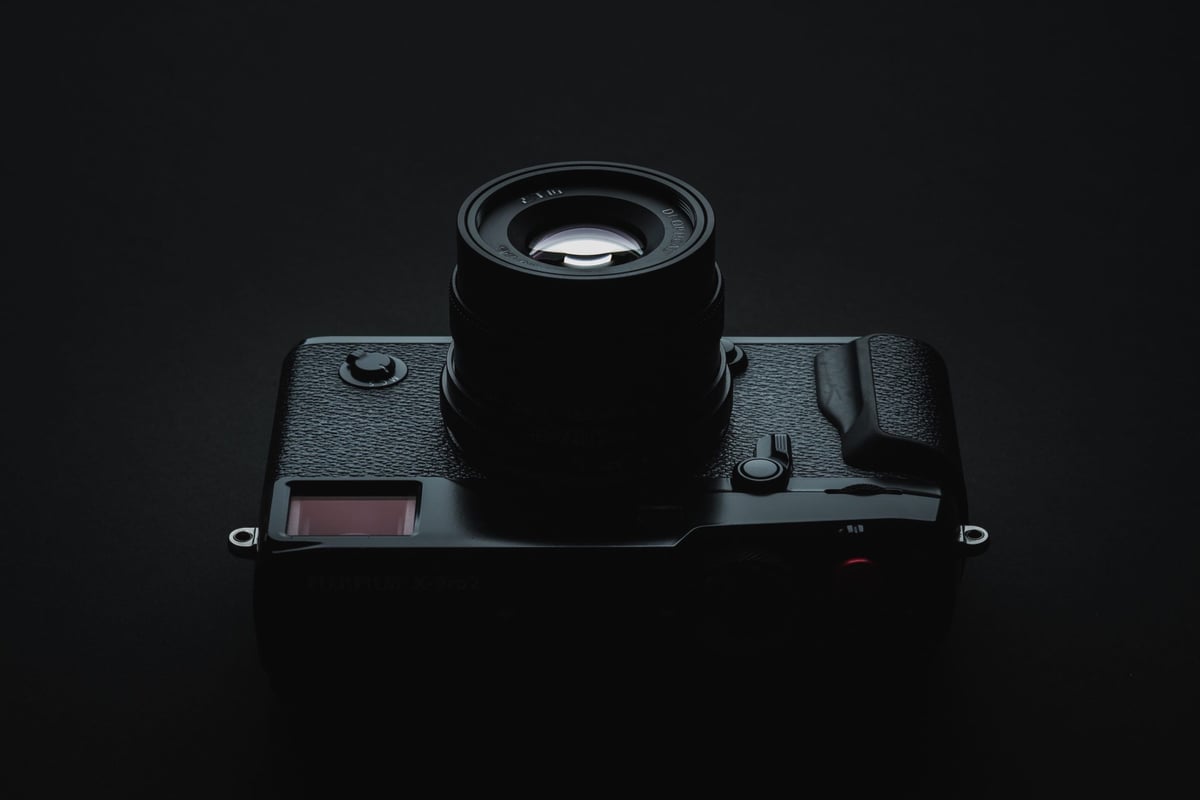
Fujifilm is the camera system I shoot most. The X-series has some of the best build quality in the APS-C segment, the film simulations are the best in-camera color science I’ve used, and the glass — especially the Fujicron primes — is legitimately excellent at every price point. The GFX medium format line is worth serious consideration if you’ve hit the ceiling on APS-C resolution. Below is the full lineup with memory card specs and links to my tested card recommendations.
This list shows all Fujifilm Mirrorless X Mount cameras, including all Fuji FX APS-C and all Fuji GFX cameras. For the glass side of the equation, check out the complete list of every Fujifilm X-mount lens — it covers all native XF and XC lenses plus the major third-party options.
List of Every Fujifilm Mirrorless Camera
The table is broken into X-series APS-C and GFX medium format. I’ve included the memory card configuration for each body — slot count, supported standards, and whether CFexpress applies.
You can toggle open the row to find more guides for each camera.
My Top Picks for 2026
Best Overall: Fujifilm X-T5 — 40MP BSI sensor, excellent IBIS, compact body, and every film simulation you’d want. The camera I’d hand to someone who shoots stills primarily and wants one body that does everything well without reaching for full-frame.
The Fujifilm X-E5 is also my favorite for the compact casual photographer, and I think it’s Fujifilm’s best overall camera for most people.
Best for Speed/Action: Fujifilm X-H2S — stacked 26MP sensor, 40fps burst, and the best autofocus Fujifilm has shipped. The answer when the shot can’t be missed — sports, wildlife, anything that moves unpredictably.
Best for Video: Fujifilm X-H2 — 8K internal recording, 4:2:2 10-bit, F-Log2. If video is your primary use and you want the highest-resolution output in the X-series, this is the one.
Most Compelling Compact: Fujifilm X100VI — fixed 23mm f/2, built-in ND filter, full film simulation suite in a pocketable body. The hardest camera in the lineup to get in stock for a reason.
Best Value: Fujifilm X-S20 — 6.2K video, good IBIS and solid hybrid performance at a price that doesn’t need justification. The X-S20 is where I’d start anyone who’s new to the X-system.
Best Medium Format: Fujifilm GFX100S II — 102MP, IBIS, and a body size that doesn’t require a backpack. Medium format resolution without the full GFX100 II footprint and price.
Fujifilm Memory Card Compatibility
Currently, all interchangeable-lens Fujifilm cameras support SD memory cards. Flagship cameras like the X-Pro, X-T, and X-H series accept UHS-II memory cards; entry-level or mid-level cameras often require only UHS-I cards.
The latest GFX and X-H series can also take CFexpress Type-B cards.
Understanding the Fujifilm Naming System
Fujifilm’s lineup is split between X-series (APS-C) and GFX (medium format), with several sub-series within each:
- X-H: Hybrid flagship. Deep grip, weather-sealed, dual card slots. The “H” stands for Hybrid — built for shooters who need serious video alongside stills. X-H2S has a stacked sensor (faster readout, better burst); X-H2 has higher resolution.
- X-T: The traditional enthusiast body. X-T5 is the stills flagship — high resolution, compact, no compromises on image quality. X-T50 is the accessible version with the same sensor in a lighter package.
- X-Pro: Rangefinder-style with a hybrid optical/electronic viewfinder. The choice for street and documentary shooters who want to shoot with both eyes open.
- X-E: Compact, minimalist, no weather sealing. The understated body for shooters who want X-series image quality in the smallest possible package.
- X-S: Creator-oriented hybrid mid-range. Good video specs, solid film sims, approachable price.
- X-M: Entry-level/ultra-compact. The lowest barrier into the X-system.
- X100: Fixed-lens compact. The Roman numeral indicates generation — X100VI is the sixth. Built-in ND filter, hybrid viewfinder, the full film simulation suite. Not interchangeable.
- GFX: Medium format (102 MP or 50 MP sensor). GFX100 series = ~100MP; GFX50 series = ~50MP. “S” denotes a compact body (GFX100S II); “R” denotes a rangefinder-style body (GFX50R). The lenses are GF-mount, not compatible with X-mount bodies.
Mark numbers and generation suffixes (II, III) indicate newer iterations within a line. The X-T5 is not the fifth version of the X-T1 — it’s the fifth number in the X-T lineup, which runs X-T1 → X-T2 → X-T3 → X-T4 → X-T5.








Leave a Reply