
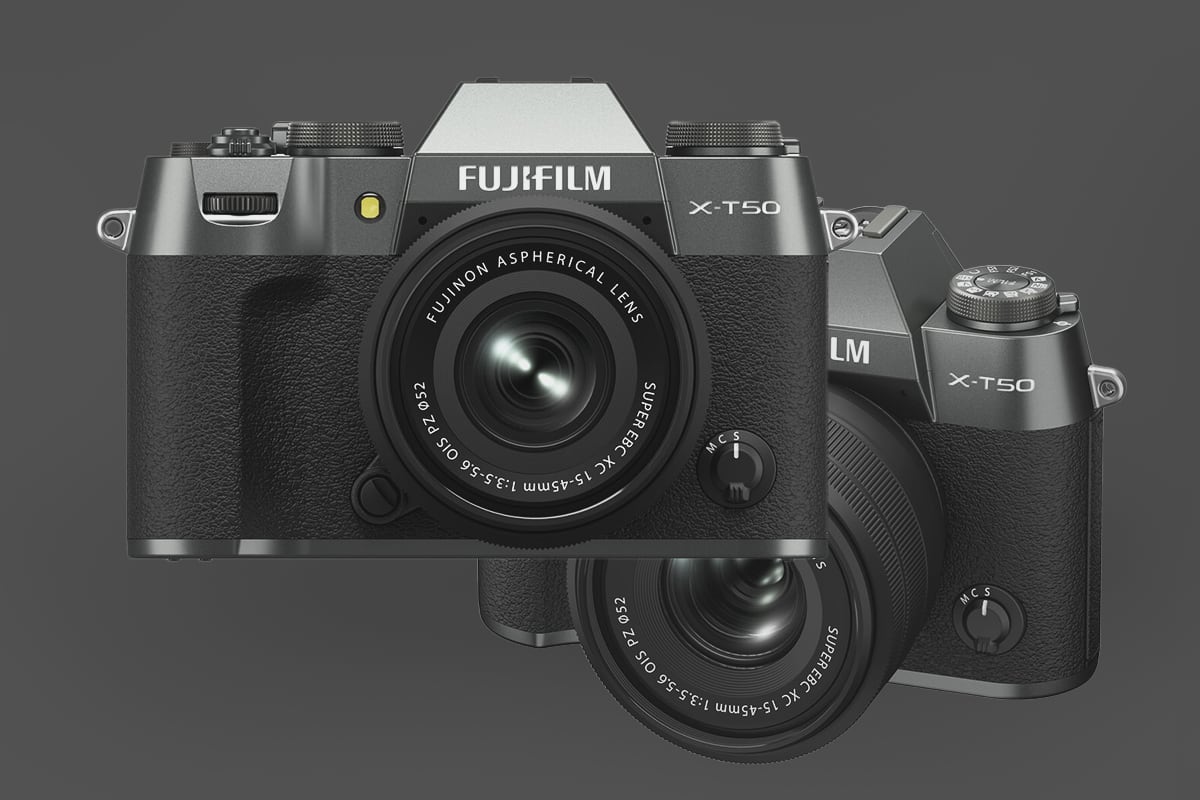
The X-T50 features a single UHS-II SD card slot, making UHS-II cards the go-to choice for optimal performance.
Here’s a curated list of the best SD memory cards for the Fujifilm X-T50, balancing speed, capacity, reliability, and value.
Recommended Memory Cards Fujifilm X-T50
Use V90 memory cards if you’re shooting a lot in continuous burst mode with RAW files.
Use v60 cards if your focus is videography or if you’re using many film-simulator modifications, which can bottleneck processor performance.
| Memory Cards | Speed Class | USB-C Write | USB-C Read | Links |
|---|---|---|---|---|
| SD UHS-II V90 | Hide | |||
| PNY EliteX-Pro90 V90 64/128/256GB | UHS-II v90 | 276 | 293 | Amazon / B&H |
| SD UHS-II V60 | Hide | |||
| Sandisk Extreme Pro v60 256/512/1TB | UHS-II v60 | 189 | 279 | Amazon / B&H |
| Lexar Silver Pro v60 128GB-1TB | UHS-II v60 | 162 | 255 | Amazon |
| Kingston Canvas React Plus V60 128GB | UHS-II v60 | Amazon | ||
| Sony E v60 256GB | UHS-II v60 | Amazon / B&H | ||
| PNY EliteX-Pro60 V60 256GB | UHS-II v60 | 183 | 280 | Amazon / B&H |
| Angel Bird V60 II 64-1TB | UHS-II v60 | 144 | 243 | Amazon / B&H |
If you want to use Tough cards, for example, the Sony Tough cards or the Lexar Armor cards, you should note that these cards are often a little thicker and in the Fujifilm cameras, where the memory card slot is next to the door, it can make it a little difficult to get the cards out.
What Cards Do You Need For Video?
The Fujifilm X-T50 shoots 4K or 6K video at up to 360 Mbps. In normal people’s terms, that translates to 45 MB/s. This is very different from the Fujifilm X-T5, which can shoot video at 720 Mbps, requires V90 cards, and is even better than the Fujifilm X-E5, which is limited to 200 Mbps.
With the Fujifilm X-T50, you can stream data at a steady 45MB/s rate using a V60 UHS-II SD card, which is capable of sustaining 60MB/s.
Another case for using only a v60 card instead of a v90 card is if you shoot with many film-simulator modifications.
Shooting Modified Film Simulators Will Slow Down Performance
If you’re shooting a lot with film simulators and like to use processor-heavy settings like grain, noise reduction and clarity, this will cause a processor bottleneck, and it will feel like your memory card is clearing the buffer very slowly.
If this is your workflow, you can save a significant amount of money by using only a v60 memory card.
Why Choose the Right SD Card for the X-T50?
The X-T50’s high-resolution sensor and video capabilities generate large files quickly. For example:
- Burst shooting at up to 20 fps (electronic shutter) can produce hundreds of megabytes per second.
- Video recording at 360 Mbps (e.g., 6.2K/30P) requires cards with a Video Speed Class of V60 or better.
- UHS-II cards offer faster write speeds than UHS-I, clearing the camera’s buffer faster during bursts and ensuring smooth video recording.
Best SD Cards Fujifilm X-T50 Conclusions
For most people using the Fujifilm X-T50, I think v60 will be sufficient for everything they want from the camera, and they will save a significant amount of money. Additionally, some V60 cards are still fast; for example, the SanDisk Extreme Pro V60 card can write at approximately 180MB/s.
However, for those who burst a lot, V90 cards will provide a much smoother experience.
Full Benchmark Results — Fujifilm X-T5 Data
The X-T50 uses the same single UHS-II SD slot as the Fujifilm X-T5 and shares the same 40MP sensor. The speeds below are from direct in-camera testing on the X-T5. X-T50 results should be very close.
UHS-II V90 Results
| Card | Speed |
| PNY EliteX-Pro90 V90 | 195 MB/s |
| OWC Atlas Ultra V90 | 190 MB/s |
| Lexar 2000x V90 | 180 MB/s |
| Adata V90 | 154 MB/s |
| Ritz Gear V90 | 147 MB/s |
| Wise Pro V90 | 146 MB/s |
| Transcend V90 | 136 MB/s |
| Delkin Power V90 | 136 MB/s |
| Delkin Black V90 | 132 MB/s |
| Kodak V90 | 123 MB/s |
| Amplim V90 | 123 MB/s |
| Kingston Canvas React V90 | 121 MB/s |
| AngelBird V90 II | 115 MB/s |
UHS-II V60 Results
| Card | Speed |
| Sandisk Extreme Pro V60 256GB+ | 154 MB/s |
| PNY EliteX-Pro60 V60 256GB | 153 MB/s |
| PNY EliteX-Pro60 V60 512GB | 153 MB/s |
| Lexar 1800x V60 | 142 MB/s |
| Sony M Tough V60 | 130 MB/s |
| AngelBird V60 II | 126 MB/s |
| Sony E V60 | 126 MB/s |
| Amplim 2000x V60 | 122 MB/s |
| Ritz Gear V60 64–256GB | 95 MB/s |
| OWC Atlas Pro V60 | 91 MB/s |
| Wise V60 | 90 MB/s |
| Hoodman Steel 1500x V60 | 85 MB/s |
| Sandisk Extreme Pro V60 64–128GB | 78 MB/s |
| Lexar 1667x V60 | 71 MB/s |
| Delkin Prime V60 | 50 MB/s |
What the Speed Numbers Mean
These speeds are measured across the full burst sequence — from first frame through the last frame written after the buffer drains. The top V90 cards (180–195 MB/s) recover noticeably faster than the best V60 options (142–154 MB/s) for burst shooting. For video at 360 Mbps (45 MB/s), any V60 card handles it comfortably without needing V90.
Can I Use a microSD Card in the Fujifilm X-T50?
The X-T50 uses a full-size SD card slot. MicroSD cards work with an adapter, but from experience they can lose connection inside the adapter — I wouldn’t use one for anything critical. See the microSD memory card guide if you need to use one.
Frequently Asked Questions
Can I use a UHS-I card in the X-T50?
Technically yes, but you’ll lose the UHS-II speed advantage. A UHS-I card inserted into the X-T50’s UHS-II slot will run at UHS-I speeds (roughly 90–104 MB/s peak writes in-camera). For 4K video at 45 MB/s that’s fine, but for burst shooting with V90 performance you’ll see much slower buffer clearing. If you’re using a UHS-I card as a short-term solution, a fast U3 V30 card will at least cover the video requirements.
What happens if my card is too slow for the X-T50?
For video, a card that can’t sustain the required write speed will cause recording to stop mid-clip — the camera will throw an error. For stills burst shooting, a slow card won’t drop frames, but the buffer will take much longer to clear, locking up the camera between bursts. The X-T50 will write to slower cards — it just won’t be pleasant to use for anything demanding.
Is V90 noticeably better than V60 for the X-T50?
For video at 360 Mbps, no — V60 handles it fine. For burst shooting, yes: the benchmark results above show the top V90 cards clearing at 180–195 MB/s versus 130–154 MB/s for the best V60 options. That difference is real and noticeable when you’re burning through multiple bursts in sequence. If most of your shooting is video or single frames, V60 saves money without any practical cost.
Does the X-T50 have a second card slot for backup?
No. The X-T50 has a single UHS-II SD slot. There’s no overflow, backup, or JPEG+RAW split capability across two cards. If card redundancy matters to your workflow — events, weddings, critical assignments — factor that into your decision. Some photographers carry a spare formatted card and swap mid-shoot rather than filling one card completely.







Leave a Reply