
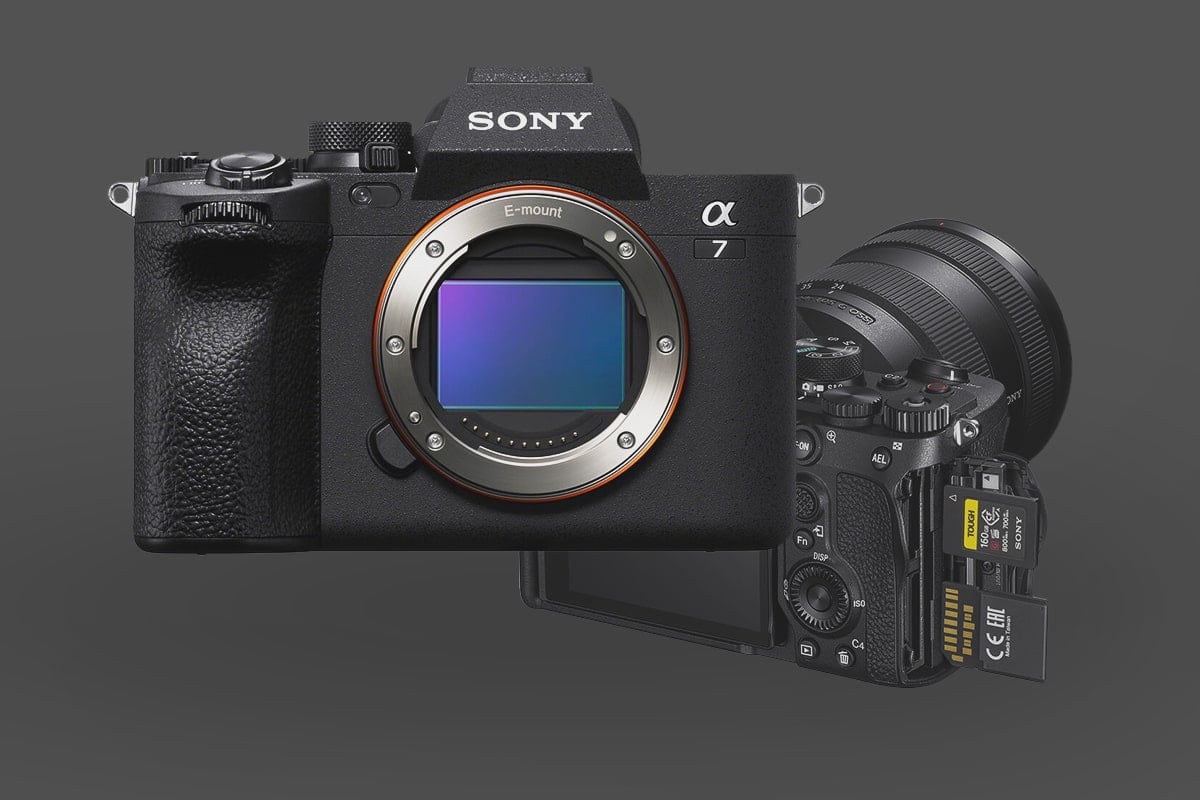
The A7 IV has an asymmetric dual-slot setup that catches a lot of new owners off guard: Slot 1 accepts either a CFexpress Type A card or a UHS-II SD card; Slot 2 is UHS-II SD only. That difference matters more than it sounds — your slot configuration mode determines which card tier you actually need in each slot.
I’ve run over 30 cards through this camera. The short version: you don’t need CFexpress for most shooting. The A7 IV’s internal bus caps at 325 MB/s, which mid-tier CFxA cards already saturate. Cards claiming 900 MB/s read speeds don’t move any faster in this body — the bottleneck is the camera, not the card. What actually matters is matching your card tier to how you shoot.
Sony A7IV CFExpress Type-A Memory Card Recommendations
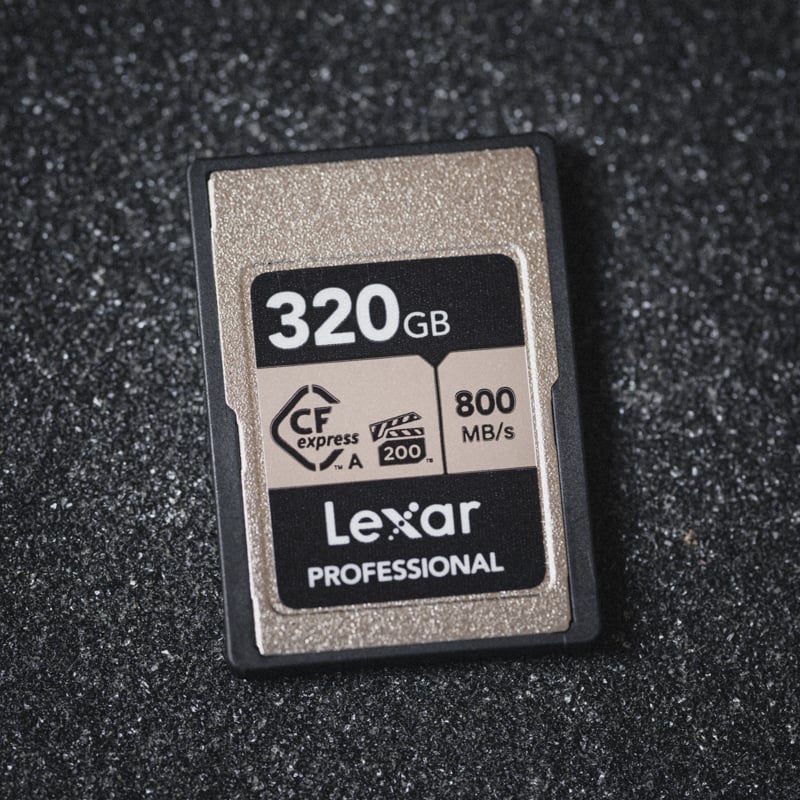
Unlike the Sony A7rV with its Dual CFxA configuration, the Sony A7IV has only Slot 1 with a dual CFexpress Type-A and UHS-II SD card configuration, so you only need one CFexpress Card.
I recommend looking at the Lexar Silver or Pergear Standard CFexpress Type-A cards. The value is unbeatable, and they are more than fast enough for the Sony A7IV. There are also new CF4.0-type memory cards, but the camera and, likely, your computer cannot use them yet. Only buy them if the price is right.
Here is a list of other great options, including the new CF4.0 cards, which hit the market in 2025.
| Recommended For Sony | USB Write | USB Read | Check Price | |
|---|---|---|---|---|
| CFExpress Type-A | Hide | |||
| Sony G Tough CF4.0 240/480/960/1920GB | 1552 | 1614 | Amazon / B&H | |
| Sony M Tough 960GB | Sony M Tough CFExpress Type-A Review | Amazon / B&H | ||
| Lexar Gold 80/160GB/320GB | 781 | 816 | Amazon / B&H | |
| Delkin Black 80GB | 602 | 805 | Amazon / B&H | |
| ProGrade Iridium CF4.0 480-960GB | 1502 | 1616 | Amazon / B&H |
SD Memory Card Recommendations: Managing the Dual-Slot Mismatch
The right card for Slot 2 depends on which recording mode you’re using — and the three options have meaningfully different speed requirements.
Simultaneous (backup): Both slots record the same content at once. The camera writes no faster than the slower card — a V30 in Slot 2 will drag down a CFxA in Slot 1. Use V90 minimum in both slots.
Relay: Fills Slot 1 first, then automatically switches to Slot 2 when it’s full. Both cards still need to sustain your recording bitrate — at 600Mbps XAVC S-I, Slot 2 needs V90 or better.
Sort (RAW/JPEG split): Routes RAW to one slot and JPEG to the other. The JPEG data stream is much smaller, so the JPEG slot barely matters for speed — a V30 card works fine there.
For most people: CFxA in Slot 1 and V90 in Slot 2 covers every mode safely. If you’re shooting JPEG overflow or single-slot only, V60 in Slot 2 is sufficient.
| Recommended For Sony | Review Links | USB Write | USB Read | Check Price |
|---|---|---|---|---|
| SD UHS-II V90 | Hide | |||
| SD UHS-II V60 | Hide | |||
| Lexar ARMOR Gold V60 256GB-1TB | 179 | 252 | Amazon / B&H | |
| Kingston Canvas React Plus V60 128GB | 101 | 276 | Amazon | |
| Sony M Tough V60 64-512GB | Sony M V60 UHS-II Review | 155 | 277 | Amazon / B&H |
| Sony E v60 256GB | Sony E Series V60 256GB Review | 183 | 275 | Amazon / B&H |
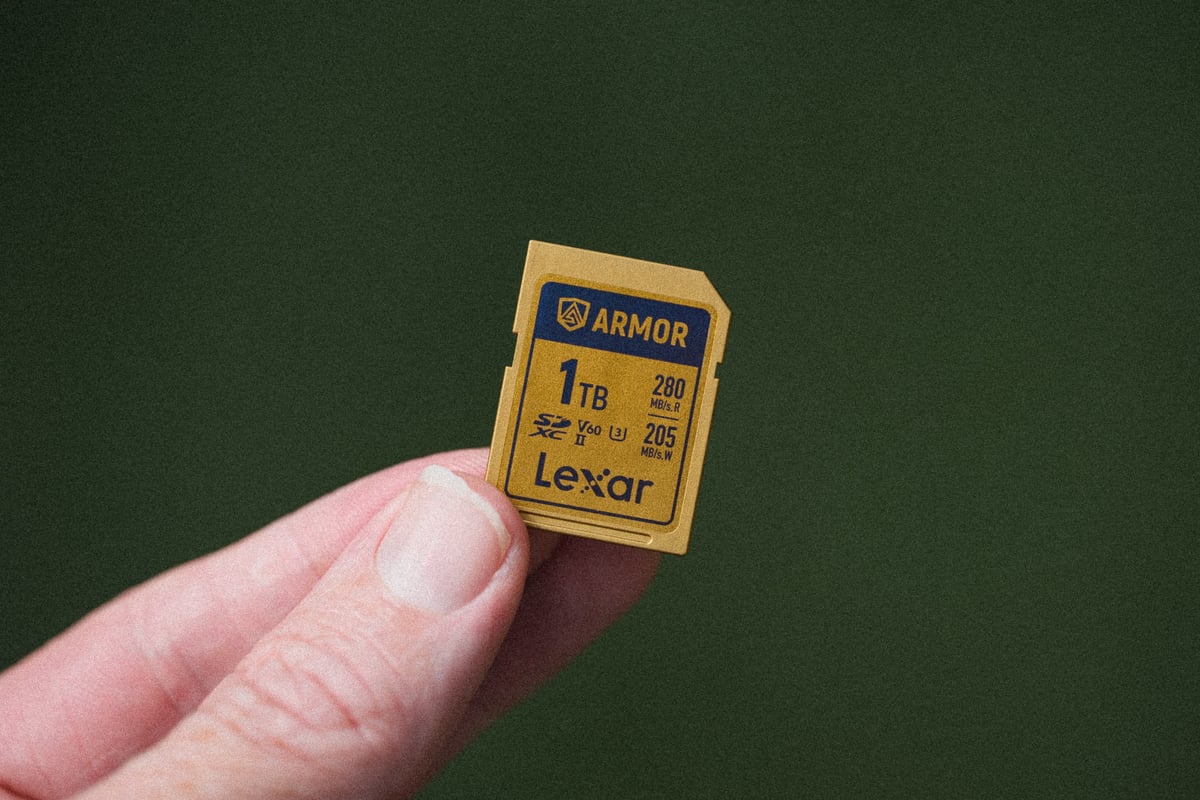
For a Tough card, the new Stainless steel Lexar ARMOR cards are a great alternative to the Sony TOUGH M cards. I recommend using tough-style cards if you don’t need the write-protection switch, since plastic cards tend to break more often. Compare the prices of Sony Tough cards and Lexar ARMOR cards, and choose the most affordable option. Both are fantastic cards.
Both slots use full-size SD card housings. MicroSD cards work with an adapter, but from experience they can lose connection inside the adapter — I wouldn’t use one for anything critical. See the microSD memory card guide if you need to use one.
How should each type of memory card perform in the Sony A7IV
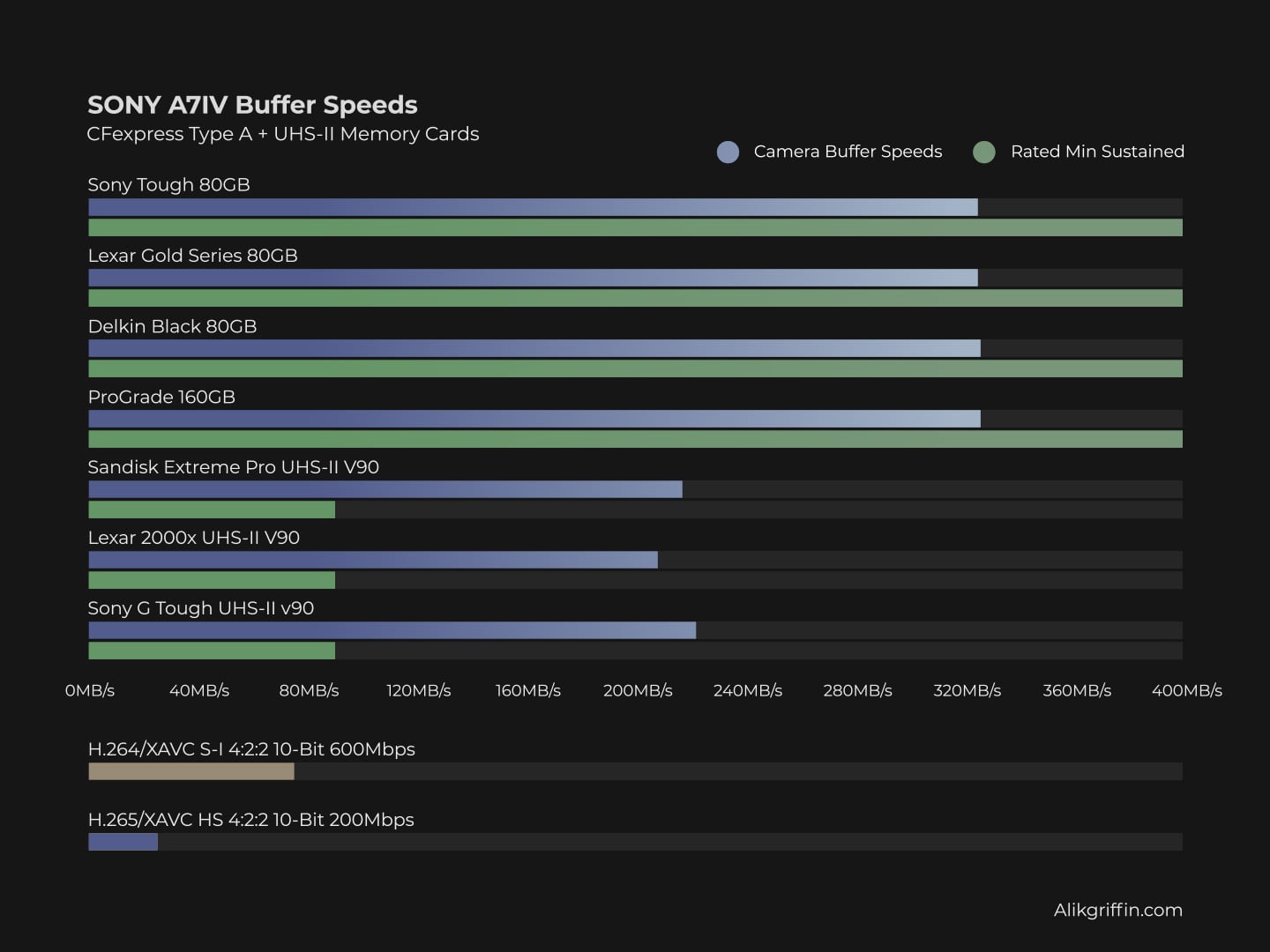
- CFxA Cards—The CFxA cards are the fastest memory cards for the Sony A7IV, topping out at speeds of 326MB/s. These cards aren’t necessary for the Sony A7IV, but if you want a nearly bottomless buffer, the CFexpress Type A cards are great.
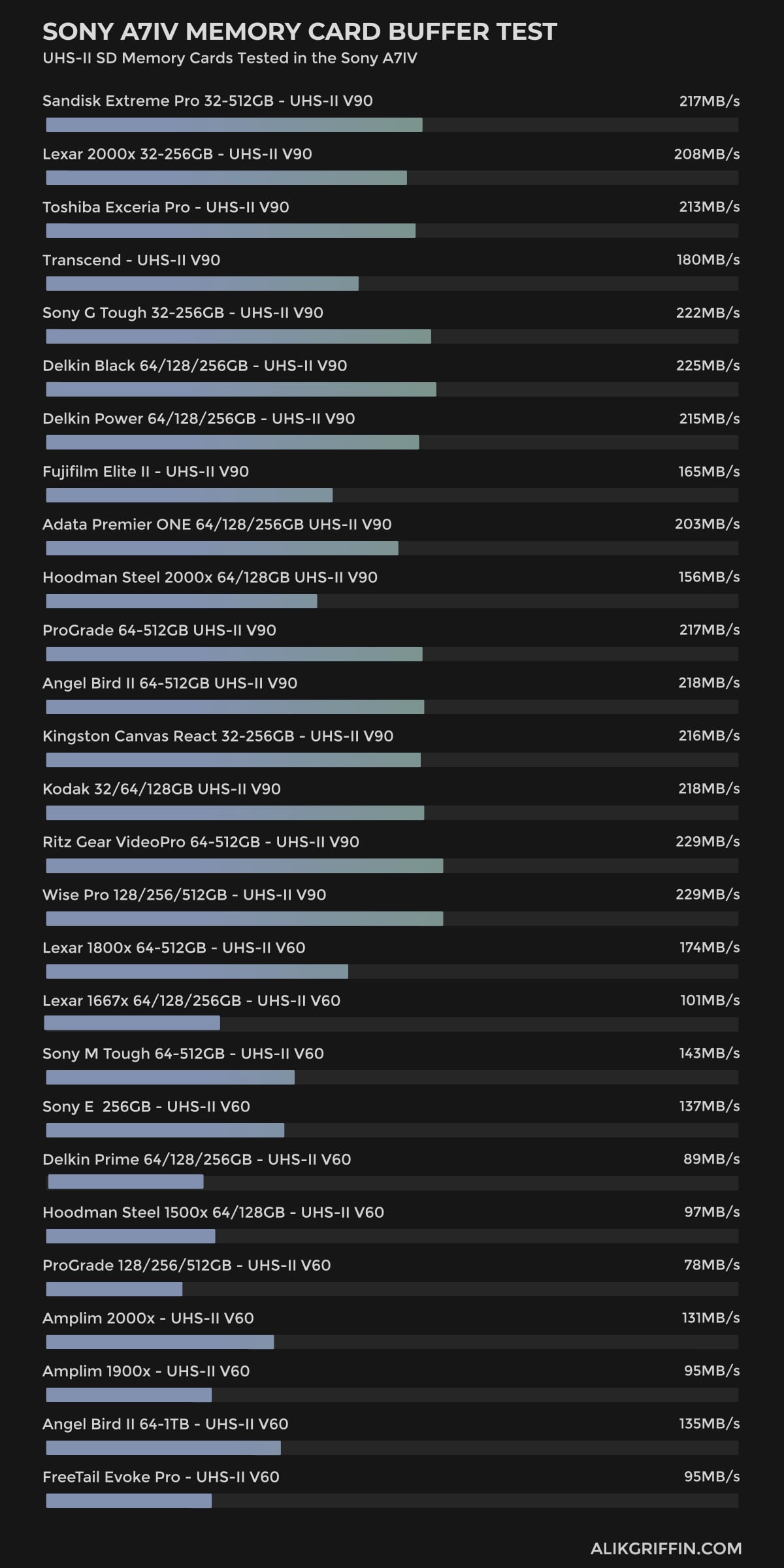
- UHS-II V90 Cards—These are the best SD cards for most people with the Sony A7IV, as they support all the camera’s frame rates and video modes. The fastest card I tested was the Sony G Tough v90 64GB model, which achieved a read speed of 222 MB/s. However, now budget CFxA cards are often less expensive and perform better than v90 SD cards.
- UHS-II V60 Cards—These are the best memory cards for casual video shooters and photographers who want much more data at a lower cost. However, you will be limited by some recording formats. These are also the best budget-friendly cards for casual photographers. The fastest V60 card tested was the Lexar 1800x V60, which achieved a read speed of 174 MB/s.
Sony A7IV Memory Card Speed & Buffer Tests
I tested every memory card I had in the Sony A7 IV and have included a few charts for your reference.
The “Maximum Speed” Reality Check
Through extensive in-camera testing, I’ve found that the Sony A7IV bottlenecks at approximately 325 MB/s.
What does this mean for you? It means that even though some new CFexpress Type A cards claim 900 MB/s speeds, you won’t see a difference in your burst shooting performance. The A7IV’s internal bus simply can’t push data faster than that. My advice? Don’t pay a premium for the “fastest” specs—stick to reliable, mid-tier cards like Lexar Silver or Pergear, which easily hit that 325 MB/s ceiling.
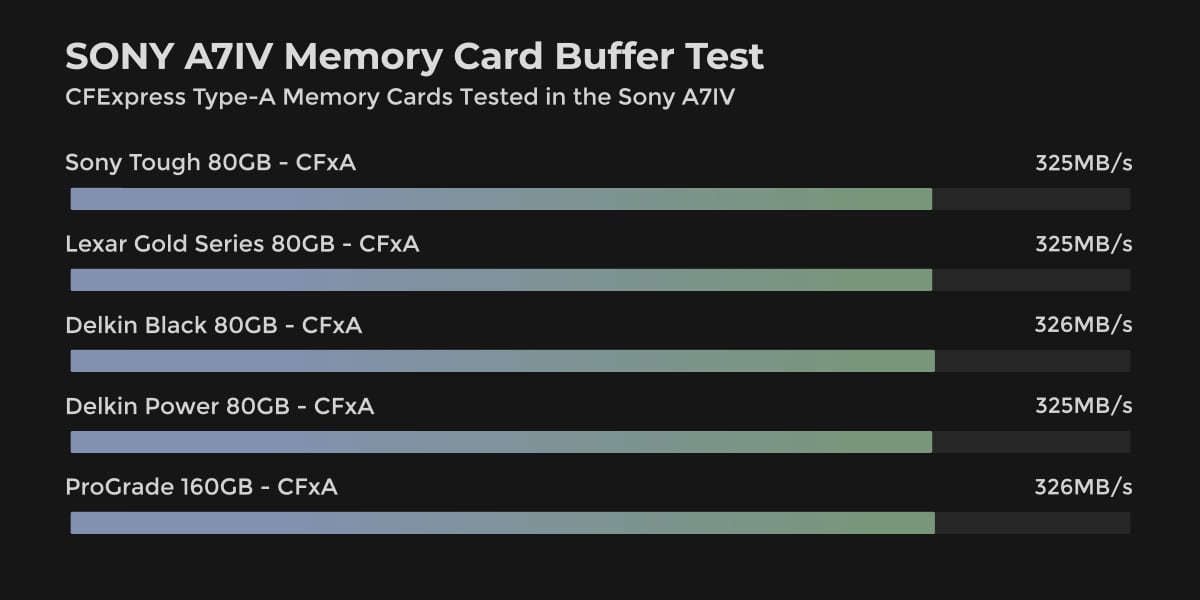
Chart Testing UHS-II SD Cards
Sony A7IV Memory Card Performance Chart
This is a text-based table showing the in-camera performance of each memory card type I tested.
| Sony A7IV Memory Card Tested | A7IV In-Camera Speeds | ||||||
|---|---|---|---|---|---|---|---|
| CFExpress Type-A | 1 | Hide | |||||
| Lexar Gold 80/160GB/320GB | 400 | 781 | 816 | 645 | 325 | Amazon / B&H | |
| Delkin Black 80GB | 400 | 602 | 805 | 220 | 326 | Amazon / B&H | |
| SD UHS-II V90 | 1 | Hide | |||||
| Delkin Power v90 64GB-2TB | 90 | 90 | 248 | 287 | 235 | 215 | Amazon / B&H |
| Angel Bird V90 II 64-512GB | 90 | 90 | 271 | 288 | 258 | 218 | Amazon / B&H |
| Lexar 1667x V60 64/128/256GB | 60 | 60 | 109 | 254 | 100 | 101 | Amazon / B&H |
| Sony M Tough V60 64-512GB | 60 | 60 | 155 | 277 | 152 | 143 | Amazon / B&H |
| Sony E v60 256GB | 60 | 60 | 183 | 275 | 177 | 137 | Amazon / B&H |
| ProGrade V60 128/256/512GB/1TB | 60 | 60 | 78 | Amazon / B&H | |||
| Angel Bird V60 II 64-1TB | 60 | 60 | 146 | 263 | 141 | 135 | Amazon / B&H |
| ProGrade Cobalt CF4.0 1.3TB | 2800 | 326 | Amazon | ||||
| Delkin Black 150/325/650GB | 1300 | 1528 | 1545 | 1421 | 174 | Amazon / B&H | |
| Delkin Black G4 325GB | 1450 | 1396 | 1538 | 1396 | 222 | Amazon / B&H | |
| Delkin Black 128GB | 1431 | 1035 | 1304 | 208 | Amazon / B&H | ||
| Delkin Black 75GB | 1195 | 1573 | 1195 | 217 | Amazon / B&H | ||
| Wise 1TB/2TB Mk II | 1300 | 1525 | 1121 | 1514 | 89 | Amazon / B&H | |
| Wise Pro MkII CF4.0 660GB/1.3TB | 3400 | 217 | Amazon / B&H | ||||
| Wise Pro 640GB | 1400 | 203 | Amazon | ||||
| Wise 512GB Mk II | 850 | 936 | 1236 | 847 | 225 | B&H | |
| Wise Pro 160/320GB | 1300 | 1257 | 1536 | 1281 | 180 | Amazon / B&H | |
| Wise 128GB/256GB | 140 | 190 | 1023 | 142 | 216 | Amazon / B&H | |
| Sony G Tough 80/160/320/640GB | 400 | 658 | 847 | 276 | 325 | Amazon / B&H | |
| Delkin Power 80GB | 400 | 641 | 847 | 133 | 325 | Amazon / B&H | |
| Hoodman Steel 2000x V90 64/128GB | 90 | 90 | 155 | 249 | 90 | 156 | Amazon / B&H |
| Hoodman Steel 1500x V60 64/128GB | 60 | 60 | 99 | 273 | 60 | 97 | Amazon / B&H |
| CFTek Shooter 1TB | 1252 | 1563 | 1026 | 1175 | 218 | Amazon | |
| Pergear Ultra 1TB/2TB | 1300 | 131 | Amazon | ||||
| Pergear CFE 4.0 Type B 1TB | 1500 | 229 | Amazon | ||||
| Wise V90 Pro 128/256/512GB | 90 | 90 | 256 | 275 | 90 | 229 | B&H |
Sony A7IV Camera Specs
| Sensor: 33MP Full-Frame, Exmor R BSI CMOS Processor: BIONZ XR Image Processor Memory Card Slots: Slot 1 SD UHS-II / 1 CFe A, Slot 2 SD UHS-II Continuous Shoot: 10fps Compressed RAW Continuous Shoot: 5fps Lossless Compressed RAW Est. Buffer Size: 1GB RAW Shots To Fill Buffer: 65 shots Sony G Tough UHS-II, pretty much unlimited CFxA – Compressed RAW Max Memory Card Capacity: Unlimited Size 4k Datarate: H.265 200Mbps XAVC HS (25MB/s) / H.264 600Mbps XAVC S-I (75MB/s) |
Understanding Read/Write Speeds For A7IV Video Recording
Sony cameras reject memory cards that are out of spec. They will also reject that old Sony M card that was recalled.
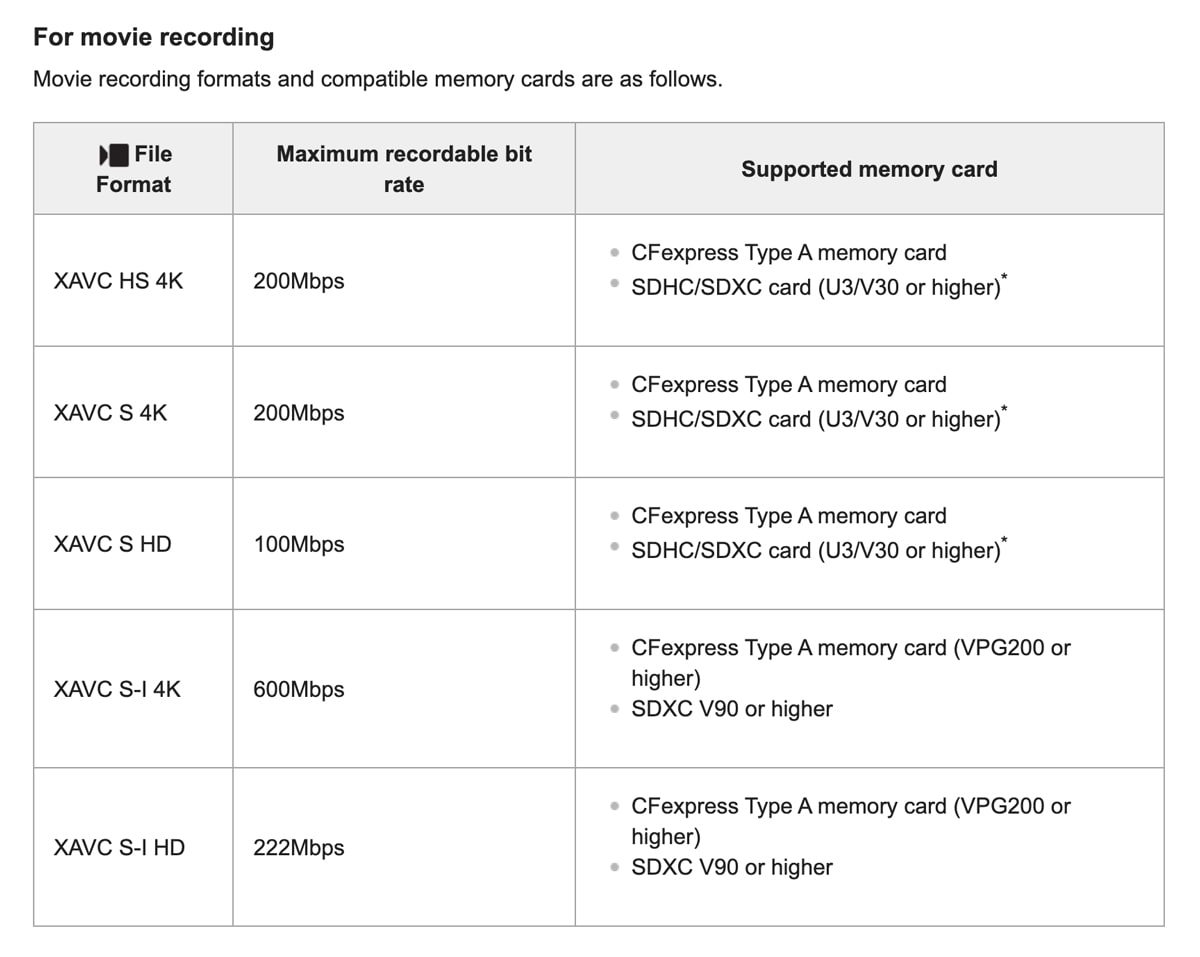
Sony cameras offer various movie recording options; here is a chart that displays the different bitrates of these options and the Supported memory cards.
S&Q Memory Card Shooting
Here are the memory cards required for the different S&Q modes.
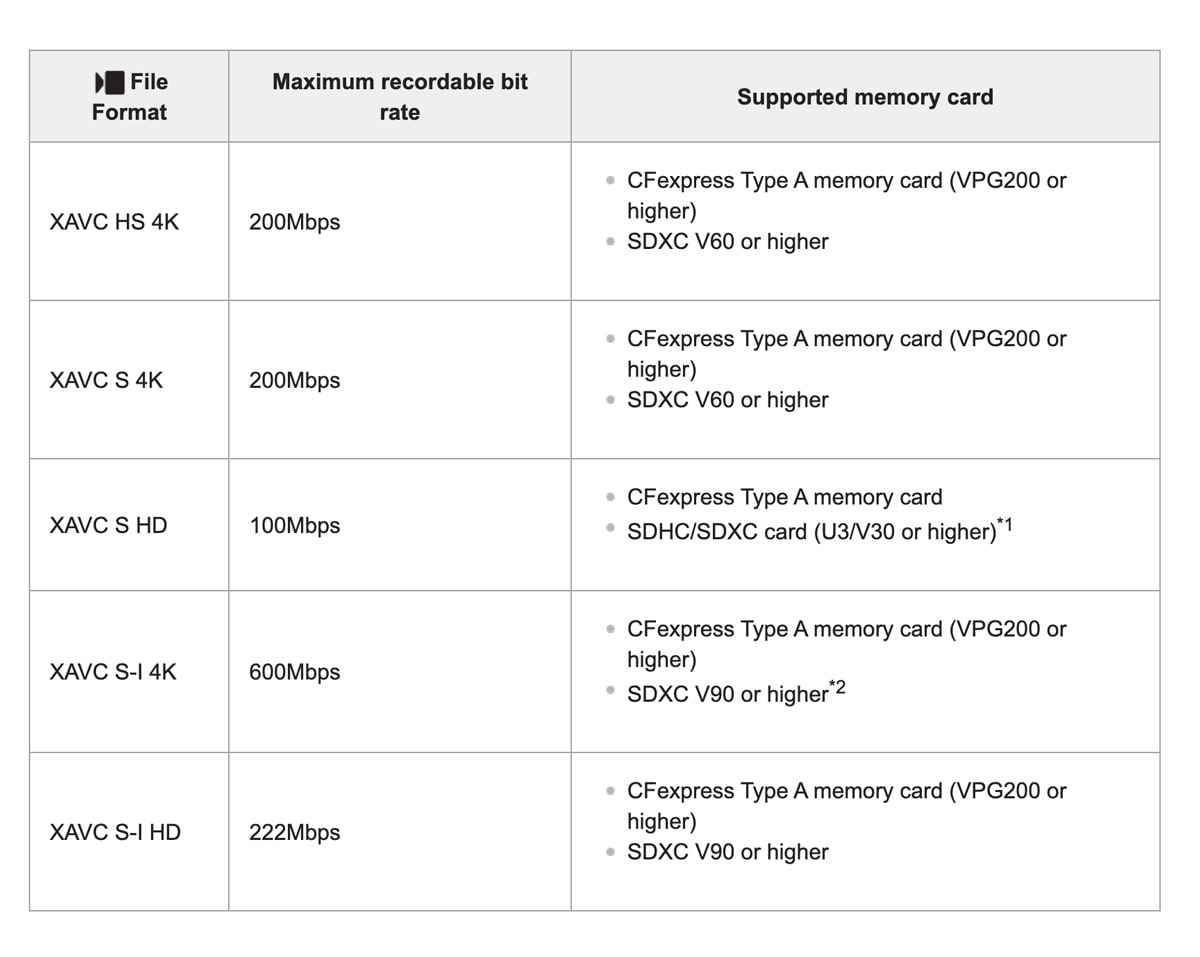
These charts are taken from the Sony Help Guide.
Sony A7IV Video Record Time
Pro Tip for Videographers: If you are shooting a long interview in 4K at 600 Mbps (XAVC S-I), a 128GB card will fill up in just 28 minutes. For event work, I strongly recommend moving to 512GB cards or shooting in XAVC HS (H.265), which gives you nearly 3 hours of footage on that same 128GB card without a massive drop in quality.
You can also use my camera record time calculator to customize your results.
| Format | Bitrate | Frame Rate | 64GB | 128GB | 256GB |
| XAVC S-I 4k | 600Mbps | 120, 60, 30, 24 | 14min | 28min | 57min |
| XAVC S-I HD | 222Mbps | 120, 60, 30, 24 | 38min | 77min | 154min |
| XAVC HS 4k, XAVC S 4k | 200 Mbps | 120, 60, 30, 24 | 43min | 85min | 171min |
| XAVC S HD, XAVC | 100 Mbps | 120, 60, 30, 24 | 85min | 171min | 341min |
Sony A7 IV Memory Card FAQ
Do I actually need CFexpress Type A for the A7 IV?
No — not for most shooting. The fastest V90 UHS-II card I tested hit 222 MB/s read in-camera, which handles everything the A7 IV shoots including 4K at 600Mbps. Where CFxA makes a real difference is buffer depth: V90 clears at around 65 RAW frames before slowing; CFxA is effectively unlimited at this camera’s write speed. If you regularly shoot sustained bursts, CFxA also gives you effectively unlimited buffer depth. And at this point, budget CFxA cards like the Lexar Silver and Pergear are often cheaper than comparable V90 UHS-II SD cards — so unless you already own V90 cards, CFxA is the better buy for most people.
Can I use a V60 card for 4K on the A7 IV?
For most 4K modes, yes. XAVC HS at 200Mbps and XAVC S-I at 600Mbps both write well within V60 sustained speeds. Where V60 can cause issues is dual-slot simultaneous recording at high bitrates — in that scenario, you need both cards sustaining the full write rate, and V90 in both slots is the safer choice.
Why is my buffer slow even with a fast card in Slot 1?
Almost certainly a dual-slot mode issue. In simultaneous (backup) mode, the A7 IV writes at the speed of the slower card regardless of what’s in Slot 1. Check your slot recording mode setting — either switch to overflow mode or upgrade the card in Slot 2 to match Slot 1.
Do I need a CFexpress Type A reader to offload footage?
Only if you want fast transfers. CFxA cards don’t fit a standard SD reader, so you’d need a dedicated CFexpress Type A reader to access those speeds on your computer. In-camera performance doesn’t require one — but offloading large shoots through a standard SD reader at 90 MB/s versus a CFxA reader at 700+ MB/s is a meaningful workflow difference.
If you found this guide helpful, you may also like my list of accessories for the Sony A7 IV. These are the accessories and brands I use with most of my cameras. For our full take on the camera itself, see the Sony A7 IV review.








Leave a Reply