
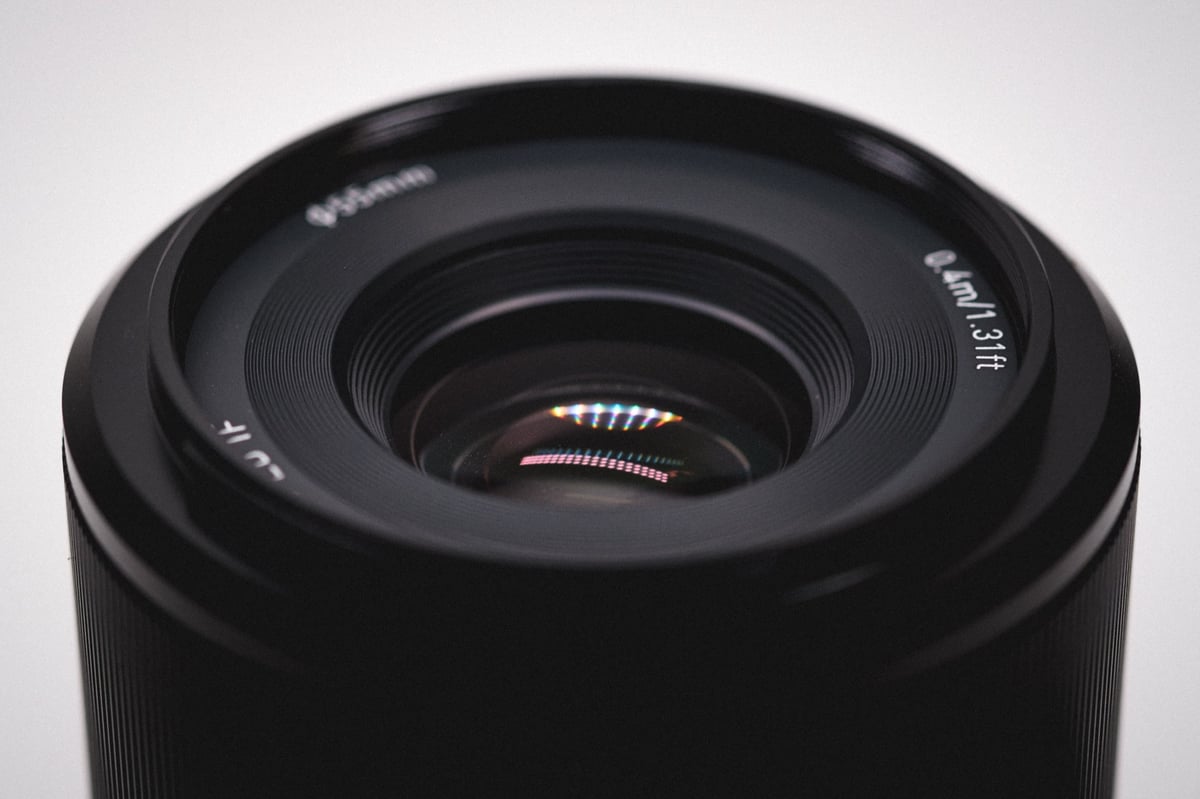
The Viltrox 35mm f1.8 is a full-frame autofocus lens for several camera brands, including Sony and Nikon. For this review, we’ll examine images taken with it on the Nikon Z6.
Lens Specs
Check Price Nikon Z, Sony E: Amazon / Adorama / BHphoto
| Focal Length: 35mm Aperture Blade: 9 Aperture: f1.8 – f16 Elements: 10 elements in 8 groups Coatings: Multicoated Weather-Sealed: Not Mentioned Minimum Focus Distance: 15.7″ / 40 cm Filter Threads: 55mm Weight: 13.1 oz / 370 g |
Viltrox 35mm f1.8 Review | Impressions
Some good, some bad, mostly good.
I’ll start by sharing my general thoughts on using these third-party brand lenses.
Initially, I held off on getting a Viltrox lens since I could afford just using the Nikon or Fujifilm lenses, and I didn’t want to spend a pretty decent amount of money on another lens that wasn’t 100% compatible with the camera, especially when the main system lenses are already so good. These Viltrox lenses are fairly inexpensive, but not that inexpensive. I’ll explain why in a little bit.
The burning question is, how big is the difference between these third-party lenses and brand-name lenses?
The answer is, it’s not big at all. However, the official lenses, at least the Nikon 35mm Z, are just a little better at just about everything. The Viltrox lens has a slightly different look. A little punchier overall, whereas the Nikon is a bit dreamy.
The Viltrox 35mm f1.8 is half the cost of the Nikon Z 35mm f1.8, or about half the price of the Sony 35mm f1.8. While I would typically just say, save up a few hundred more dollars and buy the official Sony, Nikon, or Fujifilm version of a lens when it goes on sale, this doesn’t work if you plan to own several lenses. Since you can buy the Viltrox 85mm f1.8 Z lens and the 35mm f1.8 Z lens for the cost of just one Nikon lens at MSRP. So if you were needed to build out a kit of several lenses, that cost difference can add up to a lot.
My main reason for sticking with Nikon, Fujifilm, or Sony brand lenses for my setup is that warranty service is way easier to deal with, and you’re less likely to run into minor copy-to-copy issues or camera compatibility issues. Just be sure when going with any third-party lens, that you spend a solid amount of time evaluating it before your return window closes – If you’re in a country that has reasonable return policies.
Another problem I have with this particular 35mm as a Nikon shooter is that I just got the Nikon Z 40mm f2, a lens that is actually less expensive than this Viltrox, but is all-around pretty good. Of course, it’s a 40mm, not a 35mm, and the Viltrox does have a slightly prettier rendering, but the 40mm is still pretty good for the money.
That’s where my head is at with these Viltrox lenses, and why I haven’t been rushing out to review them. Viltrox makes nice lenses, especially this one, so let’s get into what makes it great.


What’s Great About The Viltrox 35mm f1.8
The optical design of this lens is fantastic. 10 elements, 2 ED, 2 aspherical, so it’s designed to address all the big issues.
Nanocoatings minimize flaring, providing great contrast and color in any situation. Maybe even a little more than the Nikon in this regard.
Very little focus breathing (great for video), with an internal focus element. No mention of weather sealing.
Optically, this lens is great. I have pretty much no complaints, aside from a bit of distortion. It renders very high-quality images that you would expect from big brands.

What’s Not Great About The Viltrox 35mm f1.8
There are a few little complaints I have about this lens.
The minimum focus distance is 40cm. That doesn’t seem like a lot, but when you compare it to all the other modern 35mm lenses, it starts to feel like a lot. I like getting close with 35mm like with my Nikon 35mm or my Fujifilm X100V, but with this lens, you just can’t get very close. By comparison, the Nikon Z 35mm f1.8 is 25cm, almost half, and the Nikon 40mm f2 is even 29cm.
It’s a pretty lengthy minimum focus distance for a 35mm lens. Almost feels like a Leica lens. My Voigtlander 35mm f1.7 is 50cm by comparison.
The built-in Aperture ring is a nice touch. I love that the ring clicks into the A mode, so you can just set it and use it like any Nikon lens, where you control your aperture with your front dial. Otherwise, the aperture ring is de-clicked; it’s also pretty stiff, not very smooth, and a little difficult to grip with the way it’s set up.
Those are pretty much my only issues with the build, other than the lens hood, which doesn’t give you confidence in how it snaps on.
Next, autofocus.




Autofocus
Autofocus is surprisingly good for non-official protocols on the Nikon Z6.
You should be a little careful with it, though, especially if you’re shooting landscape. 99% of the time it will lock on focus great with AF-S. Occasionally, at higher apertures, when shooting landscape photography, it will lock in focus a bit early as it’s seeking. Sometimes it front focuses slightly from infinity when it needs to be at infinity, or it might front focus a little. It’s very rare in AF-S, but it can happen.
In AF-C, autofocus is a little less reliable. What often happens is the lens front focuses, or the image is in focus, then, out of nowhere, it starts drifting and looking for focus again, so I was getting a lot of AF-C shots that weren’t in perfect focus.
Always check for new firmware, since Viltrox is pretty active with its tuning.
Overall, I’m pretty satisfied with this lens in AF-S mode, and it rarely gives me issues. I was even using it in AF-C mode a lot at first, and I was still pretty happy with the results, other than a few occasional missed shots. I personally now shoot with this lens only in AF-S just to be sure I’m getting the best results possible. If you’re familiar with the Fujifilm X100V, I can say with confidence that the Viltrox 35mm f/1.8 lens on the Nikon Z6 is better and more reliable than the X100V.
Build Quality
Build quality is pretty good with this lens. It’s an all-metal construction with a nice plastic lens hood.
The lens hood doesn’t click on the lens securely, but it stays on and hasn’t fallen off.
On the body of the lens is an aperture ring. It’s a de-click ring; however, it does click into the Auto position, which allows you to use it like any Nikon or Sony lens that doesn’t have an aperture lens.
If you want to use the lens’s aperture ring for manual aperture control, it’s a little cumbersome. The grooves for grip are only along the sides and back, which makes it a little difficult to grip at times. The ring doesn’t feel very smooth or buttery either. It’s a little metal-on-metal feeling.
This lens uses an internal focusing system and keeps focus breathing to a minimum.


Technical Overview
The image quality of this lens is good but not great. It won’t blow anyone away, but it still produces very satisfying results.
I do not have a perfect copy of this lens, so I’ll take sharpness samples from the best sections. That’s one of the problems with third-party lenses: it’s rare to get a lens that doesn’t show some sharpness variability across the quadrants. The good news is that this lens is tack sharp by f8 overall, which is where it matters. When shooting f1.8, the subject usually needs to be sharp, where the corners and edges will go out of focus anyway. I never noticed any issues with this lens until I was shooting resolution charts.
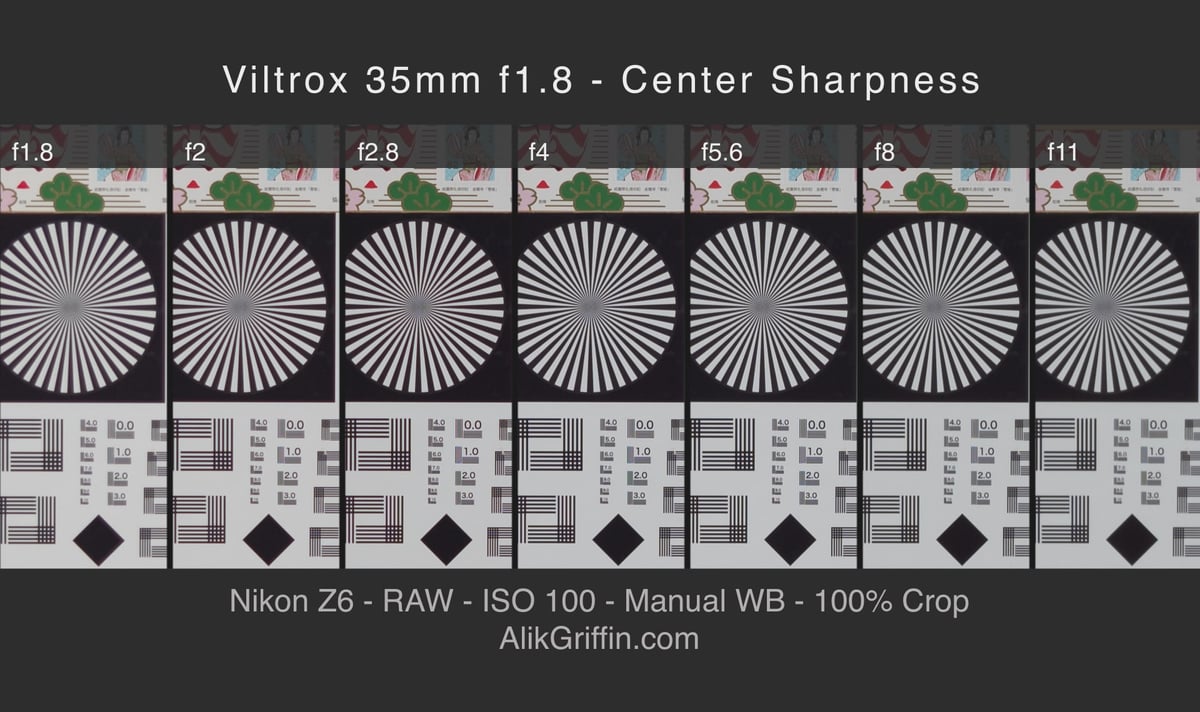
Center Sharpness
The center sharpness is pretty good. A modern lens by Nikon or Sony would probably be a little sharper in the center. Some of the more expensive lenses also handle diffraction a little nicer. Here you can see the image starting to soften up by f8, and this lens will go to f16. So landscape photographers will want to stay at f8 if possible and probably not want to shoot over f11, especially on a higher resolution camera.
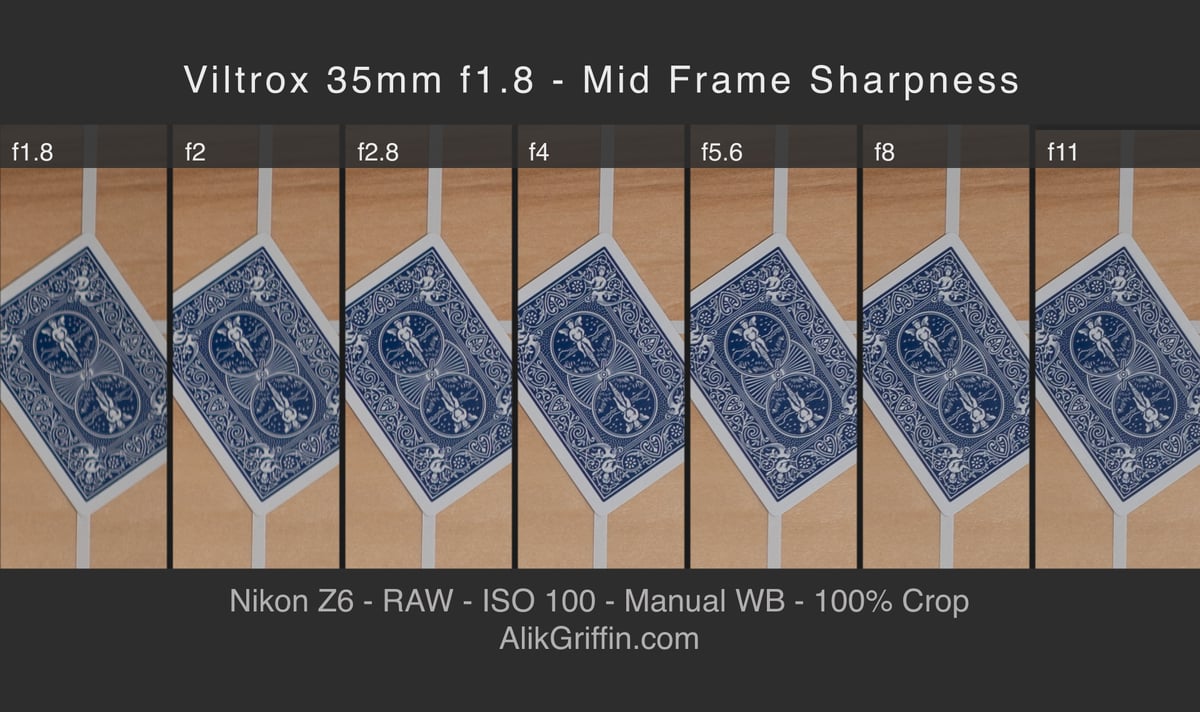
Midframe Sharpness
Midframe sharpness is just a little weak until about f2.8. Again, I’m about 5 feet from this chart. So any field curvature is easy to see.
You’ll want to be at about f8 to get the best results shooting landscape photography.
Again, I was taking the best-looking section of the lens. The left side of the lens is not as nice, a bit more smudgy.
Corner Sharpness
The corners are a little better than the midframe. The results here are good, and I was surprised.
You can see a little bit of distortion in those corners by looking at the circles. Hopefully, the Viltrox lens profile corrections clean this up when they come to Lightroom.
Ideal sharpness starts at f4, which is pretty good for a budget lens. Landscape or architectural photographers will want to use f/4 to f/8 for the best results.
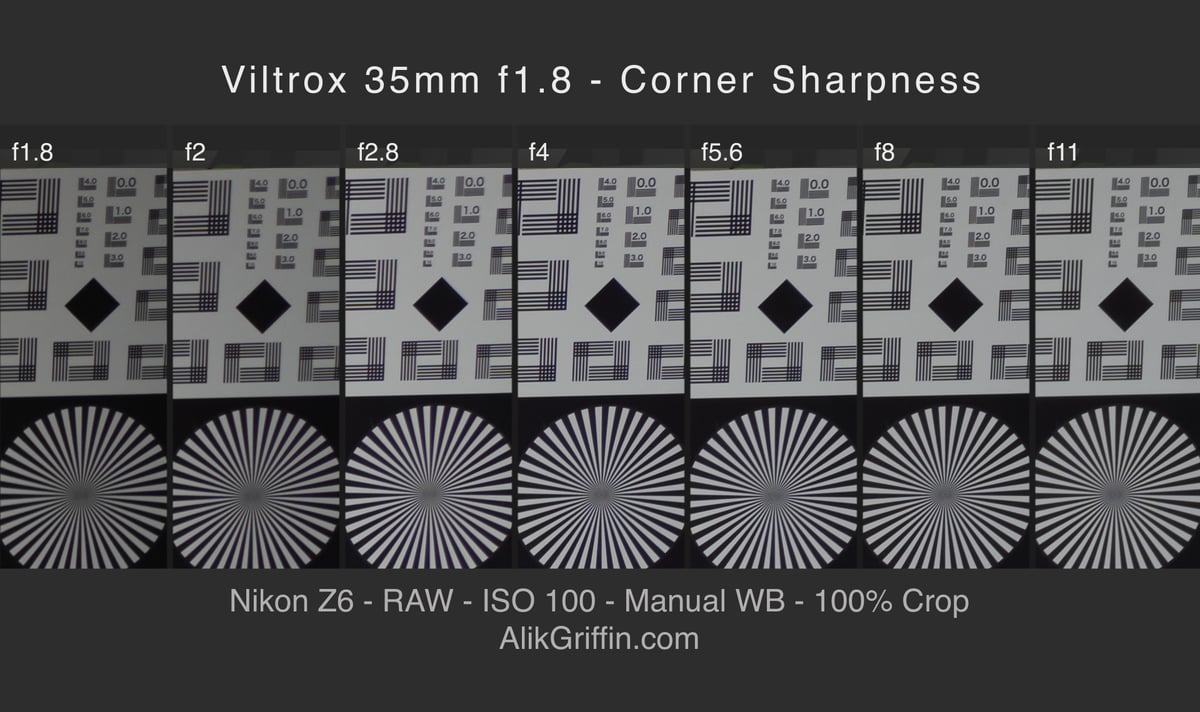
Overall, sharpness is pretty good with this lens. You would be very happy about the price if you got a perfect copy. Even with the lens not being a perfect copy, I’m still really happy with it in real-world results, especially for the price.

Distortion
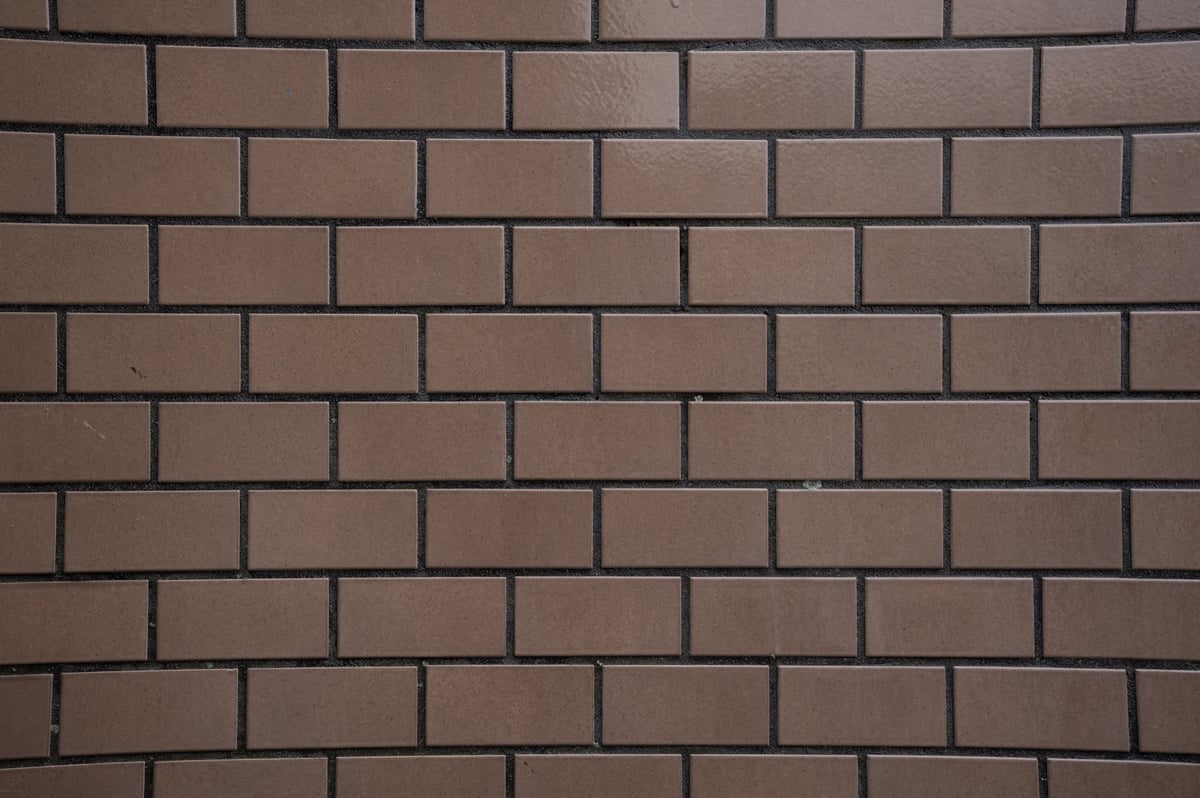
This lens has a little bit of distortion. This is one of the problems with third-party lenses: they don’t return lens profile corrections, as we see with Sony and Nikon lenses. So things like Distortion and Vignetting will have to be manually corrected. Sometimes, when stripping these profiles from the big-brand lenses, the distortion can be pretty bad. This Viltrox has some noticeable distortion, but it’s of a consistent shape and easy to correct. Again, profiles will likely be coming to Lightroom as they have with other Viltrox lenses.
For now, it’s about a -2 correction with the distortion correction tool.
Vignetting
There is a little bit of vignetting. It’s very feathered and comes almost to the center, which is nice. Often, vignetting is just very aggressive on the outer edges, but this one is a bit more feathered.
Overall, it’s not bad and easy to work with. I like a little vignetting anyway, if it looks nice, which this does.


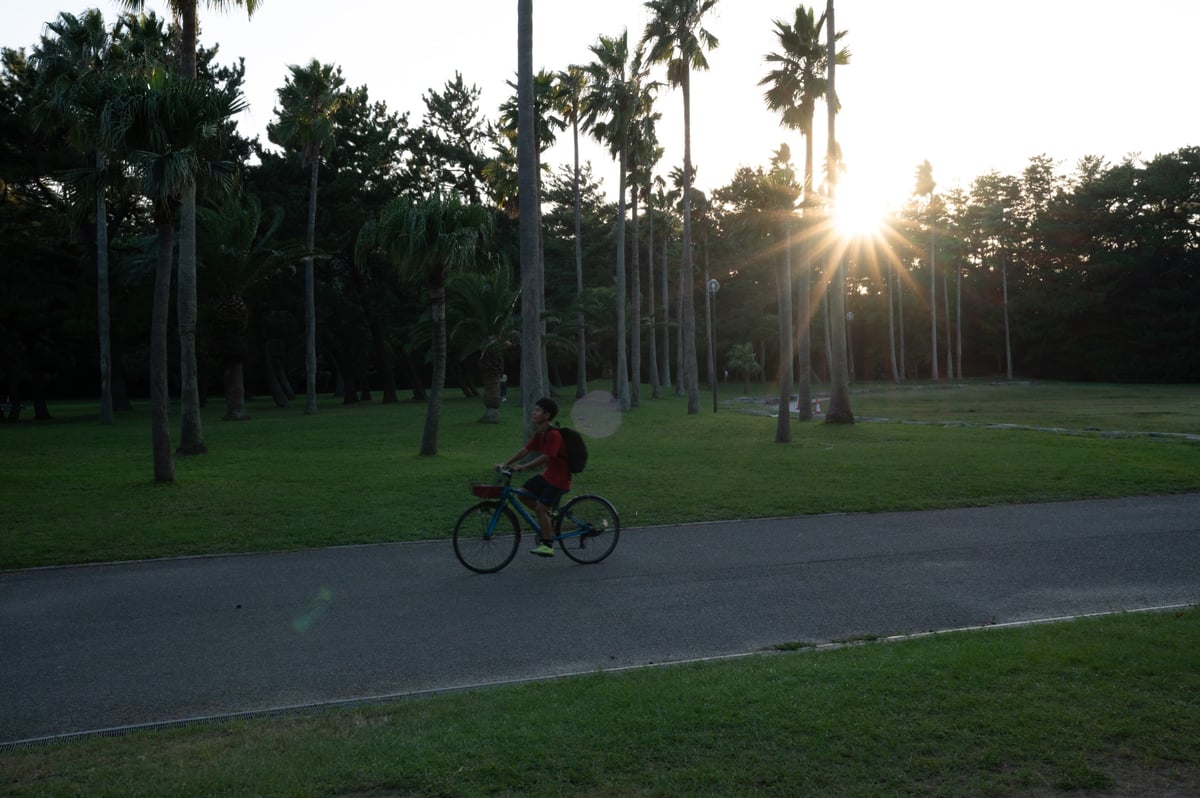
Sunstars
Sunstars are ok. Not the best, but not terrible either.
Bokeh
Overall, nice bokeh at close and distant distances.
Close Distance Bokeh Samples


Medium Distance Bokeh Samples


Bottom Line
Should you buy this lens?
I wish there had been lenses this good at this price when I was starting in photography. If you’re shooting more casually or want to eventually build a collection of cheaper lenses to save significant money, this lens is great. It’s a solid lens for $400 at launch, and I like it more than the Canon RF 35mm f/1.8.
Good sharpness, good distortion control, and vignetting control. Pretty good build, and decent autofocus. Nice-looking bokeh; overall, nice CA control.

Should you buy this lens instead of Sony or Nikon lenses?
Here is where I still stand on these mid-tier third-party lenses and why I don’t review too many of them. If you’re shooting professionally and want to buy a lens that will last you years, it kind of makes sense to just go with the official Sony or Nikon lens for your system, since both Nikon and Sony have great 35mm f/1.8 lenses.
There are a few reasons for this.
Better copy-to-copy precision with the Sony and Nikon lenses, very good warranty and repair services, baked-in lens profile corrections, and they have a little bit better image quality.
The official lenses are more expensive, but you’re getting more than just a better IQ, and the brand-name lenses may also last you longer. Also, if you’re a Sony or Nikon shooter and you ever decide to get an A1 or Z9, most brand-name lenses will have AF good enough to support their 30fps burst speeds, whereas third-party lenses will not.
Besides all that, when compared to the Nikon 35mm f1.8, this Viltrox lens has a rendering that’s significantly different, so I’d say if you want a bit more micro-contrast, this lens will do it a little better than the Nikon 35mm, which has a more dreamy rendering. I like this lens a little more for a gritty street look, but I prefer the Nikon for portraits.
I think the big question for Nikon shooters will be: should I get the 40mm f/2 or the Viltrox 35mm f/1.8? From my experience, the 40mm doesn’t have as nice bokeh; it seems a bit more edgy and nervous, and the corners aren’t as sharp.
If you ever want to browse lenses, I keep an updated list of all the full-frame Sony lenses and all the full-frame Nikon lenses.
Viltrox 35mm f1.8 Sample Photos
Check Price Nikon Z, Sony E: Amazon / Adorama / BHphoto
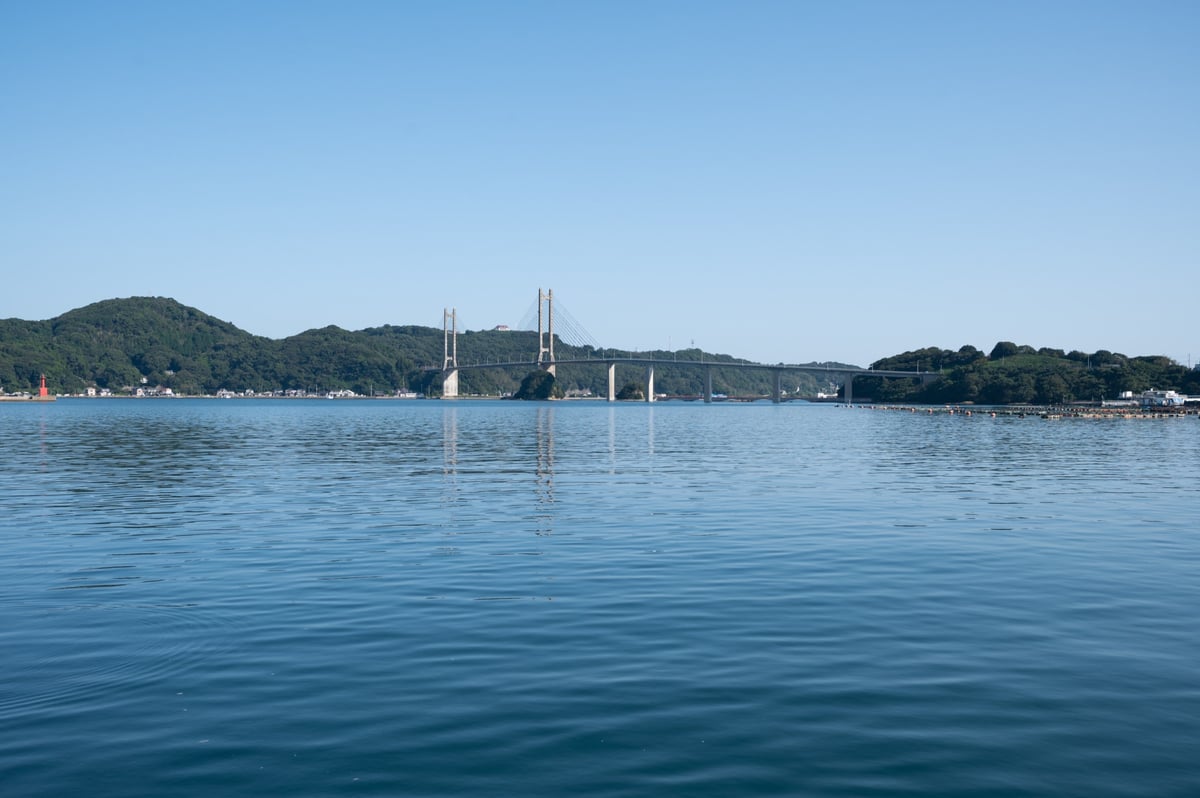
These are all shot on the Nikon Z6, colored with my presets.


Some of these were at f1.8, and the camera couldn’t keep up. f4 was a lot nicer. The shutter needed to be over 1/200 with this lens.










Leave a Reply