
Typically as photographers, we are taught, that the smaller the aperture the sharper and crisper your image is going to be.
Have you ever gone online and looked at an awesome photo’s EXIF data? Have you ever noticed almost all the landscape and HDR photos you see will be shot at f16 or higher?
If you’re always shooting high apertures for your landscape photos, you should consider dialing back and learning your lenses. Especially if you’re shooting on a camera with a high pixel density sensor like the Sony A7r, or many of the new APS-C systems.
Why Would I Want To Shoot With Small Apertures To Begin With?
I’ll explain the basics real quick for those who are new to photography.
The lens aperture is the pupil of your camera lens. It controls how much light passes from your lens to the sensor.
A high aperture number (or smaller aperture diameter) is something around an f16 to an f22, some lenses even go higher. F32 etc.
The higher your aperture number, the more in focus everything is going to be, and the deeper your depth of field.
Lower Apertures like f1.8, f2.4, and f5.6 will give you a relatively shallow depth of field, giving you that ‘blurry background effect.’
Shooting a higher aperture is nice for landscape photography because it will let the whole image be in focus, giving you a nice crisp image. But there is a limit, and the image will quickly begin losing detail if you go too high.
Why You Should Stop Shooting With Small Apertures
There is one very simple reason. Diffraction.
What Is Diffraction?
Diffraction is when a wave, (in this case light) spreads out when passing through a small slit, or aperture. Or pretty much across any type of edge.
The smaller the aperture the more a wave bends. Here is the math.
Sinθ = 1.22λ / D. Where λ is the wavelength.
As a wave passes through a boundary, it will attempt to spread out to fill the medium. It’s observable when you see waves bend around a jetty in the ocean. With light, it occurs at the microscopic level because light is such a small wave ranging from 0.7 microns in the reds to 0.4 microns in the violets. Which is why you can see blue light better than red light. It diffracts less.
Sources: http://goo.gl/o6kfGM
How Does This Affect Photography?
Rayleigh’s Criterion which is the generally accepted criterion for resolving minimum detail, basically says you can see things that are smaller if your eyes are bigger. That’s why deep water sea animals, where the light is dim, have giant eyeballs. Like the giant squid. This is because of diffraction, larger pupils help the animal resolve smaller details. Ever notice little baby fish always have such big eyes?
Now the same principle applies to our cameras. A larger aperture helps the camera resolve detail. But wait, you might be thinking, “No, when I stop down, my image gets sharper.” This actually has more to do with the depth of field, focusing, Snell’s law, and wavefronts. Basically, all the physics of a three-dimensional image are focused by various lenses and intersecting with a single plain, which is our camera’s sensor.
More about that here: http://goo.gl/NmWdpc, http://goo.gl/oiXxmL
Back To Diffraction – The Math
With Diffraction, once you get to a point where the aperture gets so small, it will begin to bend and diffract the light to the point of it being detectable by our microscopic camera sensor pixels.
The D800E and Sony A7r have pixels just under 5 microns at 4.878 microns. And the smallest spot or detail a lens can produce is 2.44 x the Fstop x the wavelength of light.
So at F19. You get a spot of (2.44 x 19 x 0.5) = 23.18 microns small.
So your spot size of 23.18 is spread across about 5 pixels.
And diffraction is really only noticeable when it’s roughly 3-4x the size of the pixel, assuming you have a perfect lens.
With the Sony A7r and D800E, you’ll have an f-stop resolution limit of about 14.634 – 19.512
Other Camera Pixel Sizes In Microns. (Also known as Pixel Pitch)
Nikon D800 – 4.878
Canon 5Dmkiii – 6.25
Canon 5Dmkii – 6.4
Sony A6000 – 3.917
Sony A77 – 3.917
Canon 7D – 4.3
Canon 70D – 4.1
Nikon D7100 – 3.92
Panasonic GH4 – 3.7
Phase One IQ280 – 5.2
Notice the APS-C and Micro 4/3 cameras have even smaller pixels? That means more diffraction at even lower apertures. If you ever get into an argument about why Full Frame is better than APS-C or M43 or why Medium Format is better than Full Frame, here is your mathematical proof. Pixel size. Bigger sensors usually have bigger pixels = better detail at higher f-stops. Of course, none of this matters if you’re a portrait shooter.
Practical Application
As you close down the aperture of your camera, the light will bend and diffract more around the iris. The amount the light-bending ends up spreading across more than one pixel, resulting in a softer less detailed image because of the distribution of dark and light fringing. Not as big of a deal with a camera with large pixels and high pass filters like the Canon 5Dmkiii. Or even other full-frame cameras with fewer megapixels and lower pixel density, like the Sony A7s.
Examples
The following diffraction tests were taken with the Sony A7r at different apertures cropped into 100%.
Here is how diffraction affects a few of my lenses on the Sony A7r. At any point, you can click the image to see a larger preview.
We’ll start with the Samyang 14mm. A great ultrawide for the budget and a staple for my landscape work.
Samyang 14mm F2.8

You can see the diffraction starts picking up at f13 and is visible at f16 but subtle. And at f22 the lens is unusable. I could see f16 maybe being fine on a camera like the 5Dmkiii with larger pixels and a highpass filter, but I now avoid it on this camera. I’ve found f13 to be the best.
Side note. So much for shutter shock being a problem on the A7r. These images are insanely sharp with a spread across different shutter speeds.
Canon 16-35mm F2.8L

Same as with the Samyang, diffraction starts affecting image quality at around f13. From f16 on it gradually increases until the catastrophe at f22. But again, on the Sony A7r, the f13 is significantly sharper than the f16.
Sony Zeiss Sonar 35mm f2.8 T*
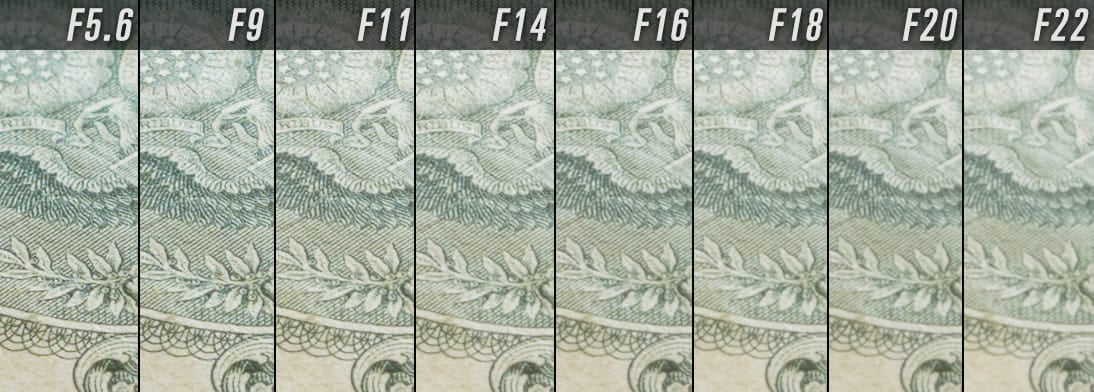
The Zeiss Sonnar surprised me. Image quality begins to drop off at f11. And quality drastically drops with a smaller aperture. Seems the sweet spot is around f5.6 to f9.
Also, you might be thinking the Zeiss is a lot less sharp than the other two. This is because my focus area is off a little. I’m actually focusing just shy of the leaves, and there is DOF falloff from there on because the dollar is more angled.
Photography Limited By Physics
We are now literally to the point where the detail we are able to image through cameras is limited by physics, not technology. Building cameras with more megapixels for more detail is pointless. Especially for landscape photography. We’ll have to build a larger sensor with less pixel density to achieve high detail at high apertures. Another reason Medium Format cameras have a one-up to full-frame and APS-C. Pixel density and diffraction.
It used to not be such a big deal with lower megapixel cameras where there wasn’t much pixel density. But with our new cameras today, especially ones with the high pass filter removed, like the Nikon D800E or the Sony A7r, the effects of diffraction are much more noticeable. And it’s even worse on cameras with greater pixel density. For example, the Sony A77 has a pixel size of about 3.917 microns.
Conclusions
If you’re a landscape photographer and you think shooting f19 will give you a better quality image, I recommend doing a few tests first. You will likely get better, more detailed images if you shoot f11 to f14.
This also means that the Canon 5Dmkiii really does sit right in that sweet spot, having a leg up when it comes to DOF over any of the higher megapixel cameras out there. Something you never see any reviews discuss. But what would you rather have? A bit more DOF? Or more megapixels? The thing is, with more megapixels, you can always scale down your 36 megapixel image to meet the equivalent resolution of a camera of 24 megapixels shot with a higher f-stop which hasn’t yet met its diffraction limit. As long as the sensor size is the same, the resolution of detail should technically be the same.
What aperture do you like to shoot your landscapes at?










Leave a Reply