
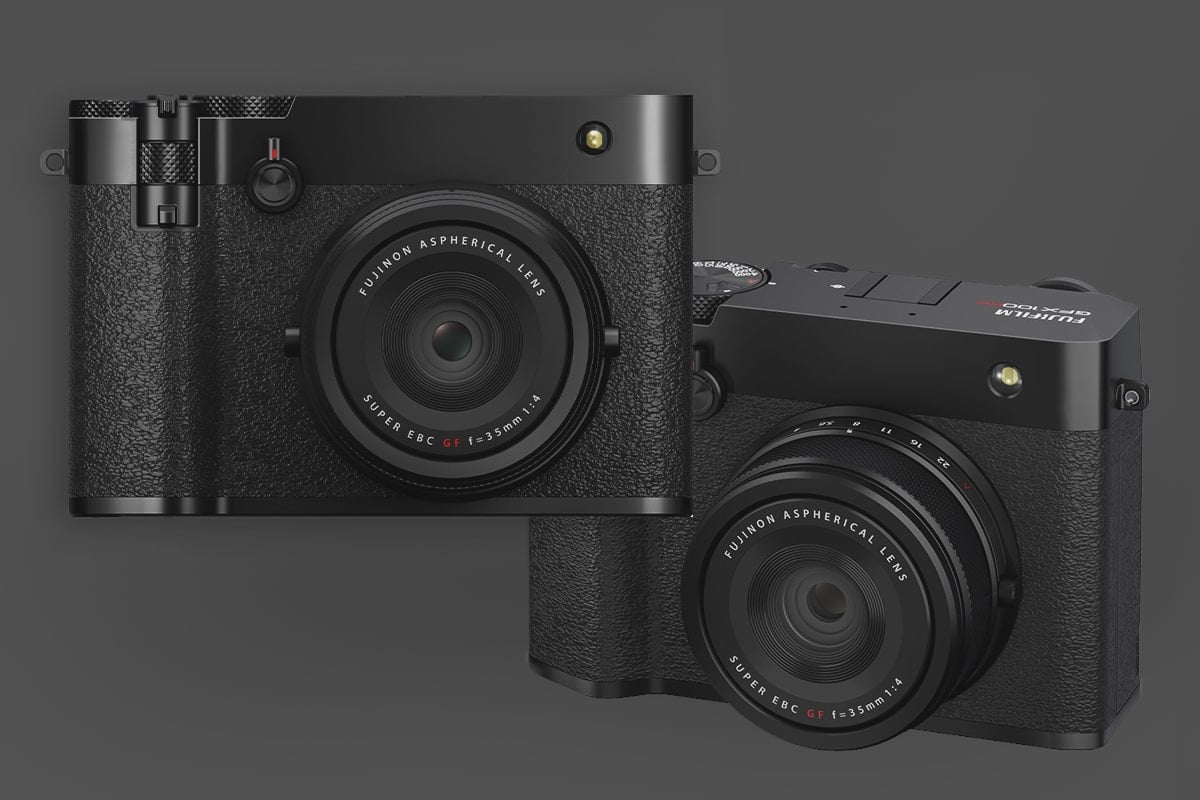
Something we’ve all been asking for for a long time is a Fujifilm X100-type camera, but full-frame or better. It’s easy money just sitting there, yet all the camera companies refuse to take this easy money.
Finally, Fujifilm has put together the “something better” option: the Fujifilm GFX100RF. However, the specs are a bit confusing at first glance.
Fujifilm GFX100RF – Is It A Miss?
The Fujifilm GFX100RF uses a 100MP sensor with a 35mm f4 lens but no IBIS. Yeah, that’s a bit of a head-scratcher. No IBIS with a 100MP sensor? So motion blur city.
I know Fujifilm has already said it’s impractical on this camera/body. They also said that when the X100V was released, and here we are, with the X100VI now with IBIS.
Why not do a 50MP sensor and make the camera cheaper? Is that possible?
I would have been happy with that. I don’t know if anyone or I need an ultra-mega resolution in a pocketable camera; it seems counterproductive, as many of us still edit on old laptops. I guess there is a possible supply chain situation here, and Fujifilm using the 100MP sensor is more practical. Using the same sensors in more cameras probably makes them cheaper for Fujifilm.
I Was Expecting More
At first glance, I was expecting a little more than what this camera offers, especially considering how the Leica Q3 is positioned. I was expecting at least a slightly faster lens or IBIS.
The Leica Q3 uses a Full Frame 60MP but has a 28mm f1.7 lens with optical stabilization. It does cost a little more, but since only Dentists buy these cameras, that difference is just giving somebody two or three additional fillings they don’t need.
Also, with the Leica Q3, you can bin that sensor down to 36MP or 18MP. A feature that Fujifilm needs to seriously consider.
The GFX100RF Concept Is Harder To Grasp
My main issue is the concept of the GFX100RF; with that f4 lens, it’s a very expensive point-and-shoot. I understand it’s a full-frame equivalent to a 28mm f3.16.
This full-frame equivalency worked better for the Fujifilm X100VI, being a full-frame equivalent to 35mm f3.
However, I don’t mind spending $1600 on an f3 point-and-shoot at 35mm. Spending close to $5k on a medium-format point-and-shoot at 28mm f3.16 is a totally different situation since it’s not really going to be great at any type of portrait photography where you want shallow depth. You’re spending a lot of money not to have that.
Yes, it has a medium format sensor, but is the compact lens actually good enough to really resolve that thing? And is it just a mathematical clinical configuration of glass, void of all character? This is what Fujifilm has been doing with their modern lenses.
This thing may be getting a little too gimmickish, although, don’t get me wrong—I still really want one.
Ultimately, my problem with it is the 28mm equivalent lens. I know why they did it: You can crop it down to more focal lengths, adding more versatility, and I would love to have a pocketable 28mm camera by Fujifilm, like the Ricoh GR III. But for me, the beauty of having a larger sensor is taking advantage of the faster lenses with a shallower depth of field—something you can still see when posting to Instagram with its 2-megapixel setting.
Let’s look at the depth of field potential of the GFX100RF.
Depth Of Field Calculations
Now that I have my depth-of-field calculator fixed (thanks to Grok), let’s calculate the maximum depth of these cameras at 10 feet. The Circle of Confusion values for the sensor are listed. I know people say the GFX is 0.05, but I am not sure this is correct, given the .79x crop factor. 0.05 should reflect more the 645 MF system, so I set the GFX at 0.038. It assumes smaller sensors have higher pixel density, which results in shallower depth since the idea of the CoC is based on prints of equal size and resolution hanging on a wall at the same distance.
The Fujifilm GFX100RF (CoC 0.038) Medium-Format with a 35mm f4 lens with a depth of field at 8.69ft.
The Leica Q3 (CoC 0.03) Full-frame with a 28mm f1.7 lens with a depth of field at 4.09ft.
The Fujifilm X100VI (CoC 0.02) APS-C sensor, a 23mm f2 lens with a depth of field at 4.83ft.
From here, you can see the GFX’s maximum field depth is 8.69 feet, significantly less than the X100VI. Now, I know it’s a 28mm lens. But if you care about bokeh, the Leica Q3 beats all of them with a depth of 4.83 feet.
I would have preferred the GFX camera to have a 35mm equivalent lens instead of a 28mm equivalent lens. It would have made the camera a little more versatile in terms of its ability to capture depth.
So, if it had a 44mm lens (35mm equivalent) with an f4 aperture, that would have given us a depth of 4.99ft, Which is now similar to the X100VI.
This is why many people are more interested in the Leica Q3, although that camera with the larger lens isn’t quite as pocketable.
Let me now make a case for why the Fujifilm GFX100RF is amazing.
Fujifilm GFX100RF – Why It’s Better Than You Think
First of all, this camera is truly revolutionary—one of a kind. First of its kind. Technological magic. My mind is blown.
I shot a lot on the GFX100 II last year, and the image quality is truly at another level. However, I never got the GFX100 II because I don’t want to deal with a camera that big right now, and really, I don’t want to deal with collecting all-new lenses for a new system. The GFX100RF solves that problem for me.
The Versatility of the 100MP Sensor
With the 100MP sensor, you can crop to the FF sensor sizing, giving you that 35mm f4. You can also crop to APS-C and get a 50mm f4 while still having tons of resolution. It’s like the Leica Q3 with its crop modes, but better.
I know I would prefer shallower depth, but F4 isn’t that bad. I shoot on the Nikon Z 24-120mm all the time, and I used to love the Canon RF 24-105 f4 as well. It’s fine for landscape and travel.
28mm f3.16 Is Actually Really Fun
The GFX100RF has a full frame equivalent sensor and an aperture of about 28mm f3.16.
This is very close to, or at least close enough to, the Nikon 28mm f2.8, which I love shooting on, or even my Nikon 26mm f2.8, or even my Zeiss 28mm f2.8, or even my latest addition, the Kipon 24mm f2.4, which I love. The GFX100RF is less than a third of a stop away from that. You would never notice less than a third of a stop in any real-world shooting.
Again, it’s a very expensive 28mm f3.16, and with Google raining down the algorithmic holocaust on bloggers for this last year, I’m not making Dentist money with this site anymore.
Maybe one day I will buy the GFX100RF, but I will watch from the sidelines for now. It’s just a little too expensive for a massive sensor point-and-shoot, and I will wait in hopes that some other brand does something more affordable. I think potentially it will be Nikon doing some RF fixed-lens full-frame system. We’ll see.
The Lack Of Competition Is Crazy
I’ve worked in the game advertising industry for nearly 20 years now, and I see these companies chasing competition like their lives depend on it. The second the first big Battle Royale game hit, PubG, literally every big studio doing shooters got to work. Then we got Warzone, Fortnight, Apex, etc.
Maybe the camera world is just radically different from games and consoles, but I sit here, and I can’t help but notice that these camera companies consistently don’t do things that make sense. For example, GoPro just let DJI eat their lunch without any interest in releasing a Pocket competitor.
With the Fujifilm X100 camera hype that’s lasted five years now? Half a decade? And not one camera company has released a reasonable competitor? Seriously, the only competitor to Fujifilm is Fujifilm. At least Sony has tried to release compact Range Finder cameras in the past, but they had the Sony problem where all their cameras looked and felt like medical equipment.
Imagine Apple releasing earbuds making 18 billion a year and not being able to sell them fast enough, and then seeing Samsung and Google say, “Nah, we’ll sit this one out.” That’s what Sony, Canon, and Nikon are doing.









Leave a Reply to Arli li Cancel reply