Alik Griffin
San Clemente Sunset
Subscription Form
  • Reviews
    • Accessory Reviews
    • Calculators
      • Video Data Rate Calculator | Record Time Calculator
      • Diffraction Calculator
      • DoF Calculator | Lens Equivalent
      • Shutter Speed to Shutter Angle Calculator
    • Camera Reviews
    • Lens Reviews
    • Memory Cards Recommendations
      • Fastests SD Memory Cards
      • Fastest MicroSD Cards
      • Fastest CFExpress Type-B Card
      • Fastest CFExpress Type-A Cards
      • Best CFast Memory Card
    • List of Mics
      • Best Streaming & Podcast Mics
  • Camera Guides
    • List of all Blackmagic Cameras
    • List Of all Canon RF Cameras
    • List of all Fujifilm Cameras
    • List of all Nikon Z Cameras
    • List of all Panasonic Cameras
    • List Of all Sony E Cameras
  • List of Lenses
    • Canon RF Lenses
    • Fujifilm GFX Lenses
    • Fujifilm XF Lenses
    • L-Mount Lenses
    • Leica M Lenses
    • Micro Four Thirds Lenses
    • Nikon Z Lenses
    • PL Mount Cine Lenses
    • Sony E Lenses (FE and APS-C)
  • Store
  • My account
Alik Griffin
Alik Griffin
  • Reviews
    • Accessory Reviews
    • Calculators
      • Video Data Rate Calculator | Record Time Calculator
      • Diffraction Calculator
      • DoF Calculator | Lens Equivalent
      • Shutter Speed to Shutter Angle Calculator
    • Camera Reviews
    • Lens Reviews
    • Memory Cards Recommendations
      • Fastests SD Memory Cards
      • Fastest MicroSD Cards
      • Fastest CFExpress Type-B Card
      • Fastest CFExpress Type-A Cards
      • Best CFast Memory Card
    • List of Mics
      • Best Streaming & Podcast Mics
  • Camera Guides
    • List of all Blackmagic Cameras
    • List Of all Canon RF Cameras
    • List of all Fujifilm Cameras
    • List of all Nikon Z Cameras
    • List of all Panasonic Cameras
    • List Of all Sony E Cameras
  • List of Lenses
    • Canon RF Lenses
    • Fujifilm GFX Lenses
    • Fujifilm XF Lenses
    • L-Mount Lenses
    • Leica M Lenses
    • Micro Four Thirds Lenses
    • Nikon Z Lenses
    • PL Mount Cine Lenses
    • Sony E Lenses (FE and APS-C)
  • Store
  • My account
  • Viltrox 9mm f2.8 Air Review
    Viltrox 9mm f2.8 AIR Review & Sample Photos
    • January 14, 2026
  • Biker Bro
    Viltrox Spark Z3 Flash – Review & Sample Photos
    • January 14, 2026
  • Kalina Flower FIeld
    Nikon Z 50mm f1.4 Review & Sample Photos
    • April 13, 2025
  • TTArtisan 27mm f2.8 AF Front of Lens
    TTArtisan AF 27mm f2.8 Review & Sample Photos
    • March 8, 2025
  • TTArtisan 23mm f1.8 Product Shots
    TTArtisan AF 23mm f1.8 Lens Review & Sample Photos
    • February 5, 2026
  • Thypoch Simera 75mm f1.4 Review

    Thypoch Simera 75mm f1.4 Review & Sample Photos

    View Post
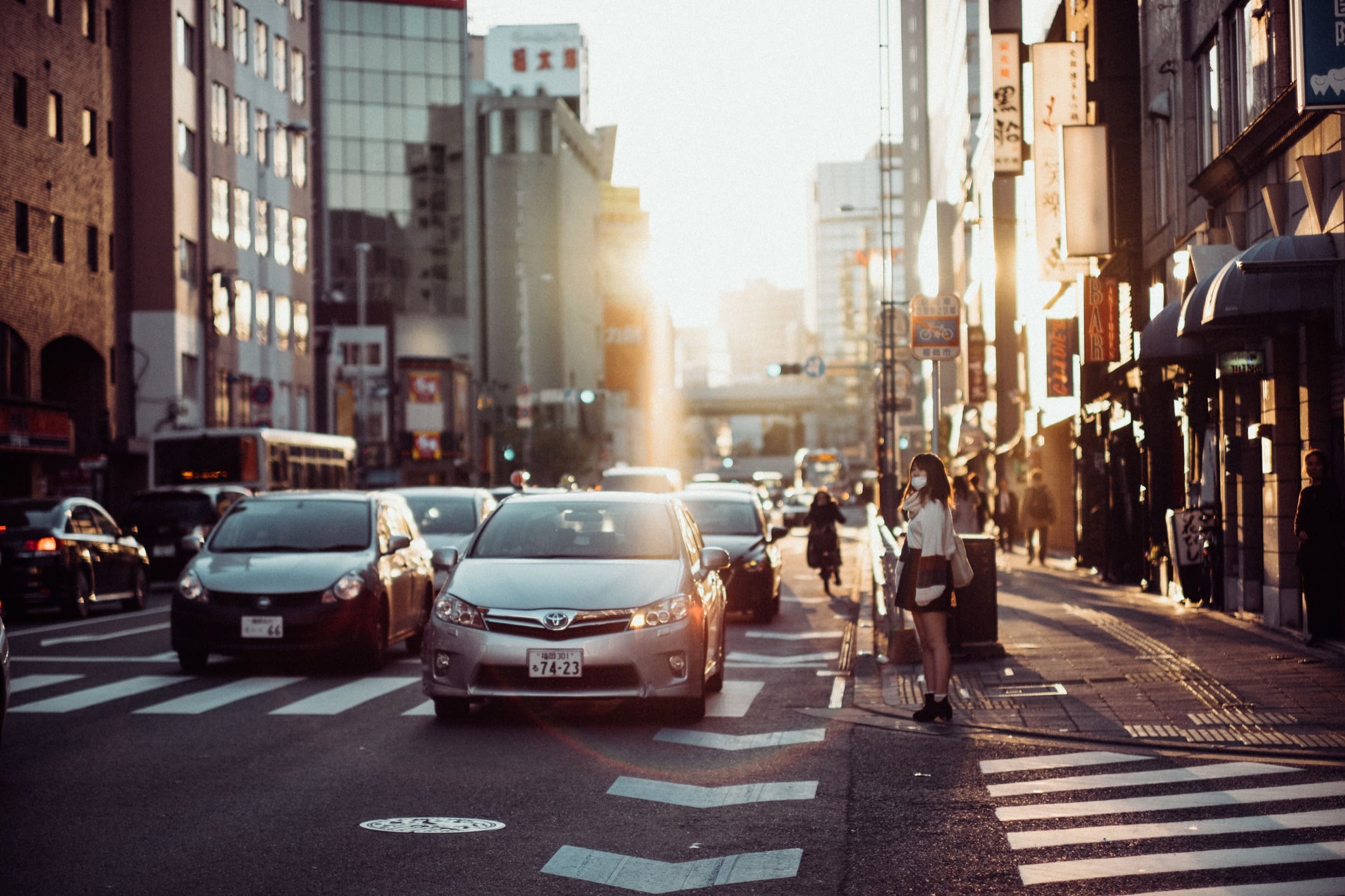
  • Cool Street In Nakasu Fukuoka

    Viltrox WCL-X100VI Review | A Budget-Friendly 28mm Upgrade

    View Post
  • Sony A7V Announcement

    Sony A7V – They’re Back In The Game

    View Post
Trending Posts
  • Nikon Zf Official Announcement 1
    Nikon Zf – The Fujifilm Killer?
    • December 25, 2024
  • Nikon Z 50mm f1.8 S Lens Review 2
    Nikon Z 50mm f1.8 S Lens Review & Sample Photos
    • April 11, 2025
  • 3
    Fujifilm X100F – A Real World Review
    • April 14, 2024
0
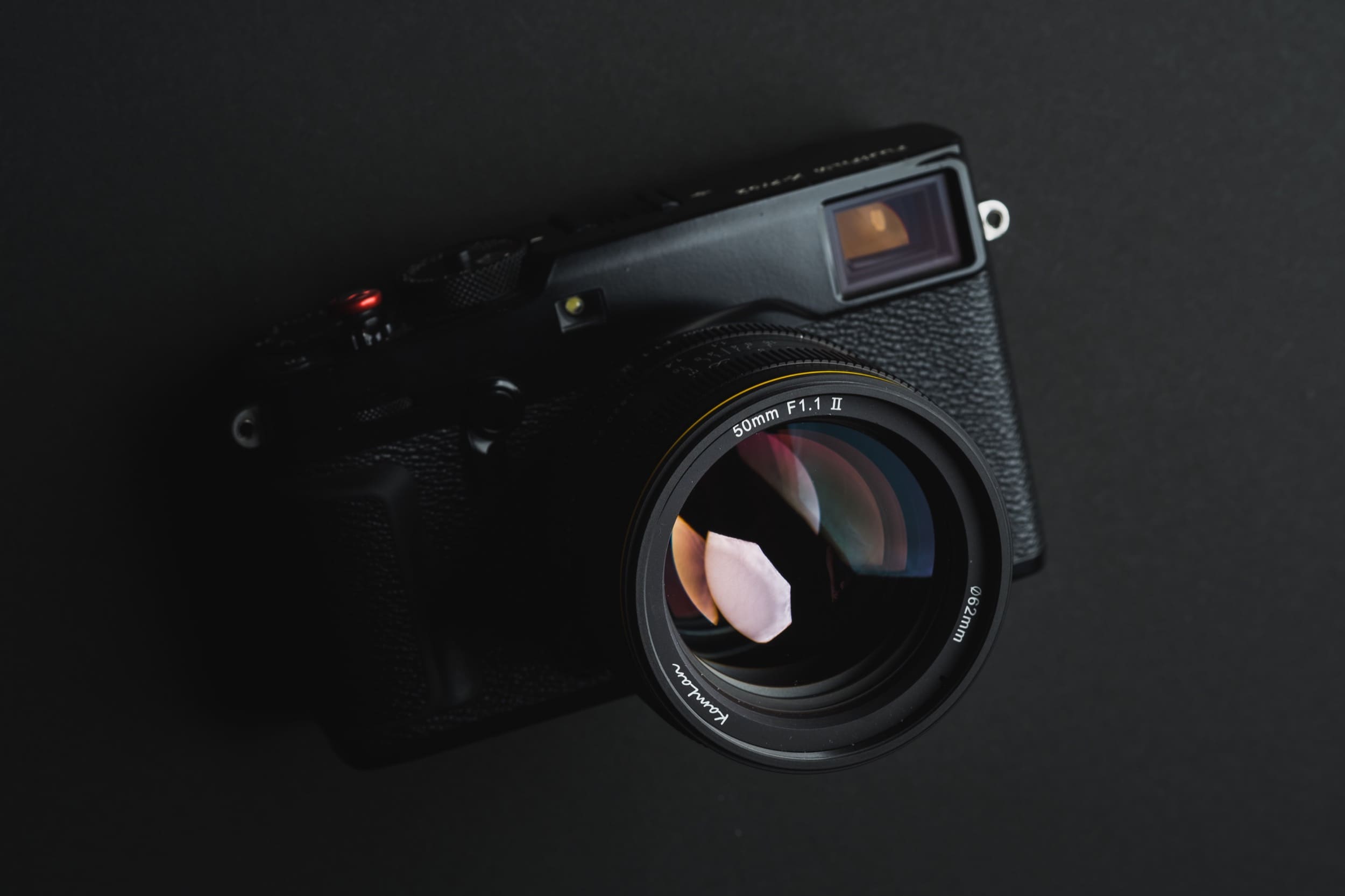
Kamlan 50mm f1.1 II Product Shot
  • Blog
  • Lens Reviews

Kamlan 50mm f1.1 II Review & Sample Photos

  • Alik Griffin
  • January 18, 2025
  • 55 comments
**This website contains affiliate links. We will earn a small commission on purchases made through these links. Some of the links used in these articles will direct you to Amazon. As an Amazon Associate, I earn from qualifying purchases.

The Kamlan 50mm f1.1 version II is an ultra-fast full-manual all-metal constructed 50mm f1.1 lens designed for the APS-C mount. The fast f1.1 aperture with the 75mm equivalent focal length produces a very shallow depth of field that is great for portrait photography. The lens also maintains a wide-open sharpness even at far distances, making it a great choice for low-light photography.

Kamlan 50mm f1.1 II Review

This review of the new and improved Kamlan 50mm f1.1 version 2 will be a little more portrait-heavy since that is the primary purpose for such a lens as this. I’ve also worked in some night street photography.

Lens Stats

Focal Length: 50mm (75mm equiv)
Focus System: Manual
Aperture Blade: 11 Circular Blades
Aperture: f1.1 – f16
Aperture Ring: DeClick
Elements: 8 elements in 7 groups
Coatings: I’m assuming it’s multi-coated.
Weather-Sealed: No
Minimum Focus Distance: 40cm
Filter Threads: 62mm
Weight: 600g

Kamlan 50mm f1.1 II – Amazon

I can no longer find this lens on Amazon. I have no idea what happened.

Here is a link to the Kamlan store.

What’s Good – Decently Sharp when wide open, sharp at a distance when wide open, nice corner sharpness, great bokeh, beautiful rendering, great build quality, 11R aperture produces great bokeh even stopped down, very little cat eye bokeh, well priced.

What’s Bad – Some lateral CA, flaring, only 180-degree focus ring.

Table Of Contents

  • Kamlan 50mm f1.1 II Review
    • Lens Stats
  • Kamlan 50mm f1.1 II Impressions
  • Build Quality
    • The Materials
    • Size Weight
    • Focus & Aperture Rings
    • Design
  • Technical Overview
    • Sharpness Chart
    • Center Sharpness
    • Corner Sharpness
  • Kamlan 50mm f1.1 II vs Fujifilm 56mm f1.2 Sharpness
    • Vignetting
    • Distortion
    • Chromatic Aberrations
    • Flaring
  • Art & Character
    • Depth Of Field / Bokeh
    • Micro-Contrast
    • Color Rendering
    • Other Lenses Like This One
  • Kamlan 50mm f1.1 Sample Photos
Kamlan 50mm f1.1 II Sample Photo
ISO 2000, f1.1, 1/200

Kamlan 50mm f1.1 II Impressions

I have a lot to say about this lens, and a lot of it stems from the idea constantly being pushed online that faster lenses are somehow better or more professional. In reality, faster lenses only offer a different look—shallow depth.

Slower lenses also can often offer a different look, higher-micro contrast, and usually better IQ, yet this is disregarded. I think this comes from this strange perception people get that because faster lenses are more expensive (since they require more materials to make right), they must be better. You’re getting a tool that offers a different look, not necessarily a better one. Just because this lens is an f1.1 does not mean it is better than an f1.2 or f1.4 lens, but it is capable of producing very shallow depth with a good low-light performance, which is great in some situations.

Kamlan 50mm f1.1 II Sample Street Photo
ISO 250, 1.1, 1/200

The only reason I bring this up is that when you have fast lenses like this, you, or at least I tend to shoot wide open all the time, and with a manual focus lens, it completely kicks my ass. I shoot manual a lot, I’m good at it, and this lens still kicks my ass, and I miss out on a lot of shots because of this.

I’m trying to say that shooting with an f1.1 manual focus lens might not be in your best interest. It’s hard, frustrating, and rewarding when you get it right. So, know what you’re getting into. Yes, you can always stop down, but then you’ll get better image quality from a lens designed for slower apertures.

The ideal aperture for a 50mm APS-C street low-light photographer would be f1.4. However, there are no f1.4 lenses that are as good and cheap as this lens, which is even at f1.4, making it very appealing now.

Ideally, you’ll really want this lens for shooting things that are still. Portraits and some low-light travel stuff. The 180-degree focus ring makes it a little difficult to track subjects moving with precision. However, suppose you’re good about shooting at the appropriate aperture for the given situation because of the 11R aperture blades. In that case, you really can take advantage of the great-looking bokeh even at slower apertures.

Kamlan 50mm f1.1 II Sample Street Photo
ISO 1600, f1.1, 1/200

With it, you can shoot street photography at night wide open, but it’s very challenging and takes a lot of practice and patience. I eventually had to change my style and start shooting people who were not moving so much.

Kamlan 50mm f1.1 II Sample Street Photo
ISO 1250, f1.1, 1/200

The look this lens produces is incredible. I love the way it renders, flares, and the build quality. Kamlan just got so many things right. By the way, I bought this lens like I do most of my lenses for my reviews.

Kamlan 50mm f1.1 II Sample Portrait Photo
ISO 1600, f1.1, 1/200

Build Quality

Kamlan 50mm f1.1 II product shot

Kamlan lenses have always had incredible build quality, and the 50mm f1.1 version II is no exception.

Aside from the factories the big brands have set up in China, few places make really high-quality professional optics.

I’ve heard some of the Kamlan lenses are assembled in the same facilities that Kipon uses, and as you know, Kipon has some of the best mounts with the highest precision in the world, and they also make very high-quality lenses as well.

I say that because I don’t want you to look at Kamlan with the same stigma as some of the cheap made-in-China products. Made in China is not always a bad thing, there are very high-quality products coming out of there like many of the new Nikon Z lenses. Even the Fujifilm X-T3 is made in China.
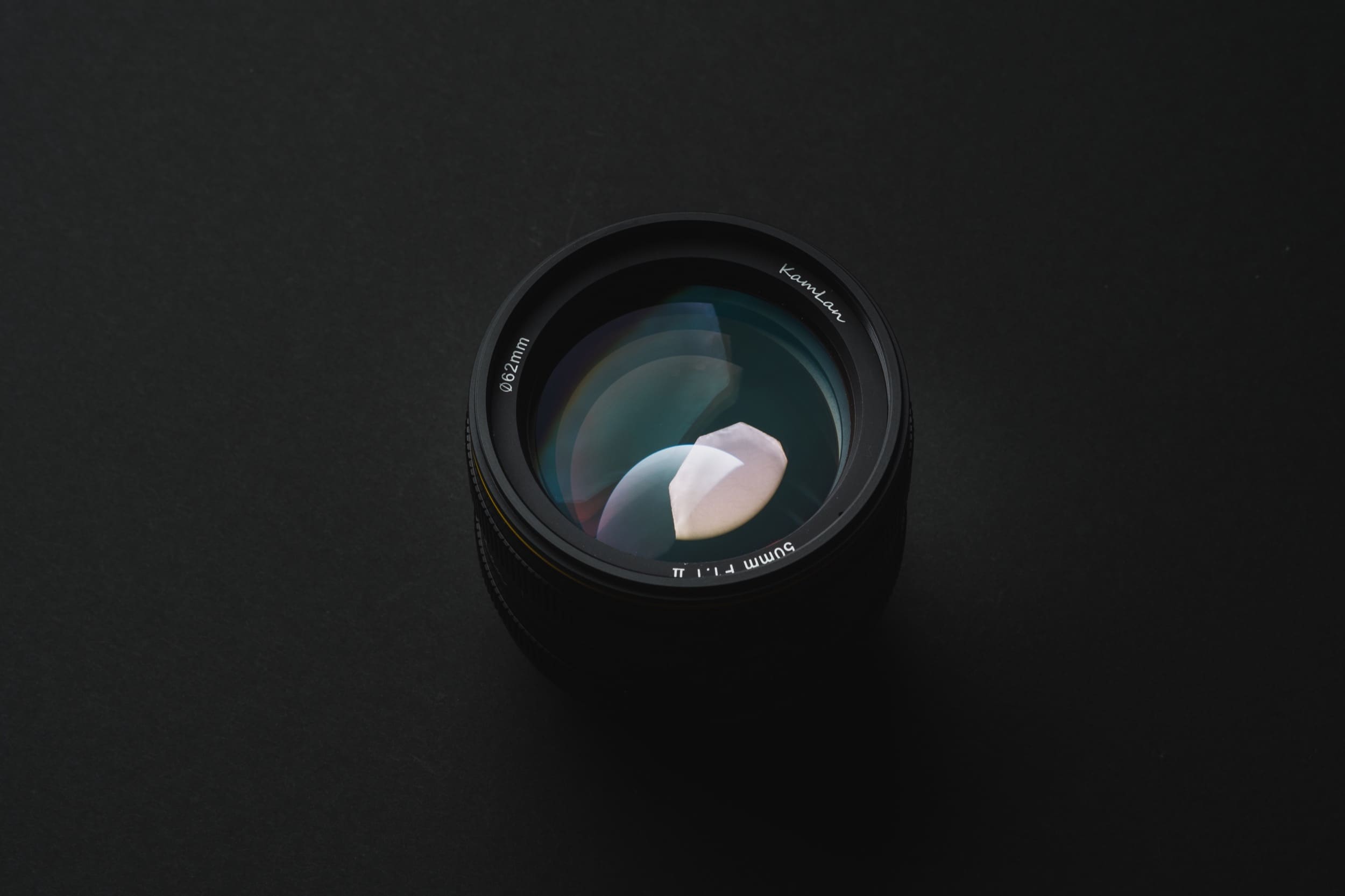
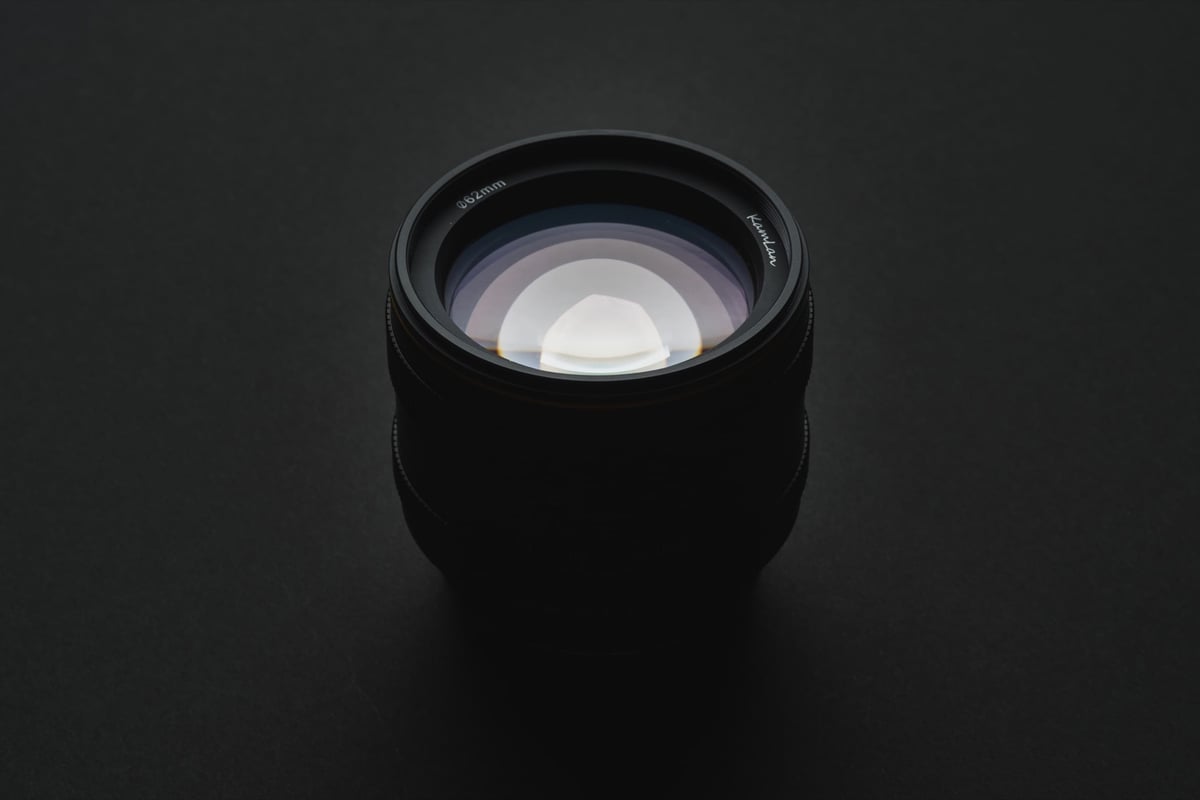
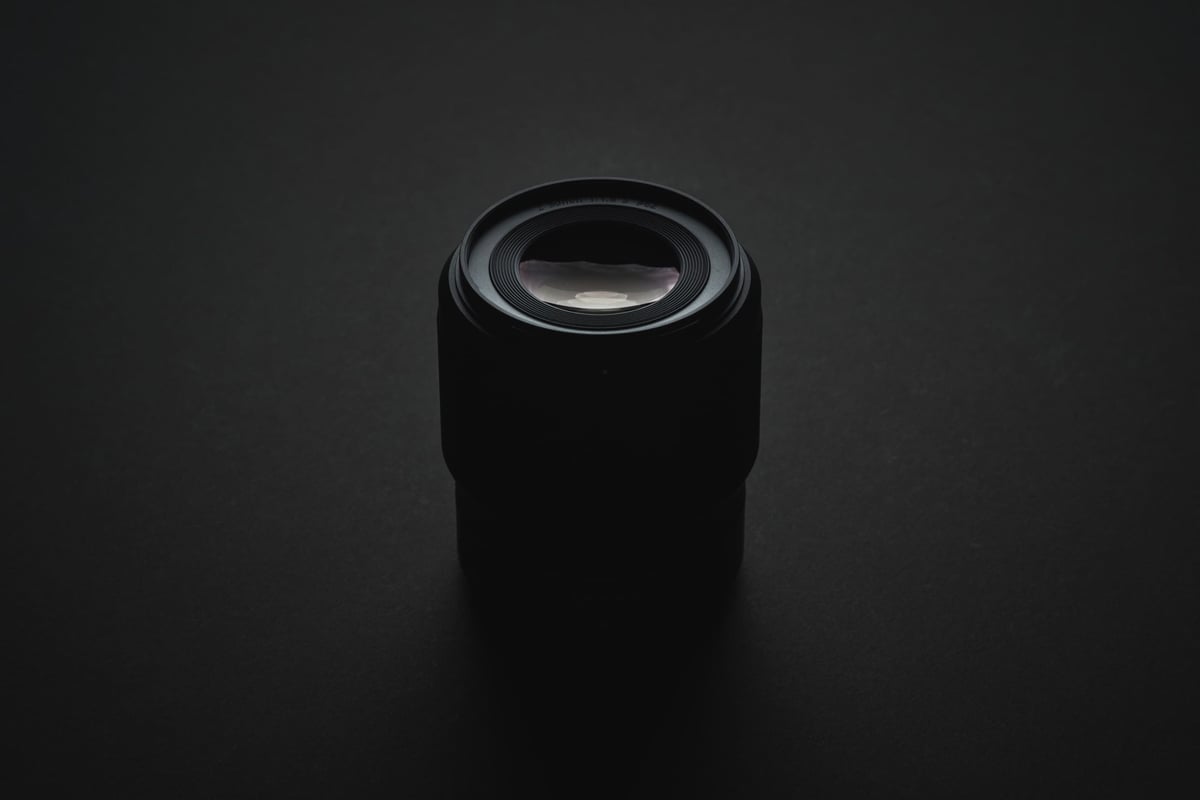
Kamlan 50mm f1.1 version 2 front element

The Materials

I’m not exactly sure what you will get when you order this lens, but my lens came with a metal lens hood and a metal body. My lens also came with a 3-stop ND filter.

I’m not sure what you’ll get because Amazon says it comes with a plastic lens hood but does not mention a 3-stop ND filter.

The lens has an all-metal construction; whether that’s a good or bad thing is debatable. Technically, it’s better to make the outer shell of lenses out of plastic since it won’t ding as easily and won’t hold heat. But metal lenses feel cool and are more fun to use.

I have a Samyang 50mm f1.2 lens with a plastic shell, and while it is technically better than this lens in some areas, it just doesn’t feel as cool and isn’t as fun to use.

Size Weight

The size and weight are good. It’s a little heavier than the 56mm f1.2, but the extra weight isn’t cumbersome. I shot for four hours straight with it and never felt like it was an issue or too heavy.

Without the lens hood attached to either lens, it’s a touch smaller than the 56mm f1.2, with the hood it’s quite a bit smaller.

Focus & Aperture Rings

Both focus and aperture rings are perfectly stiff and very smooth. The aperture ring is a little tougher to turn than the focus ring, but this is often slightly different from copy to copy. This is even true for Fujifilm lenses.
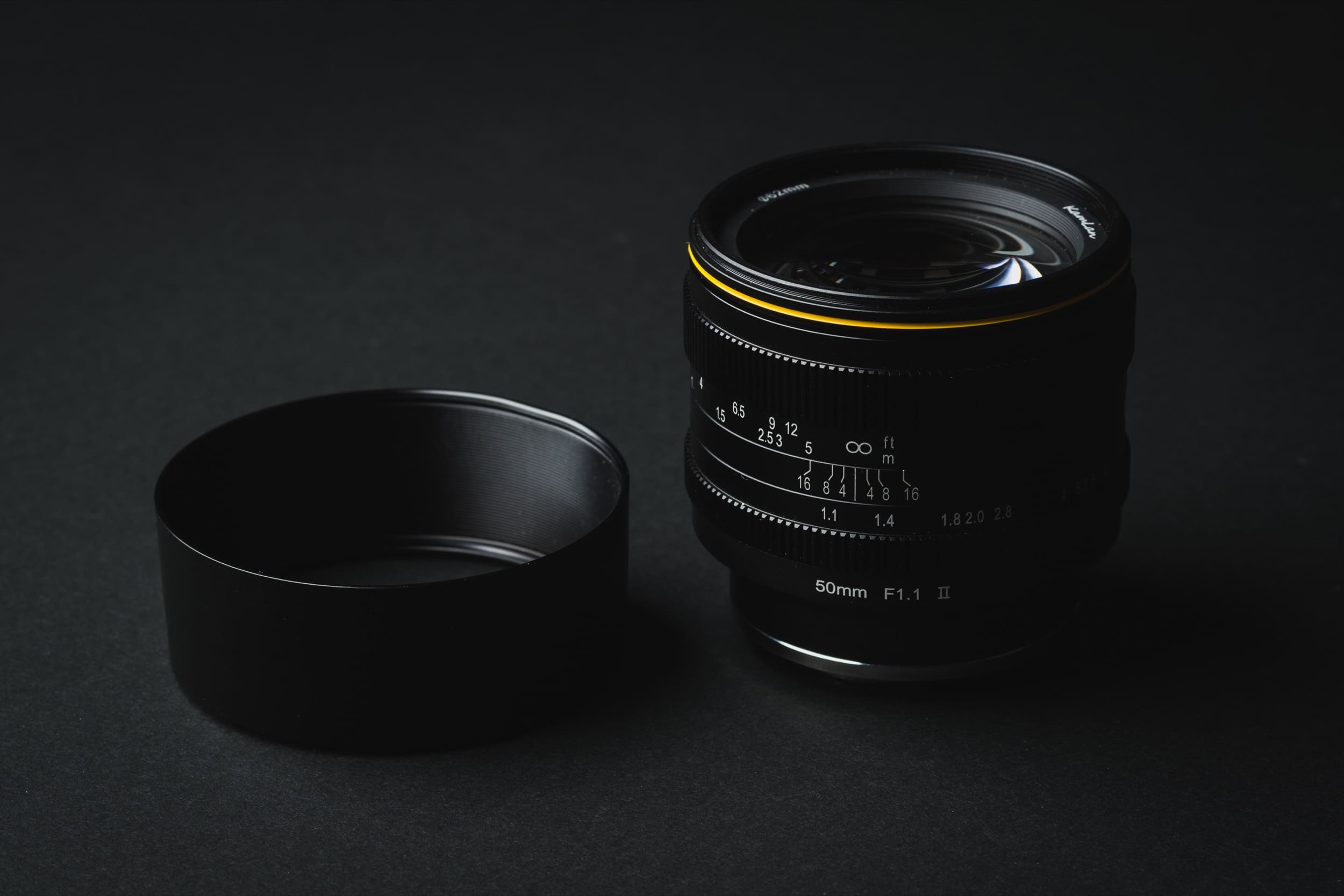
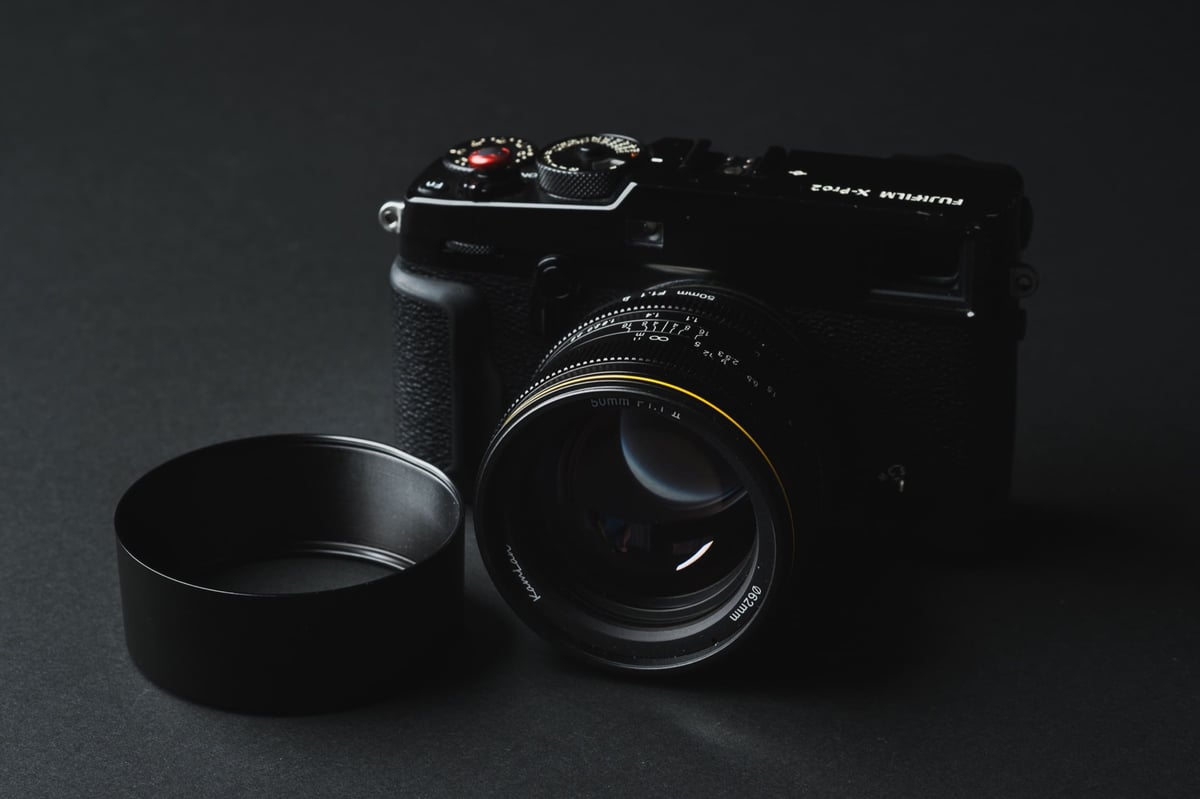
Lens with metal hood

My One Complaint

The focus ring only rotates 180 degrees. It needs to rotate at least 200 degrees because trying to fine-tune focus or pull the focus to track moving objects is just too difficult with this sensitive focus ring on a lens this fast.

Design

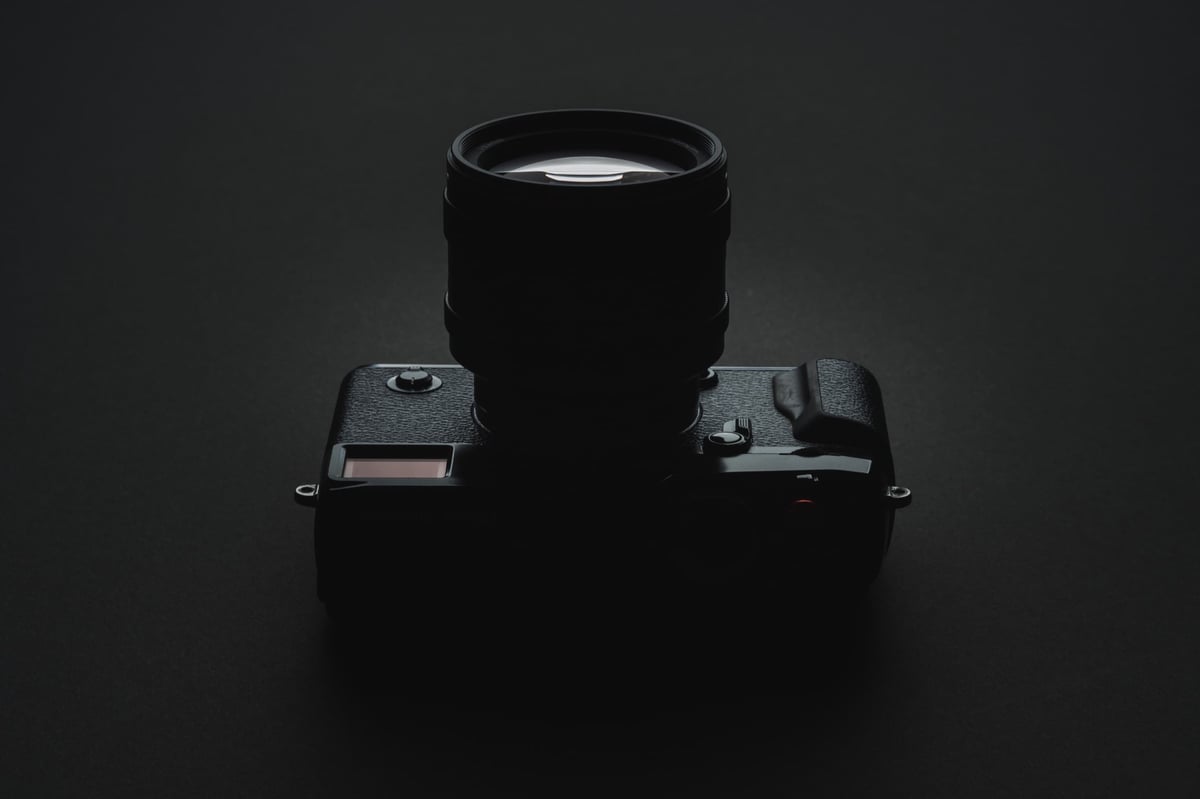
The rear element comes right up to the mount’s edge to maximize the mirrorless design’s capabilities.
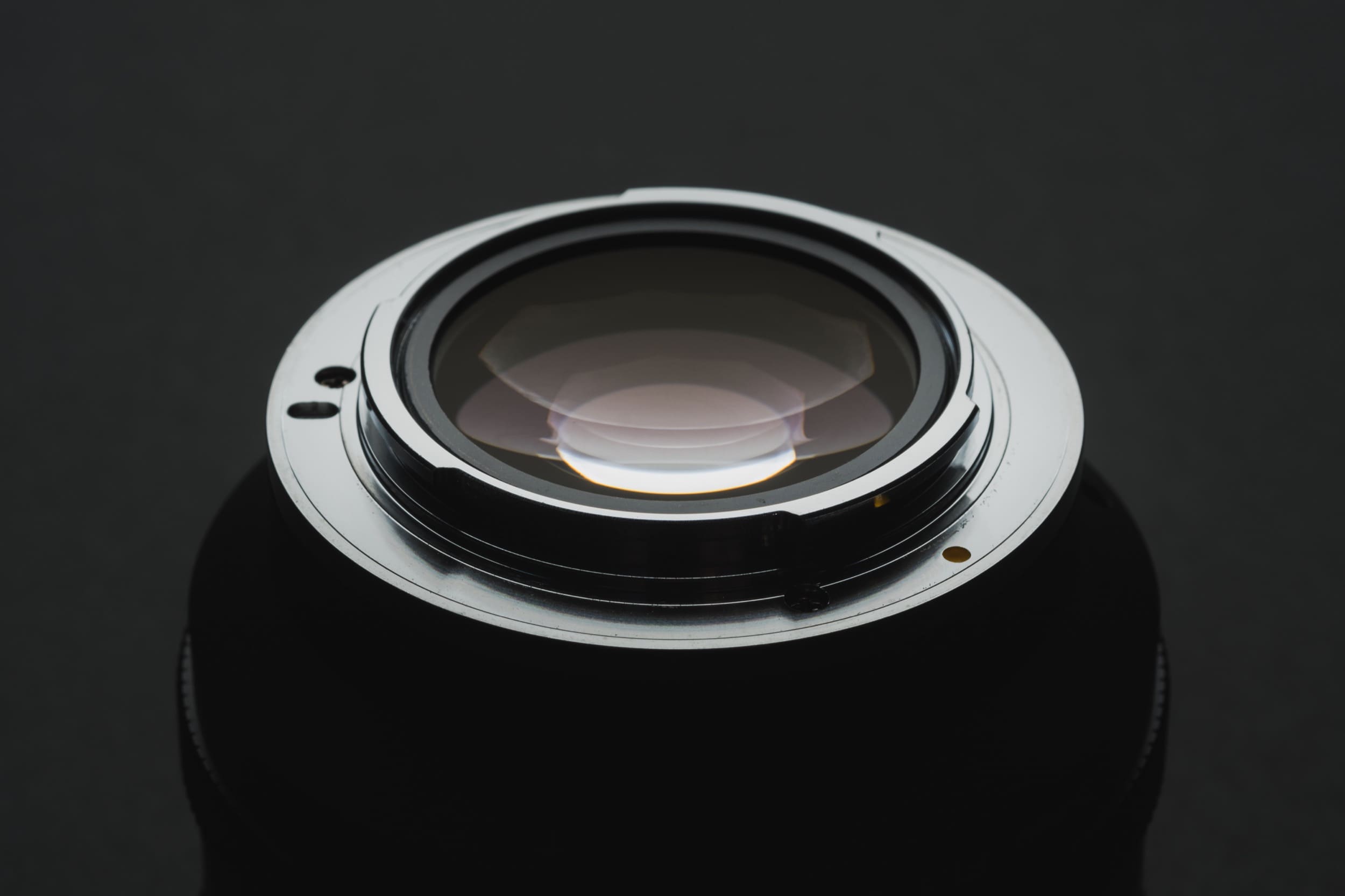
rear element

The front element is massive.

Overall, the build quality is very high. No shortcuts were taken, and everything felt very precise and well-tuned.
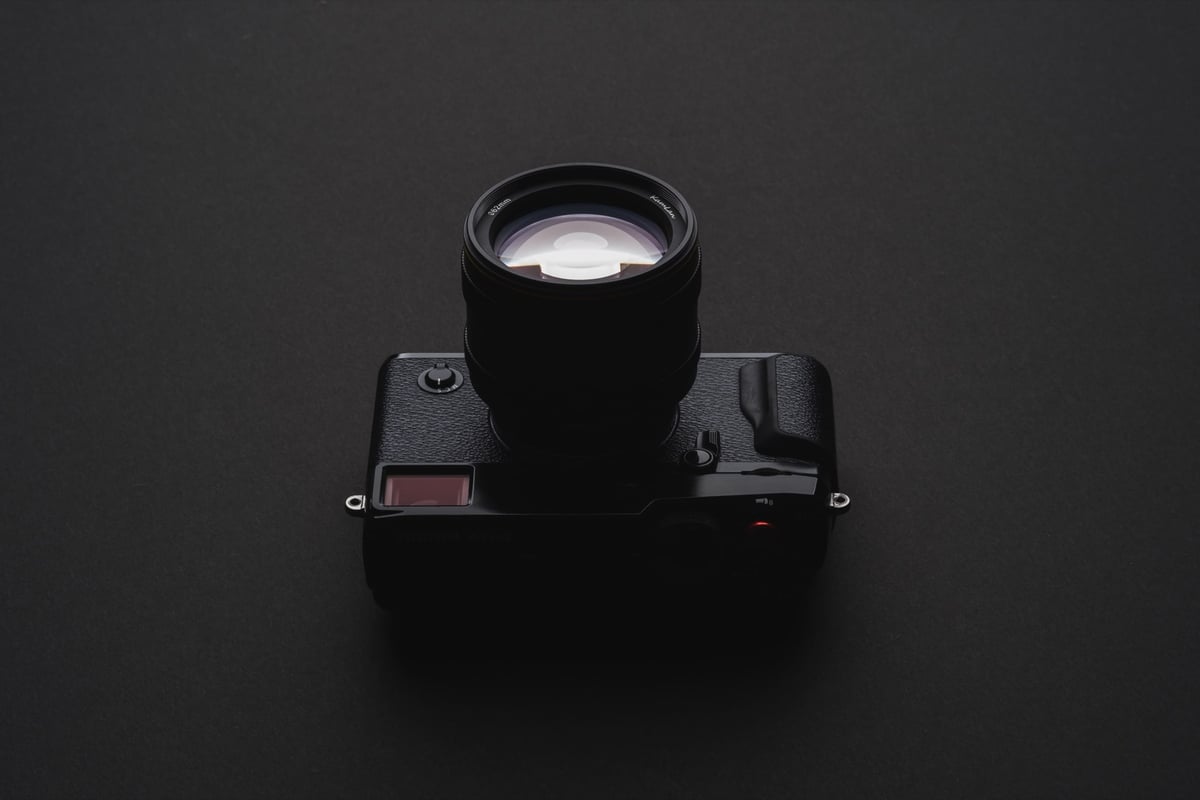
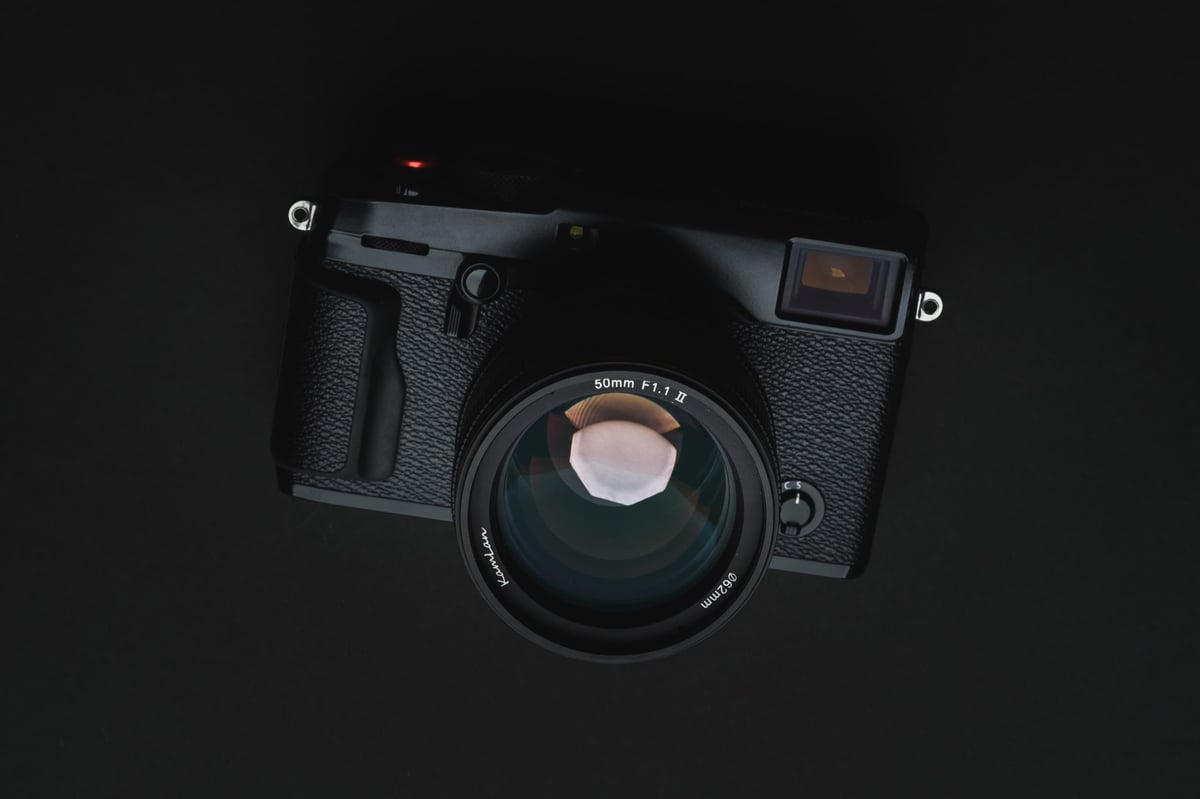
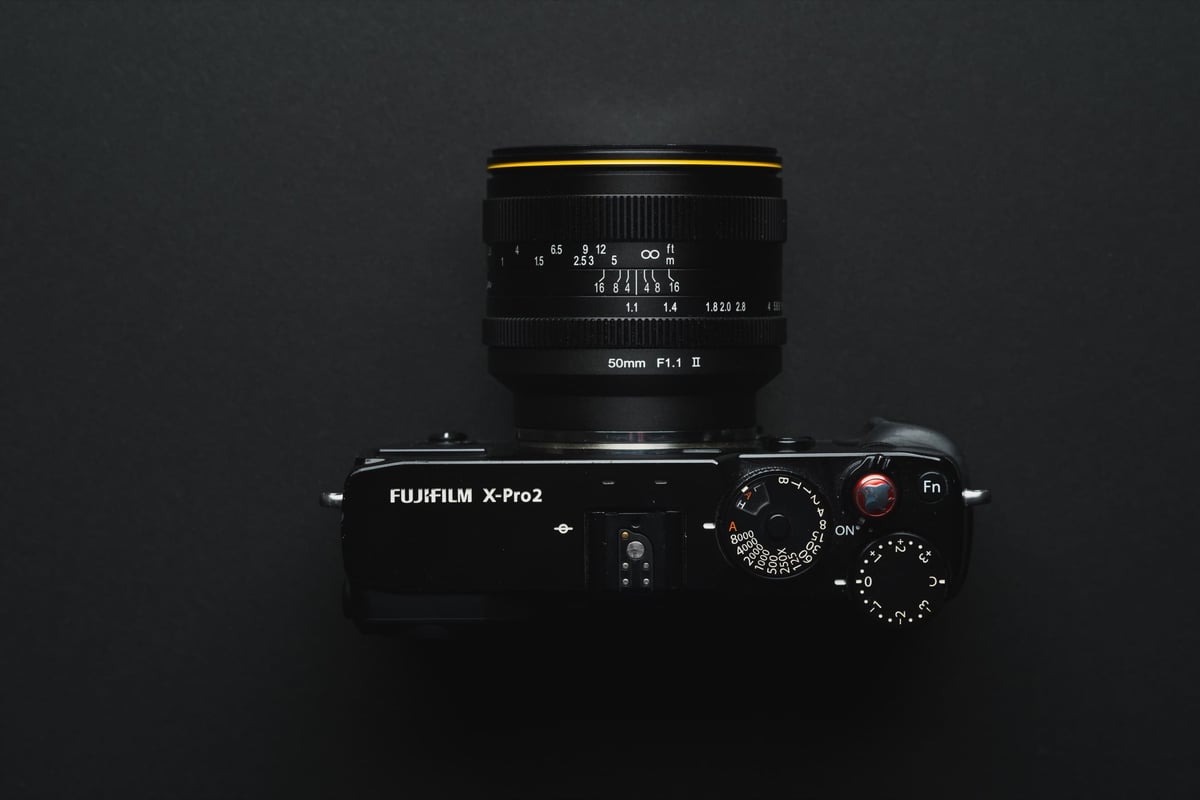
Kamlan 50mm f1.1 II Product Shot with the Fujifilm X-Pro2
Kamlan 50mm f1.1 II Product Shot
Kamlan 50mm f1.1 II Product Shot with the Fujifilm X-Pro2 and the metal lens hood.
Kamlan 50mm f1.1 II Product Shot with the Fujifilm X-Pro2 with no hood attached.

Technical Overview

Kamlan 50mm f1.1 II Sample Lifestyle Photo
ISO 640, f1.1, 1/200

Sharpness Chart

Sharpness actually blew me away. Those who read my first Kamlan 50mm f1.1 review, the version 1 review, probably saw that I didn’t really like that lens. I never recommended it simply because it was only sharp in the center. It was more of a micro-four-thirds lens that just happened to work for APS-C, and it had a bad design.

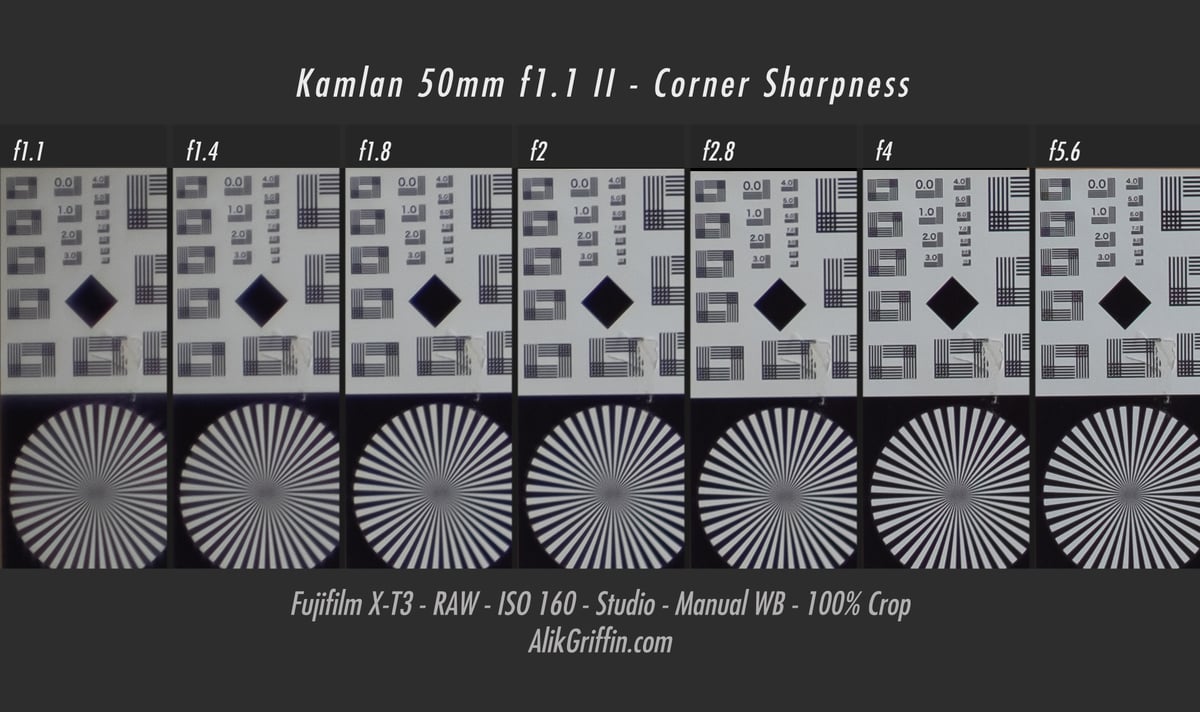
By making the lens bigger, Kamlan improved the sharpness across the frame. The lens has very impressive sharpness and is even decently sharp in the corners at f1.1. However, when dealing with the depth of field at f1.1, you’ll likely never notice, even if it wasn’t sharp. Even the slightest tilt in my resolution chart causes the corners to go out of focus.

This lens also maintains its sharpness even at far distances, which is rare for lenses in this price range. That’s the big problem with most of those fast 7Artisans, Neewer, and Meike lenses: They don’t hold their sharpness at far distances.

Center Sharpness
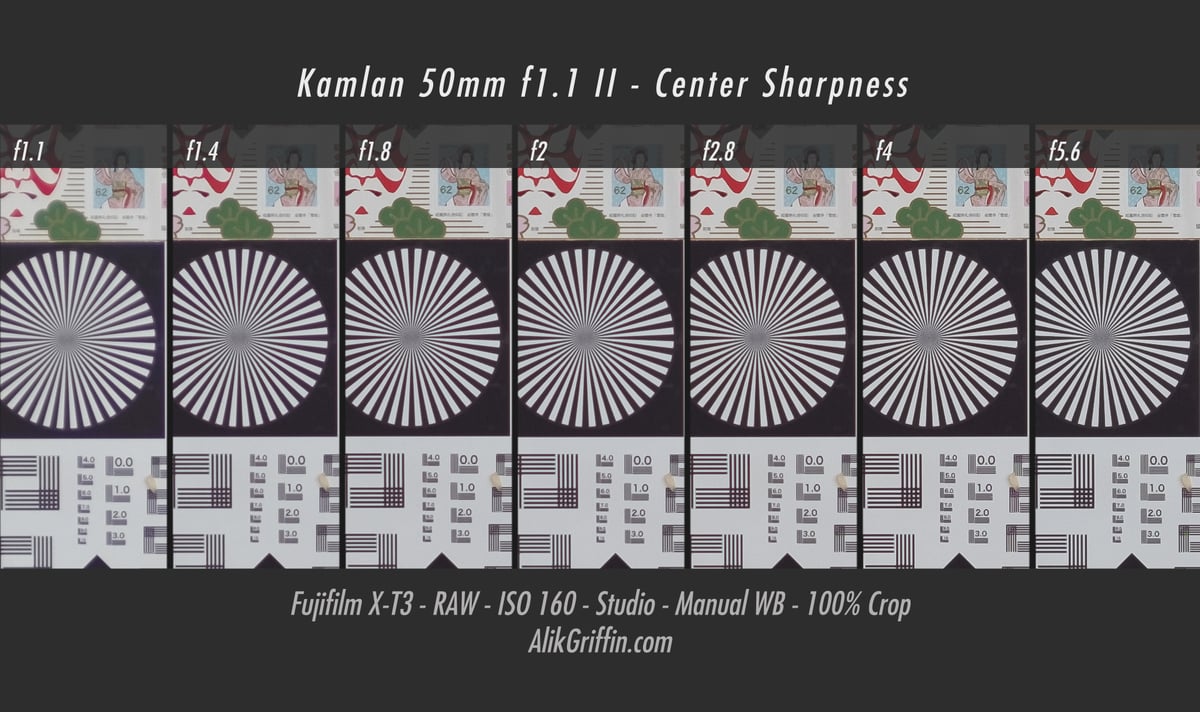
Kamlan 50mm f1.1 II Center Sharpness Chart

At f1.1, you can see a little bit of a misty effect. However, you can still make out the details of the fine print. You can even slightly make out the little 10 at f1.1, which is very impressive. This haze clears up by f1.4, and the lens progressively gets sharper. At f4, sharpness is very good.

Corner Sharpness
Kamlan 50mm f1.1 mkII Corner Sharpness

Corner sharpness is also good; there is no astigmatism, either. You can’t make out the little 10 until about f2, which means the corners at f2 are as sharp as the center is at f1.1, which is pretty good. It’s possible I could get it better, too; I just don’t focus on the corners; I only focus on the center of the chart, so my alignment here isn’t necessarily perfect, and what we could be seeing is a slightly out of focus at those lower apertures.

My lens has a slight de-centric issue where the top is slightly sharper than the bottom. So it’s possible different copies could have slightly softer tops and slightly sharper bottoms with more balanced field curvature than what you see here.

Kamlan 50mm f1.1 II vs Fujifilm 56mm f1.2 Sharpness

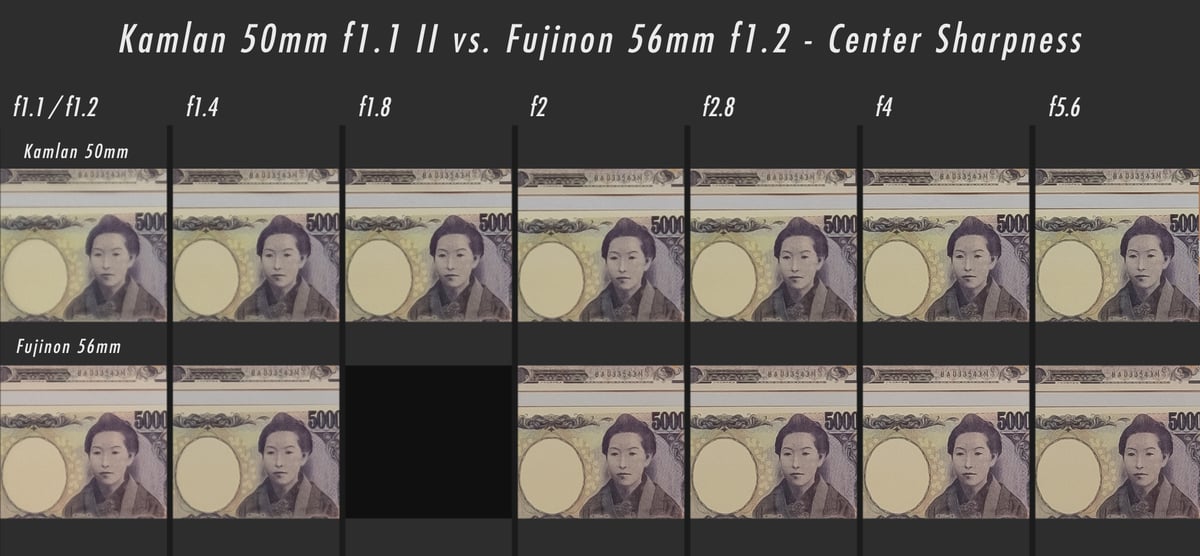
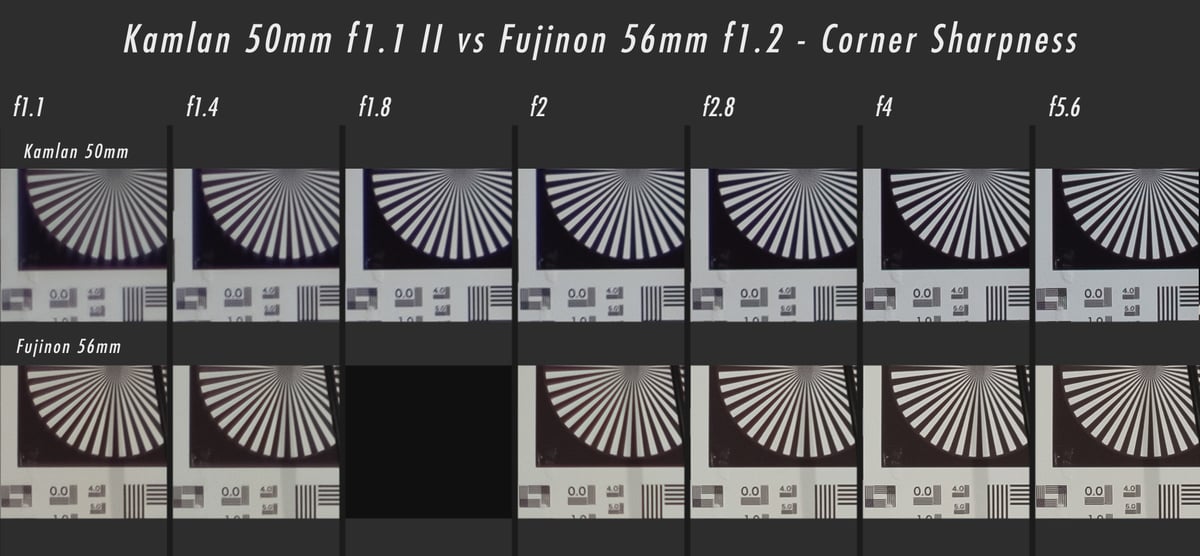
It’s always difficult to tell just how sharp something is unless there is something to compare it to. So, I’ve pulled up some patches from the mighty Fujifilm 56mm f1.2 charts to see.

Sorry, I couldn’t get the white balance to match perfectly, I’ve since upgraded my chart to include a Kodak Color Control Patch and Kodak Grey Scale which I now use to get a white balance. I’m also missing the f1.8 patch on the Fujifilm, which I never shot.

I am also unable to tell you which lens is brighter now. I just moved into a new place and can’t get a controlled enough environment for that yet.
Kamlan 50mm f1.1 II vs Fujifilm 56mm f1.2 Center Sharpness

Overall, the Fujinon is a little sharper up until about f4, then it’s pretty close. I would argue that you get slightly better tonal detail (micro-contrast) in the Fujifilm 56mm.

Still, Kamlan is very good in comparison.

Here are some patches from a corner.
Kamlan 50mm f1.1 II vs Fujifilm 56mm f1.2 Corner Sharpness

Does it matter that the Kamlan is not as sharp as the Fujinon?

Under studio conditions, it might, and probably at those longer distances when shooting wide open, the extra little bit of sharpness might help a little. Still, in the real world with more casual photography, so many factors will prevent you from having perfect sharpness and detail that you’ll never be able to tell the difference in sharpness.

For example, motion blur will likely reduce sharpness, both with camera shake and subject motion, and high ISO / low light, no matter what lens, sensor, or camera, will always show a reduction in detail since there is less photonic resolution in low light (yes, I just made that term up). It has to do with the spatial coherence of the light.

You’ll also likely rarely nail perfect focus if you’re shooting anything that moves. This is why I try to encourage people not to get too hung up on sharpness.

Vignetting

Surprisingly, there is very little vignetting with this lens. Here is a sample at f1.1.

Vignetting Sample
ISO 160, f1.1, 1/750

Distortion

It’s has pretty much almost no distortion.

Distortion Sample
Distortion Test

Chromatic Aberrations

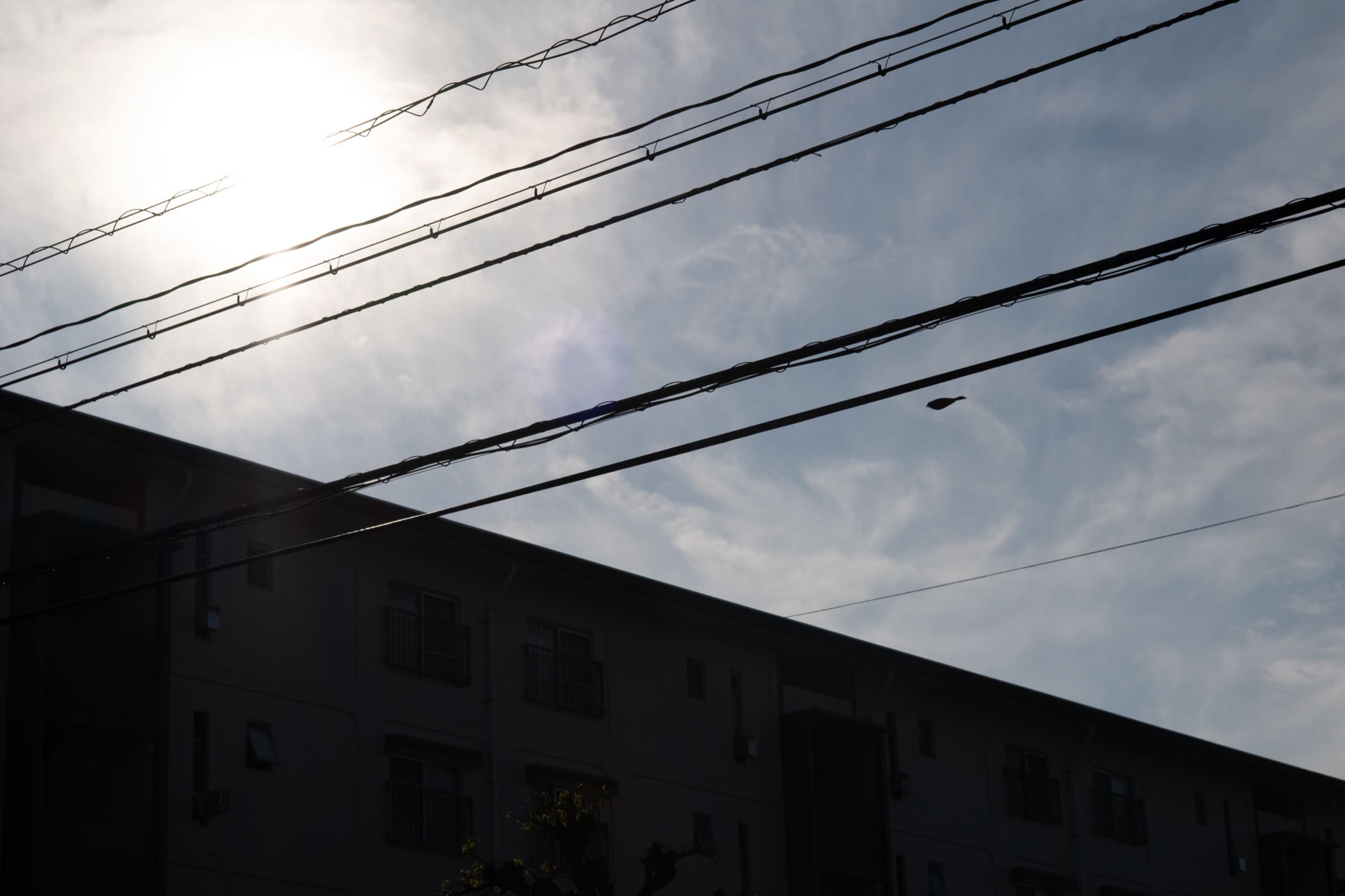
Some chromatic aberrations in the out-of-focus areas render purple and green. I’m not seeing much CA on high-contrast edges.

Lateral CA Sample
ISo 160, f1.1, 1/5000
Longitudinal CA Sample
ISO 160, f1.1, 1/2000

Flaring

One big thing I notice about most third-party lenses or lenses from companies that haven’t done it for 100 years is the flaring. Like most Fujifilm lenses, it seems like all the big companies have proprietary coatings that almost completely eliminate flaring.

There is more to lens coatings than just flaring reduction, though. All the internal elements are usually coated with something to help with light transmittance and to reduce inner lens light scattering and reflecting, which can cause serious issues in bright environments.

I haven’t had too many issues with this lens not performing well in bright environments, and the contrast is actually decent, even when getting hit with lens flares.

Flaring Samples

I took off the lens hood and shot toward the sun to see what madness I could unleash. Some of the effects are cool, and you can’t get those with higher-quality coatings from bigger brands. Also, I tinted the look of these a little orange with split tones to complement the effect.

I think this look is awesome, and I love that you can still buy lenses that do this.

Flaring Sample
ISO 160, f1.1, 1/10500
Flare Circles
ISO 160, f1.1,, 14400
Flaring Sample
ISO 160, f1.1, 1/8500
Kamlan 50mm f1.1 II Flaring Sample
ISO 160, f1.1, 1/4700
business man
ISO 160, f1.1, 1/5800
flaring sample man at cross walk
ISO 160, f1.1, 1/4000
green bloom
ISO 160, f1.1, 1/4400
red bloom
ISO 160, f1.1, 1/2400

Art & Character

This is where the rubber meets the road, which is the main thing I care about with lenses. Sure, a lens has to be sharp, especially at a distance and especially if it’s advertised as a fast lens, but weakness in any of the above characteristics is more of a nuisance as long as the images still look cool.

Kamlan sample photo
ISO 160, f1.1, 1/200

A lens must be decently sharp, and too much distortion or vignetting can be annoying. While it’s great to see the Kamlan 50mm f1.1 II achieve 90% optical perfection, lenses still have to render inspiring, cool-looking images.

This is one of the problems I have with many new modern lenses. The new Nikon 85mm f1.8 Z is pretty much perfect technically. I mean, it’s insane what that lens is, however, there’s a night and day difference between it and the Fujifilm 56mm f1.2 which has just a prettier rendering to it. The Fujinon is not nearly as good technically, but the images have more life. This is a real thing and significantly more important than corner sharpness, and that is why I spend so much time on this section of my reviews.


Kalina cooking, lifestyle photo
ISO 1250, f1.1, 1/200
Kalina cooking, lifestyle photo
ISO 1250, f1.1, 1/200
Kalina cooking, lifestyle photo
ISO 1250, f1.1, 1/200

Depth Of Field / Bokeh

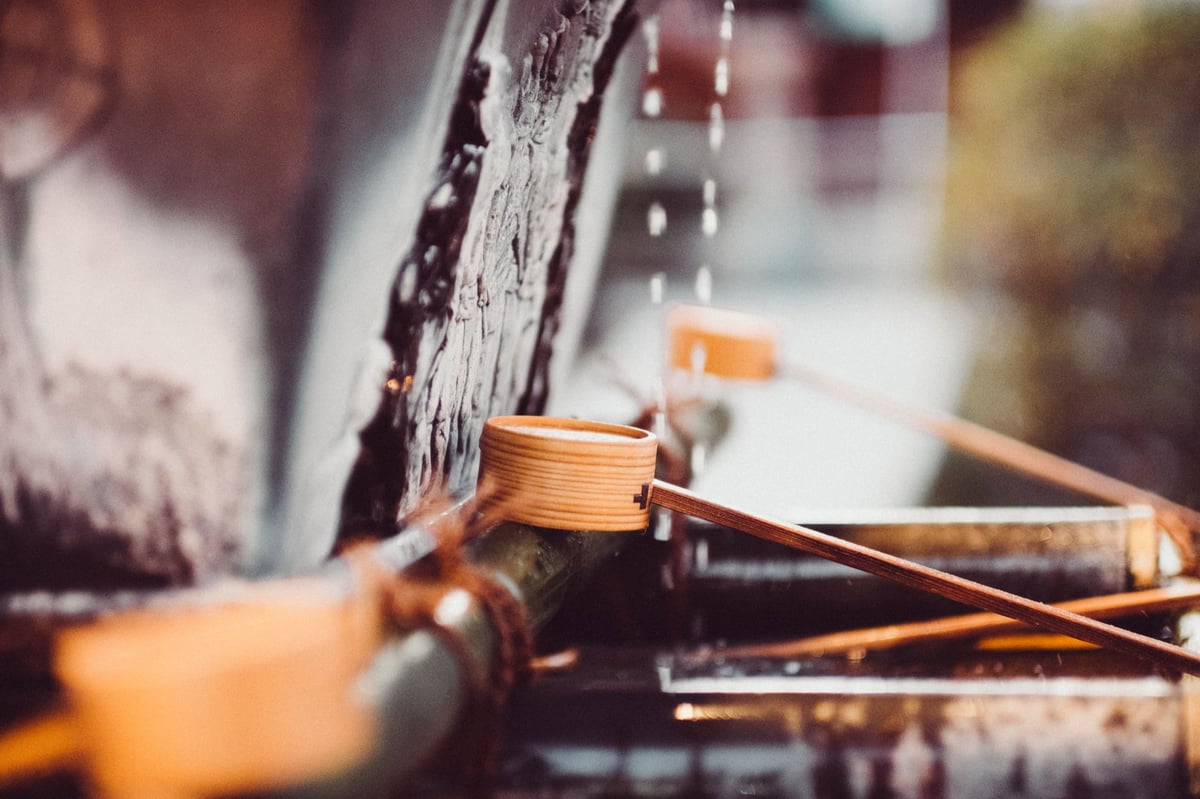
One thing nice about the Kamlan is that the bokeh stays fairly circular as you stop down (close the aperture), and there is very little cat’s eye bokeh. This can be very distracting. Some people don’t mind it, and some people hate it.

Often, when people look at the bokeh, they get distracted by just the bokeh balls, but a unique rendering can happen, which you will see in some lenses and not others.

Bokeh Sample
ISO 250, f1.1, 1/200

It’s hard to describe this; I always refer to it as a focus falloff. This is how the lens transitions from what’s in focus to what’s out of focus. Some lenses are very smooth, and some lenses have a harsher fade.

Bokeh Samples
ISO 3200, f1.1, 1/200
Bokeh Samples
ISO 2000, f1.1, 1/200
Bokeh Samples
ISO 800, f1.1, 1/200
Bokeh Samples
ISO 640, f1.1, 1/200
Bokeh Samples
ISO 3200, f1.1, 1/200

The falloff with the Kamlan 50mm f1.1 II is actually really smooth. Images shot at f1.1 have a very soft and elegant look, even more so than the Fujinon 56mm f1.2, and it’s unique and pleasing.

And it is a different look. That’s what’s cool about all these fast lenses; you get something different from them. The Fujinon 56mm has this puffier bokeh, whereas the Kamlan seems a little more creamy. The Kamlan also maintains a nice bokeh when stopped down because of the 11R aperture, whereas the Fujifilm gets pretty gross once you get to about f2.

So, if you had the Kamlan 50mm f1.1 II, the Rokinon 50mm f1.2, or the Fujinon 56mm f1.2, they’d all have slightly different looks you can take advantage of.

Micro-Contrast

Micro-Contrast Sample
ISO 160, f1.1, 1/680

The Kamlan 50mm f1.1 II has fairly decent micro-contrast.

Lens designers must find the sweet spot for what their customers will accept. Big companies like Nikon have to bend their knees to the sharpness and IQ keyboard warriors that run most of the big blog and YouTube channels. That’s all anyone talks about anymore and is all anyone has been trained to be concerned with regarding lenses. What’s cool about smaller companies like Kamlan is that they aren’t scrutinized nearly as much, and at their price point, they can get a little more experimental with their designs. Hopefully, there will be an awakening, and one day, the big companies can make cool lenses again that aren’t just a solid barrel of glass designed solely for perfect corner sharpness at their widest aperture.

Compared to Fujinon lenses like the 56mm f1.2, the Kamlan looks like it has slightly less pop.

B&W Sample
ISO 160, f1.1, 1/2200

Color Rendering

Here are some straight-out-of-camera RAW files from the Fujifilm X-T3. Since the lens comes with an ND filter, the first three shots have it.

The colors are good with this lens. There are no strange or strong shifts even with the ND filter, and there are no color ring patterns. Highlights render well even in bright environments, and the contrast is better than most of the less expensive third-party brands.


SOOC Sample With ND
ISO 2000, f1.1, 1/200 ND
SOOC Sample With ND
ISO 160, f1.1, 1/6000 ND
SOOC Sample
SISO 160, f1.1, 1/8000
SOOC Sample
ISO 160, f1.1, 1/1400
SOOC Sample
ISO 160, f1.1, 1/3800
SOOC Sample
ISO 1250, f1.1, 1/200
SOOC Sample
ISO 160, f1.1, 1/2000
SOOC Sample
ISO 2000, f1.1, 1/200
SOOC Sample
ISO 160, f1.1, 1/1000

Kamlan 50mm f1.1 Review | Bottom Line

This lens is simply awesome. It has such a perfect balance between technical performance and its art and character. The only thing it’s missing that wouldn’t compromise the design is a little more throw on that focus ring. While 180 degrees is still good, I feel like I could use a little more, especially when trying to fine-tune focus on moving distant objects.

Flower Poke
ISO 160, f1.1, 1/900

Other Lenses Like This One

Rokinon 50mm f1.2 – My review of the Rokinon 50mm f1.2 isn’t as pretty, but it’s also a really nice lens. Regarding IQ, for a third-party brand making lenses for APS-C cameras, Rokinon gets the closest to the quality of Fujinon, except they don’t feel as cool and aren’t as fun as the Kamlan lenses. Something about the Kamlan 50 makes it fun that you don’t get from the Rokinon lenses, even though their lenses are really good now.

Kipon 40mm f0.85 II – If you really want to get crazy with low light and have the cash to burn, don’t forget about the Kipon 40mm f0.85 II. Kipon lenses are very high quality. This lens CA’s like a monster, though, so bright light / high-contrast scenes aren’t going to be your friend. I think it could have benefited from using a few ultra-high refractive polymers instead of the all-glass design to keep the size down a little. I know the owner of Kipon is a purist, so what he did makes sense, and the lens is still pretty cool.

7Artisans 55mm f1.4—This one didn’t quite hit the mark for me, but many people like it for the price. Like many cheap lenses, it struggles with sharpness at a distance wide open.

Brightin Star 50mm f1.4 – I just got this lens, I’ll be reviewing it soon. So far, I think I like it more than the 7Artisans 50mm f1.4. It has a little nicer colors, a little better contrast, and bokeh. But I’ll need to do some more side-by-side comparisons.
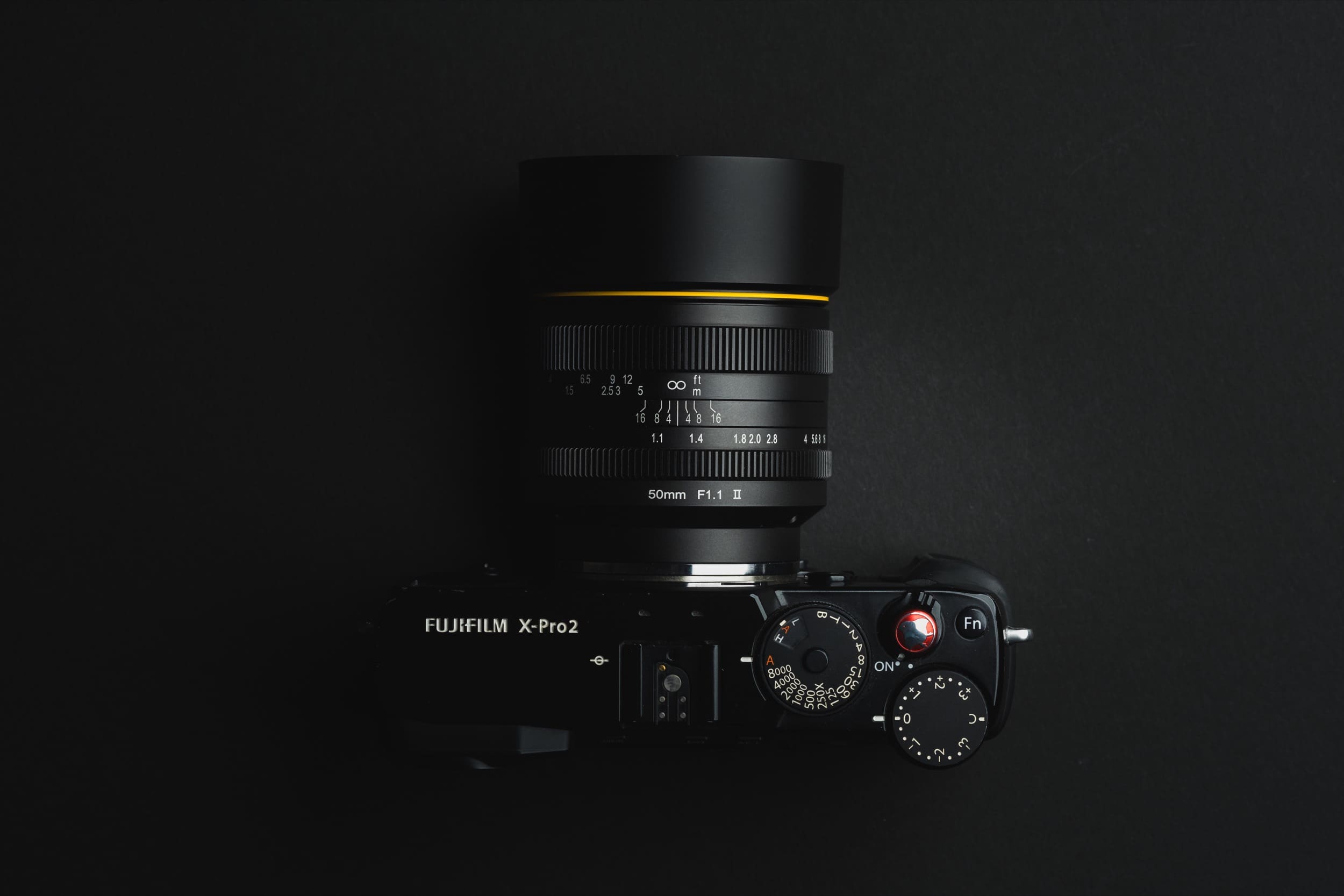
Kamlan 50mm f1.1 II with lens hood attached on the Fujifilm X-Pro2.

Kamlan 50mm f1.1 Sample Photos

Kamlan 50mm f1.1 II – Amazon

These samples are all shot with the X-T3 using RAW compression. I limited the shutter to 1/200. One thing great about the f1.1 aperture is that you can keep that fast street photography shutter without digging too deep into your ISO.

These are all colored with my presets. I’m experimenting with a few new looks, which is why things are a little more orange than usual. If you click the images, there should be an option to view them in full size.


lifestyle photo sample.
ISO 160, f1.1, 1/1100
street photo sample
ISO 160, f1.1, 1/1800
street photo sample
ISO 250, f1.1, 1/200
street photo sample
ISO 500, f1.1, 1/200
street photo sample
ISO 2000, f1.1, 1/200
street photo sample
ISO 320, f1.1, 1/200
Bokeh Samples
ISO 800, f1.1, 1/200
street photo sample black and white
ISO 5000, f1.1, 1/200
Low Light Street Photography
ISO 2500, f1.1, 1/200
Kamlan 50mm f1.1 II Sample Photo
ISO 320, f1.1, 1/200
street photography
ISO 4000, f1.1, 1/200
bokeh ball sample
ISO 400, f1.1, 1/200
bokeh sample
ISO 160, f1.1, 1/6400
0
0
2
0
0
Alik Griffin

A professional video editor, and photographer with a Bachelors in Film studies from UCSD. Based in Los Angeles, I have created commercials, trailers, and other video content for various clients and platforms since 2005. I also love to write about my passions and share my insights on my blog.

Related Topics
  • Fujifilm X-T3
  • KamLan 50mm f1.1 II
  • Lifestyle
  • Street Photography
Previous Article
  • Camera Guides
  • Memory Cards Recommendations

Best Memory Cards Nikon Z50 | Real Benchmarks

  • Alik Griffin
  • February 12, 2026
View Post
Next Article
  • Camera Guides
  • Memory Cards Recommendations

Best Memory Cards Nikon Z6/Z7 – Real Benchmarks

  • Alik Griffin
  • February 12, 2026
View Post

Subscribe

Subscribe now to our newsletter

You May Also Like
Thypoch Simera 75mm f1.4 Review
View Post
  • Blog
  • Lens Reviews

Thypoch Simera 75mm f1.4 Review & Sample Photos

  • Alik Griffin
  • January 28, 2026
  • No comments
Cool Street In Nakasu Fukuoka
View Post
  • Blog
  • Lens Reviews

Viltrox WCL-X100VI Review | A Budget-Friendly 28mm Upgrade

  • Alik Griffin
  • January 18, 2026
  • 2 comments
Sony A7V Announcement
View Post
  • Blog
  • What's New

Sony A7V – They’re Back In The Game

  • Alik Griffin
  • December 30, 2025
  • 4 comments
Viltrox 9mm f2.8 Air Review
View Post
  • Blog
  • Featured
  • Lens Reviews
  • Reviews

Viltrox 9mm f2.8 AIR Review & Sample Photos

  • Alik Griffin
  • January 14, 2026
  • 2 comments
Subscribe
Notify of
guest
guest
55 Comments
Inline Feedbacks
View all comments
kllo
kllo
6 years ago

Thanks for such a thorough review. This lens looks very interesting, great falloff. I hope the quality of the Chinese brands keeps improving like it has been.

Reply
Alik Griffin
Alik Griffin
Reply to  kllo
6 years ago

Me too. Every year they seem to get a little better. Some of them are actually hiring designers out of Germany now to refine and improve their designs, which is pretty cool.

Reply
Muchtoobizy
Muchtoobizy
6 years ago

Thank you so much for taking the trouble to write up this review and share so many great photographs that show a perfect utilisation of this type of lens. It’s much appreciated. I’m looking forward to owning and using it.

Reply
Alik Griffin
Alik Griffin
Reply to  Muchtoobizy
6 years ago

No problem and thanks for the kind comment. They are rare in the photography blog world. 🙂

Reply
Mike Porter
Mike Porter
6 years ago

I’m excited about this lens. I’ve recently switched to Fujifilm and haven’t owned a manual focus lens in decades. And never anything near an f1.1. Will be on the X-T30. Thanks for the write-up. — Mike

Reply
Mike Porter
Mike Porter
Reply to  Mike Porter
6 years ago

Oh, and those amazon points made it very, very inexpensive 🙂

Reply
Alik Griffin
Alik Griffin
Reply to  Mike Porter
6 years ago

awesome. Have fun. I love this lens. It’s one of my favorite MF lenses for the Fujifilm system. Just be patient when trying to focus at f1.1. 🙂 Use focus peaking and sometimes it’s helpful to throw your camera into a black and white setting with red focus peaking.

Reply
Mike Porter
Mike Porter
Reply to  Alik Griffin
6 years ago

Oh… that’s a great idea!

Reply
Mike Porter
Mike Porter
Reply to  Mike Porter
6 years ago

And pushing in the rear dial brings up focus zoom. I had focus zoom set to pop up whenever the focus ring was turned and in manual focus mode, but that of course only works for Fuji lens. Had to search around to find out how to do it for manual lens.

Reply
Mike Porter
Mike Porter
Reply to  Mike Porter
6 years ago

Shot photos of a belly dancer in a restaurant we visited right next to my Fuji dealer. Great fun. She was 40-50’ away though. When she came to the table, I just put the camera down and enjoyed the dance. No Lens I’ve ever owned would have made those photos at iso 800.

Reply
Alik Griffin
Alik Griffin
Reply to  Mike Porter
6 years ago

I like that this Kamlan does still hold some sharpness at far distances, it’s rare for the less expensive but faster lenses to do this. And I use that rear dial button for focus magnification as well. You can toggle the amount of magnification of it by turning the wheel too.

Reply
Jazzi Jazz
Jazzi Jazz
6 years ago

I have a dilemma. I want to buy 1 of these either for my G9 or A6400. The pros for the G9 is the ibis for occasional video, but the depth of field wide open will be 2.2/100mm equiv. vs 1.65/75mm on the Sony. I’m leaning towards the m43 version, but I wonder if the amount of subject separation at f2.2 on pana g9 vs f1.65 on the a6400 would be huge? Would the m43 choice give just slightly less subject separation, but a little easier to focus and work with? If you could only get 1 (for stills) and had the 2 systems, which one would you get, sony or m43? Why?

Reply
Alik Griffin
Alik Griffin
Reply to  Jazzi Jazz
6 years ago

I threw some numbers in my depth of field calculator. At 10feet with Sony you’ll have a dof of 6.34″ with MFT at 15 feet you’ll be at 10.75″. So it should be a little easier on MFT.

Either-way, the lens is going to be difficult to focus. 🙂

This is a tough one because the Panasonic has 10-bit 4:2:2 at what is it 150Mbps? That’s so much better than Sony 8-bit 100Mbps. How effective is IBIS going to be with a 100mm lens and won’t it only do 3-axis because it’s a manual non-Panasonic lens?

Reply
Jazzi Jazz
Jazzi Jazz
Reply to  Alik Griffin
6 years ago

Thanks. it will do 5 stops in body with any lens vs 6.5 with native power ois lenses i believe, but again, video isn’t my main goal. My main use will be stills to get max blur and subject separation for non moving subjects. I saw 1 comparison on youtube with a m43 lens on a panasonic vs with a m43-e adapter on a sony (my original strategy was to get the m43 version and also use it with adapter on the a6400 obviously only part of the sensor (2/3?) will be lit on aps-c) but the guy wasn’t framing similarly by standing at different distances to compensate for the longer focal length of the m43 lens. Here is a useful comparison with the kamlan V1 https://www.youtube.com/watch?v=Q5Xb9qPEUKw&t=8s,

i ordered a m43-nex adapter that fits fine on my sloppier A6000 mount but absolutely will not turn into place on the a6400’s mount. Anyways, the real dilemma is how much of a difference will the difference be in blur/separation at f1.65 vs f2.2 equiv.. The G9 is also 100mm vs 75mm, not sure if this is good or bad. I have the kamlan II m43 version en route, but I could still return for emount version, but would have to ship back to china.

Reply
Alik Griffin
Alik Griffin
Reply to  Jazzi Jazz
6 years ago

I didn’t realize there was an M43 to E-mount. That seems like a solution if you can find one that works. I found this one.

Reply
Edward Hui
Edward Hui
6 years ago

Thank you for the in-depth analysis of this lens, your sample photos speak for this lens 🙂
Keep up your hard work, hope to see more similar review in the future, and thanks for providing similar alternatives too!

Reply
Alik Griffin
Alik Griffin
Reply to  Edward Hui
6 years ago

Thanks Edward, I’m going to try to do a lot more lens reviews this year.

Reply
Escher
Escher
6 years ago

Really enjoy your blog, Alik! Is the aperature ring on this Kamlan clicked or declicked?

Reply
Alik Griffin
Alik Griffin
Reply to  Escher
6 years ago

Declicked. Forgot to add that detail. 🙂

Reply
Lukas
Lukas
6 years ago

Thank you for this great review and the beautiful pictures. You have a really artistic point of view that is quite rare in this topic that seems to be all about numbers and technical aspects. So it helped me a lot and I am thinking on buying this one or maybe the Handevision 50mm 2.4 (I also read your review on that one). Both seem beautiful and I am not sure yet. Do you have a preference?

Reply
Alik Griffin
Alik Griffin
Reply to  Lukas
6 years ago

Of the Handevision lenses my favorite are the 75mm and 35mm. I never really fell in love with the 50mm. There just wasn’t anything that special about it. It rendered well but I think for that price, with an APS-C camera you can have more fun with this Kamlan. Unless you need compact, small and light. Then that IBERIT 50mm is nice. But those Kamlan lenses are full frame lenses, and you pay a bit more because of it.

Reply
Lukas
Lukas
Reply to  Alik Griffin
6 years ago

Oh thanks a lot, I think a made my decision then.

Reply
Nick Dyson
Nick Dyson
5 years ago

Really enjoyed reading this review Alik, backed up by some beautiful photos. I’ve just purchased an X-T3 and I’m in the market for a lens for casual portraits of friends and family, plus something that could be used for street photography. My number 1 choice is the XF56 I love the look of the images from that lens especially wide open but it’s expensive! I’ve looked at the XF50 but I already own the XF35 and don’t want another lens that’s too clinical, would prefer something with a bit of character. The Samyang 50mm and Kamlan are interesting lenses. Which would you recommend?

Reply
Alik Griffin
Alik Griffin
Reply to  Nick Dyson
5 years ago

The Kamlan has more character but the Rokinon is probably better in terms of IQ. I haven’t done a side by side but I personally have more fun with the Kamlan and shoot with it more. But it’s a hard decisions to make.

Reply
Nick Dyson
Nick Dyson
Reply to  Alik Griffin
5 years ago

I’m leaning towards the Kamlan but have just seen a review on Amazon state that the lens has no coating and that’s the reason for the inclusion of an ND filter, is this true?

Reply
Alik Griffin
Alik Griffin
Reply to  Nick Dyson
5 years ago

The ND filter is so you can use it wide open outside in the day with a mechanical shutter. Not sure about the no coatings thing, looks like it has coatings to me. But it does flare quite a bit.

Reply
Mike Porter
Mike Porter
Reply to  Alik Griffin
5 years ago

I didn’t get an ND filter with mine. Could this be for the older version? Looking at the 28mm f1.4 now.

Reply
Alik Griffin
Alik Griffin
Reply to  Mike Porter
5 years ago

Interesting. Maybe? Does yours have a metal or plastic lens hood?

Reply
Mike Porter
Mike Porter
Reply to  Alik Griffin
5 years ago

Metal lens hood. It’s clearly labeled as a 50mm “II”. I bought it from a reputable place – most likely via link in this post.

Reply
Alik Griffin
Alik Griffin
Reply to  Mike Porter
5 years ago

Interesting, I was wondering why I got an ND filter because Amazon did not mention it. I wonder if it was a return and someone forgot to take it off?

Reply
Mike Porter
Mike Porter
Reply to  Alik Griffin
5 years ago

If you bought it from the Amazon warehouse, that would make sense.

Reply
Alik Griffin
Alik Griffin
Reply to  Mike Porter
5 years ago

I did yeah, I’ll update the article and let people know the ND filter might not be included.

Reply
Eirik Havre
Eirik Havre
Reply to  Alik Griffin
5 years ago

I was part of the Kickstarter for this lens (the first backer actually :P) and during the Kickstarter, if I remember correctly, they said they were gonna include a UV filter. But some of us brought up the idea that they should include a ND filter instead so that people can shoot it wide open in daylight. That’s how I remember it at least.

So the ND filter might have only been intended for the backers and maybe they had extra copies of those that they didn’t get backers for and just sent those to Amazon instead?

I’m just guessing, I don’t actually know.

Reply
Alik Griffin
Alik Griffin
Reply to  Eirik Havre
5 years ago

It seems plausible. It was weird because my lens came with the ND filter screwed on already.

Reply
Eirik Havre
Eirik Havre
Reply to  Alik Griffin
5 years ago

I might be generating fake memories right now, but I think mine was too. Was it a Zomei ND 4? That’s the one I own that I don’t have a case for. I keep it in a Hoya case that was empty (for some reason).

Reply
Alik Griffin
Alik Griffin
Reply to  Eirik Havre
5 years ago

I don’t remember actually what the brand was. It’s back at my place in Japan.

Reply
Paul Lin
Paul Lin
5 years ago

Hi Alik, I’m debating Kamlan 50mm mk2 or adapting a Nikkor 50mm f1.4 AFD, want to pick your brain here, which would you prefer (if you have adapted nikkor on fuji) Thank you!

Reply
Alik Griffin
Alik Griffin
Reply to  Paul Lin
5 years ago

Sorry missed this comment somehow. I haven’t used Nikkor lenses on the Fujifilm. I really want to start collecting some of those Nikkor lenses but just haven’t gotten around to it yet. Let me know what you went with, I’d be curious to see how the Nikon works on the Fuji.

Reply
Patrick Dabrowski
Patrick Dabrowski
5 years ago

Hi Alik, Great write up! i am on the verge of ordering this lens, but i am still trying to pick between this one and the mitakon 35mm 0.95f. i like both focal lengths and depending on what i will buy, i will complement it with either a XF 35mm f1.4 or the XF 50mm f2. what is your opinion on these lenses? witch one has better rendering, seperation, sharpness? Thanks for the advise!

Reply
Mike Porter
Mike Porter
Reply to  Patrick Dabrowski
5 years ago

Hi, I thought I would jump in here with my own thoughts since I own both. I won’t discuss image quality between the two as I really do not have enough experience. Both are fun lenses to use in low light situations. I’ve shot many a photo in the living room when the LED TV is showing a bright commercial or whatever at ISO3200 and f1.1 or f0.95. I doubt auto-focus would work very well in these situations. Focus zoom and focus peaking in combination with moving the spot cursor over the critical focus point can yield some pretty fast focus times. You’ll want to pick something critical in the photo because the depth of field at 5-10′ is really quite short with both of the these lenses when wide open. If I am not using them wide open, I would probably use a different lens most of the time. Both lens are heavy on an X-T30, particularly the KamLan. I guess I would decide based on where I am most likely to want to use auto-focus. And the XF35 f1.4 is a pretty great lens from what I hear, so maybe the KamLan and the 35mm Fuji? However, I can say that if I bought the Fuji 35mm, I would not sell the Mitakon unless I had to. This post is less helpful than what I hoped it would be!

Reply
Patrick Dabrowski
Patrick Dabrowski
Reply to  Mike Porter
5 years ago

Thanks for the reply, indeed it still leaves me with some questions😀 perhaps you can point out the difference in sharpness between the kamlan and the Mitakon? That’s the thing I al the most curious about, as I believe that they both have a nice character…

Reply
Mike Porter
Mike Porter
Reply to  Patrick Dabrowski
5 years ago

I don’t know how to properly evaluate that. But there are probably blogs that make a specialty of that analysis. However, dead sharpness in minimal light at F0.95 or F1.1 isn’t really my goal. Especially edge to edge and corners where typically I will add a vignette anyhow with really low light. In reality, I would own the Fuji 35 1.4, 2.0 and 56 F1.2 along with the Kamlan 50 and the Mitakon. I actually had a bid on the Fuji 56mm the other day, but it went for market price without any certainty that the lens worked, so I skipped it. Oh, and a Fuji 90mm would be fun, too. And my Laowa 65mm F2.8 is pretty cool as well. I guess if money was a concern, I would go for the KamLan 50mm and the Fuji 35mm f1.4. Mostly because you would spend $600+$250=$850 on that combo, $400+$250=$650 on a KamLan, Mitakon, and about $1400 on a Fuji 56mm/Mitakon 35mm. But, there are so many photos I’ve taken at F0.95 that probably would not have worked in any other way. If I was heading to a camp fire, I’d grab the Mitakon. If I were street shooting at night in stealth, then the KamLan – I don’t like to get to close to people. I’m not sure that any auto-focus lens would auto-focus in low light levels. We’ll have to wait for someone that owns them to weigh in. My reading of reviews suggests they would not unless you caught a strong edge. (X-T30)

In a non-low light situation, I probably would not use any of the named lenses. Unless bokeh was a goal. Today, in daylight, I brought my kit 18-55. I was likely to shoot static buildings and objects where bokeh was not too likely to figure in, and since I was with my wife, grabbing a quick shot was … helpful 🙂

Reply
Mike Porter
Mike Porter
Reply to  Mike Porter
5 years ago

… except that I forgot to change the camera from manual focus, so who knows what is on there.

Reply
Alik Griffin
Alik Griffin
Reply to  Mike Porter
5 years ago

I’ve shot a lot in low light with the 90mm f2. It performs very well on the X-T3, no problems at all. It was my go-to lens for a lot of last summer street shooting. The 56mm f1.2. is a little to slow for street shooting at night, so is the 35mm f1.4. You can do it but you just have to be patient with it and learn what it likes and doesn’t like and shoot around those constraints. I usually use the f2 lenses in low light at night without any problems, as long as it’s not too dark. Here in L.A. it’s often too dark since the streets aren’t lit up as much at night, but in Japan, they are totally fine. So I guess it depends on your city. Usually, if there isn’t at least some light the photos don’t turn out very good anyway. So I kind of camp around some nice light sources and usually in those situations you can get a lot done with the f2 lenses.

I prefer the Kamlan over the Mitakon. The Kamlan just has a little more life to the images and more soul. The with the Mitakon the images always just feel kind of dead to me.

https://alikgriffin.com/street-photography-with-fujifilm-90mm-f2/ Here are some 90mm samples. It’s so fun once you get used to the range.

The Rokinon 50mm f1.2 is actually a good one too. In terms of overall quality, it performs the closest to the Fujinon 56mm f1.2. I would almost go as far as saying they are on par with Fujinon. Not quite as good of coatings maybe. But Rokinon is definitely the best third-party manual focus brand that you can buy for Fujifilm.

I’ve been told by an optics company that the Mitakon resolves low light more like an f1.2 lens but because they use those ultra-high refractive elements they’re able to pull off the geometry to call it an f0.95.

A lot of the cheap Chinese lenses don’t actually perform at their rated aperture. Often the f1.2 or f1.4 lenses by like 7Artisans are about a half of a stop off in terms of how much light they pull in. Rokinon and Fujinon lenses perform as they should, I think the Kamlan does as well, they are assembled by Kipon and have really improved their last design. Mitakon is the same as SLR Magic and I still keep having build quality issues with them, they use that same mechanical design for all the lenses and they keep having focus sticking issues on me, especially in cold weather. I’ve had several lenses by them give me issues with sticky, grinding focus, including my Mitakon.

Reply
Patrick Dabrowski
Patrick Dabrowski
Reply to  Alik Griffin
5 years ago

Thanks for the information Alik, and Mike… I’ve thought about the rokinon too… it gets really nice reviews everywhere, and you seem to like it aswell. from what i have read it seems the kamlan has better rendering and a smoother bokeh(character), but a bit less sharp in center, and alot less sharp in corners than the rokinon(wide open, where i intend to shoot alot)). without trying them its hard to know if i will be bothered more with the less creamy bokeh of the rokinon, or the lesser sharpness of the kamlan. wish i could try them both lol…. I have the possibilty to order a ‘returned’ rokinon 50mm from a camerashop nearby, that i can return if it doesnt suit me but with the kamlan, if i buy it from china, no way i can ship it back if it wouldnt suit me 🙂

Reply
Alik Griffin
Alik Griffin
Reply to  Patrick Dabrowski
5 years ago

I’d have to wait till I get back to Japan to test those on the same camera. I didn’t bring those lenses with me and I think tested the MItakon originally on a different camera / different test chart. Fujifilm changed the RAW sharpness values between the X-T3 and X-T2 so it makes it hard to compare. Both lenses are acceptably sharp though. I’ve never ever felt they underperformed in terms of sharpness, except the Mitakon gets al little soft along the edge when you open it up, but that’s not really an issue for real-world use.

Reply
John Keiffer
John Keiffer
5 years ago

Can you change your “bend knee” analogy given all that’s happened? Otherwise, nice review and looking forward to more.

Reply
Mike Jones
Mike Jones
5 years ago

Great review, thank you.

Absolute novice here. Looking for a lens alot like this on an EF-M mount, but mostly for indoor full-length portraits in smallish rooms. Looking for a first fast lens, so willing to sacrifice edge sharpness for speed and if necessary some centre sharpness for some vintage character.

But…I’ve experimented a bit with focal lengths on my kit zoom, & I don’t think I can live with 80mm equivalent for what I want to shoot.

Do you have a view on the Kamlan 28mm f1.4, or can you recommend any alternatives say <$250, =<35mm optical / c.50mm equivalent, maybe f1.4 or faster)? Or would I be better off with a Viltrox speedbooster (can't sttetch to the Metabones) and a nifty fifty?

Also open to persuasion that I should go with this one because 80mm equivalent will be fine once I get some real world experience, if you think I'm overfixating on focal length.

Thanks again for a great site. I'm learning alot, in that 'discovering-new questions-faster-than-I'm-answering-the-existing-ones' way that goes with diving into a new field.

Reply
Gerard V
Gerard V
4 years ago

Hi Alik!

Thanks a lot for the time and effort you put into these reviews! I’m always amazed by how you manage to make them so interesting to even newbies like myself!

Maybe you can pick your brain here? I’ve just bought the Kamlan 50mm f1.1 II (haven’t received it yet) but then I saw the Viltrox 56mm f1.4 and now I hesitate… As a newcomer with a very basic lens kit unlikely to grow a lot (I own a 23, a 35 and I’m now looking for a 5X), would it make more sense to go for the AF lens instead?

Although I still prefer my Meike 35mm 1.7 to my Fujinon 23mm f2 (both in terms of shooting experience and output), some AF functions come in handy from time to time – specially with my 3 y.o. kid…).

Thoughts?

Cheers!

Reply
Alik Griffin
Alik Griffin
Reply to  Gerard V
4 years ago

This lens has some magic to it that I have not seen with the Viltrox lenses but having AF lenses is really nice with a 3 year old. That’s a really tough decision.

Personally, I like using wider lenses with my kids. 23mm on APS-C or even 35mm. I rarely use the longer lenses unless I’m going out to specifically shoot portraits or doing a review like this and even then, I never felt like this lens was too punishing with kids once you get used to it. But you have to use it in situations where the kids are contained. So like, not running around and throwing water balloons in the backyard. You’ll want AF for that.

It’s fine for sitting at a dinner table, waiting to go down a slide, stuff like that, you can totally make the manual focus work. But this isn’t really a going to Disneyland with kids type of lens. More of an artistic lens, portraits and controlled situations with kids.

So it depends on how you plan on shooting since the Kamlan will always require both hands on camera and lens to use all the time, where as an AF lens you can use with one hand, which is nice when holding stuff like an umbrella or something.

Reply
Gerard V
Gerard V
Reply to  Alik Griffin
4 years ago

Thanks a lot, Alik. Very helpful. I think artistic lens + portraits + contained kids captures pretty much what I need/intend to do with it. Kamlan it is. Thanks again!

Reply
just_eirik
just_eirik
1 year ago

Hello. Do you still have this lens? I just got a copy and mine does not flare even close to as much as yours. When I’m at 1.1 and have the sun outside the frame, I get a lot of that misty-low contrast flaring and a weak hint of some rainbow flare. When I stop down to 1.8 or f2 the mist goes away and I get a bit of rainbow flare, but only if I get the sun at the exact right spot, it disappears super fast as I move the camera. The sun also has to be outside the frame, which I think is different from what you got in the sample photos here.

Do you know if they changed the formula of the lens? I have the mark 2 version, but mine has the name (Kamlan) written in a blocky font, unlike yours which is more hand written.

I feel so dumb because I had the same version as you because I backed the kickstarter, but then I sold it because I was a dummy. Now I’m wondering if the early version of the lens is different and I wish I had mine still.

Reply
William Smith
William Smith
1 year ago

It appears that Kamlan lenses may be a thing of the past. Their web shop does not show any lenses and parts of their webpage have been disabled.

Reply
Alik Griffin
Alik Griffin
Author
Reply to  William Smith
1 year ago

I’ve noticed that as well. Getting a lot of broken links from them now on my review pages.

Reply
Law
Law
7 months ago

Can you do deep review on Kamlan 70mm f1.1 lens and 50 mm f1.4 full frame lens.

Reply
San Clemente Sunset

Join The Newsletter

Featured
  • How To Edit Photos To Look Like Film
    • 4 comments
  • On Board
    Fujifilm X100VI Review & Sample Photo
    • 4 comments
  • Mud Face
    Nikon Z 35mm f1.4 vs Nikon Z 35mm f1.8 S – Sample Images
    • 28 comments
  • What is Micro Contrast
    Micro-Contrast, Is It Real? – Samples With Lens Comparisons
    • 17 comments
  • Nikon Z 26mm f2.8 Review – A Little Miracle
    • 24 comments
  • Zeiss Planar 50mm f2 on the Leica M11
    Zeiss Planar 50mm f2 Review & Sample Photos
    • 5 comments
  • Nikon Z 28mm f2.8 Review & Sample Photos
    • 18 comments
  • Tiffen Black Pro Mist Filter At Night. Streets Of Tenjin Japan
    Tiffen Black Pro Mist Review – Is This The One?
    • 10 comments

Subscribe

Subscribe now to our newsletter

Privacy Policy | Ethics Statement | Licensing | About Me | Contact

Copyright © Alik Griffin Inc. 2025

Input your search keywords and press Enter.

Manage Consent
To provide the best experiences, we use technologies like cookies to store and/or access device information. Consenting to these technologies will allow us to process data such as browsing behavior or unique IDs on this site. Not consenting or withdrawing consent, may adversely affect certain features and functions.
Functional Always active
The technical storage or access is strictly necessary for the legitimate purpose of enabling the use of a specific service explicitly requested by the subscriber or user, or for the sole purpose of carrying out the transmission of a communication over an electronic communications network.
Preferences
The technical storage or access is necessary for the legitimate purpose of storing preferences that are not requested by the subscriber or user.
Statistics
The technical storage or access that is used exclusively for statistical purposes. The technical storage or access that is used exclusively for anonymous statistical purposes. Without a subpoena, voluntary compliance on the part of your Internet Service Provider, or additional records from a third party, information stored or retrieved for this purpose alone cannot usually be used to identify you.
Marketing
The technical storage or access is required to create user profiles to send advertising, or to track the user on a website or across several websites for similar marketing purposes.
  • Manage options
  • Manage services
  • Manage {vendor_count} vendors
  • Read more about these purposes
View preferences
  • {title}
  • {title}
  • {title}