
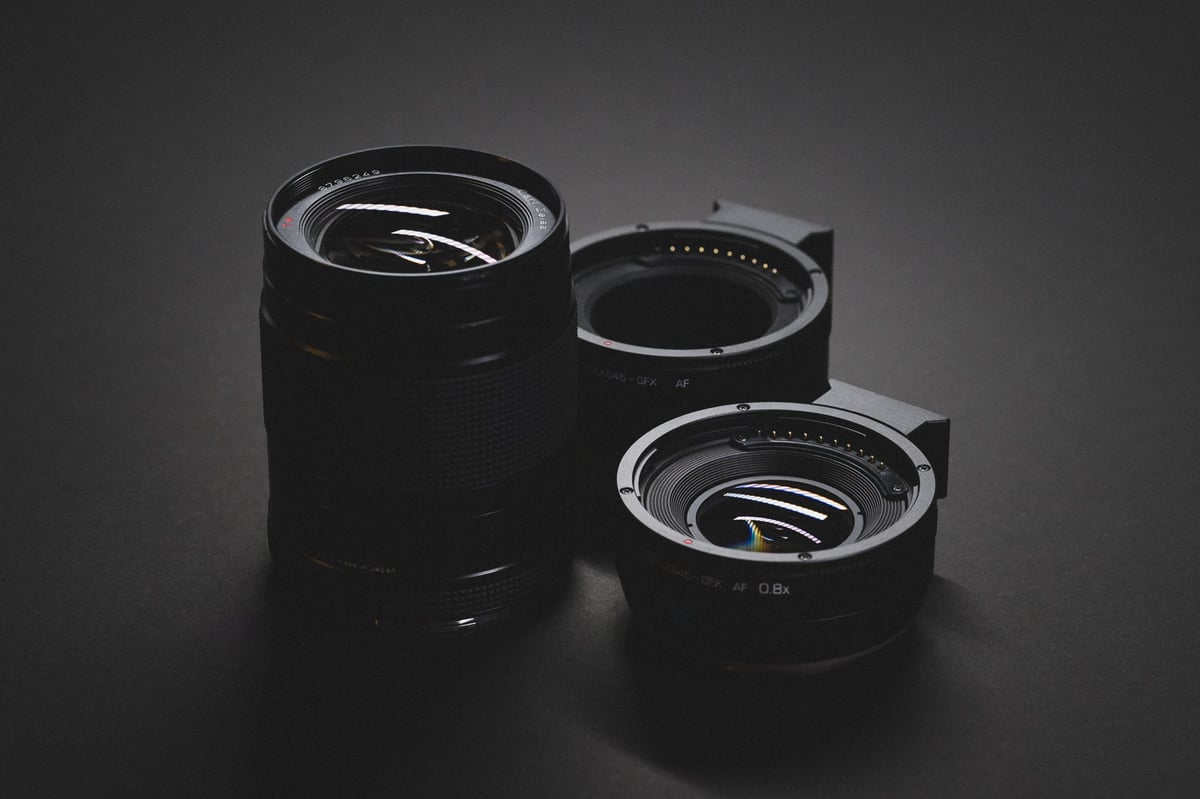
The Contax645 to GFX adapters by Kipon is genuinely one of a kind in that they are your gateway into using Contax645 lenses on the GFX system, with seamless autofocus, infinity focus, and electronic aperture control.
The Baveyes adapter offers a 0.80x angle of view reduction and adds one full f/stop of light, which can transform your GFX experience, considering the limited lens selection of the system.
For this review, I have two of the Kipon adapters, the Standard and the Baveye 0.8x focal reducer, three different Contax lenses, and a Fujifilm GFX100 II. Kipon let me borrow this pile of gear for a month, and it was so much fun.
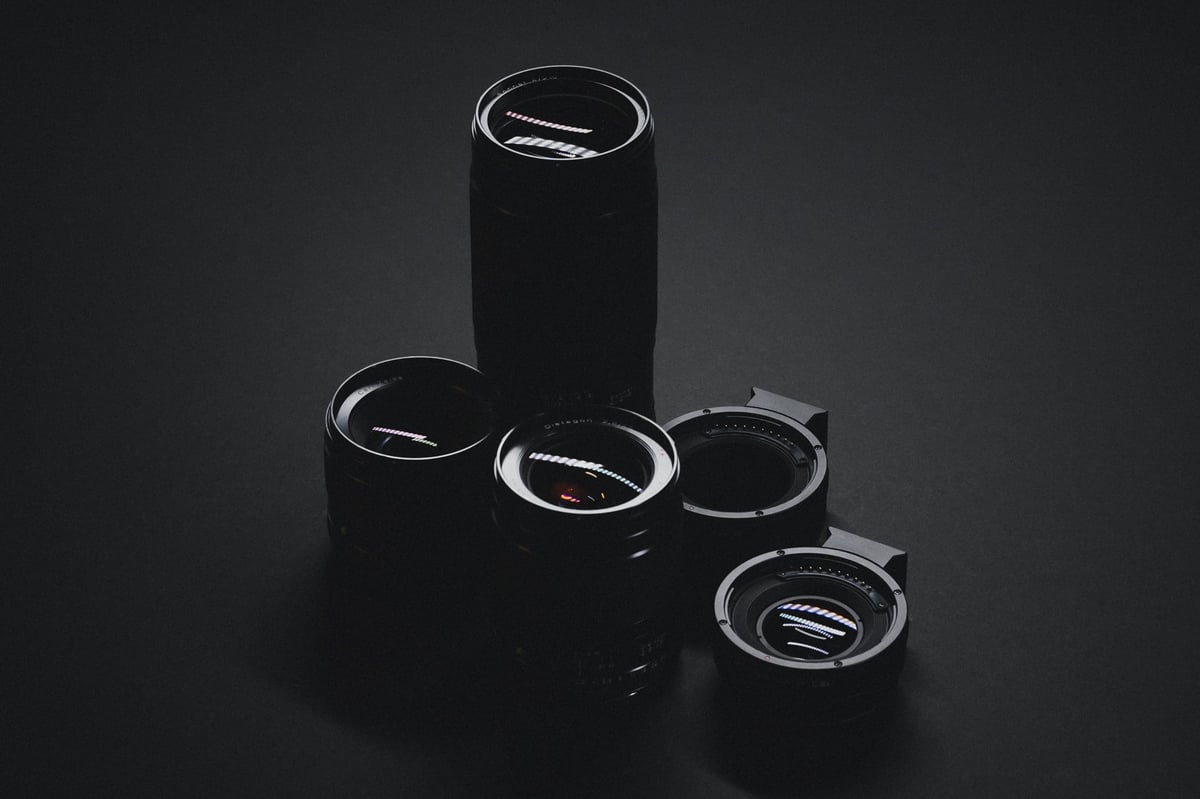
If you’re looking to adapt Contax lenses to the GFX system, you probably just want to buy both adapters Kipon offers as the kit, as they can both be useful. I often went back and forth about 50/50 between the adapters, as the crop factor is significant enough to allow you to have two different focal lengths out of each lens.
The Baveye Focal Reducer gives you just about the total 0.62x crop factor of Contax 645 lenses, meaning a Zeiss 80mm f2 lens becomes something like a 50mm f1.2 in the full frame equivalency.
With the standard adapter, you have the GFX system’s standard 0.79x crop factor. So, the Zeiss 80mm f2 lens is 63mm at about f1.6 – with that lens, you’ll want the focal reducer. For other lenses, you might be okay with the standard adapter.

I really enjoyed shooting on the Zeiss 45mm f2.8 with and without the focal reducer. With the focal reducer, that lens becomes basically 28mm f1.8, whereas with the standard adapter, it is 35mm f2.2 in a full frame equivalency. Both were fun to use for different use cases.
I know most wedding photographers and portrait photographers love the Zeiss 80mm f2 Planar, and that’s kind of the whole reason people are buying this adapter. However, don’t ignore this Zeiss Distagon 45mm f2.8. It’s one of the best lenses I’ve ever used. I’m just totally blown away, and personally, I want to get this system just for that lens eventually. The focus falloff, the detail, and the micro-contrast are just insane.
Here is a sample

And another

Kipon Contax 645 to GFX Adapter Overview
Order Links: Amazon / Kipon / B&H
Be sure to check the list of Fujifilm GF lenses.
Kipon Contax 645 Baveyes 0.8x AF Focal Reducer
Pros – Official Fujifilm Protocols – just about zero loss in sharpness – good build quality – allow you to use the full 645 Image Circle.
Cons – A little heavy – won’t project correct image circle with the tele lenses anything beyond maybe100mm (you have to switch to 35mm crop mode with long lenses)- in bright lighting conditions (bright sky) you can get some center blue flare – I struggle to get full aperture control in video mode on the GFX100II – it doesn’t correctly tell the IBIS system what focal length the lens is simulating so you will sometimes see some strange IBIS shifts between shots if bursting, IBIS still seems to be helping, but I might not reliable for video.
It’s quite a list of cons, but most of those only impact you under unique shooting conditions, and most of these focal reducers have similar issues.
Kipon Contax 645 Standard AF Adapter
Pros – It perfectly adapts the lenses, and IBIS works perfectly.
Cons – Failed to control the aperture properly in video mode on the GFX100 II.
What Is Auto Focus Like?
The adapter communication to the lenses is excellent. The GFX 100 II is a fantastic camera. However, these old Contax lenses are not so great mechanically.
AF is only as good as the lenses’ capabilities. The Fujifilm GFX system still tries to operate the lenses as though they have modern AF motors, and the lenses sometimes struggle to keep up with the camera. AF-S works fine on static subjects, and AF-C mostly works fine with moderate movement.

If you’re shooting portraits and want a perfect hit rate, learning a hybrid shooting method may be best. Set the camera in Manual mode, use the back AF button to find focus, and adjust the lens slightly with MF if it’s not perfect. It takes practice to learn the limitations of each lens, and you have to adjust accordingly.
It’s definitely not really a fast-paced system. Ideal for portraits and landscapes.
There is also a lot of aperture chatter with these old lenses. For whatever reason, the GFX system likes to move around the iris to help with AF and exposure, sometimes stopping it down or opening it up rapidly. This is more of a Fujifilm characteristic than any issue coming from the adapter, I think, but the iris chatter is pretty loud with these lenses. If you need to shoot in a very quiet setting, you’ll likely need to go all manual and only use the AF Back button during the shots.
That’s the general overview. Let’s get into some more details.
Build Quality
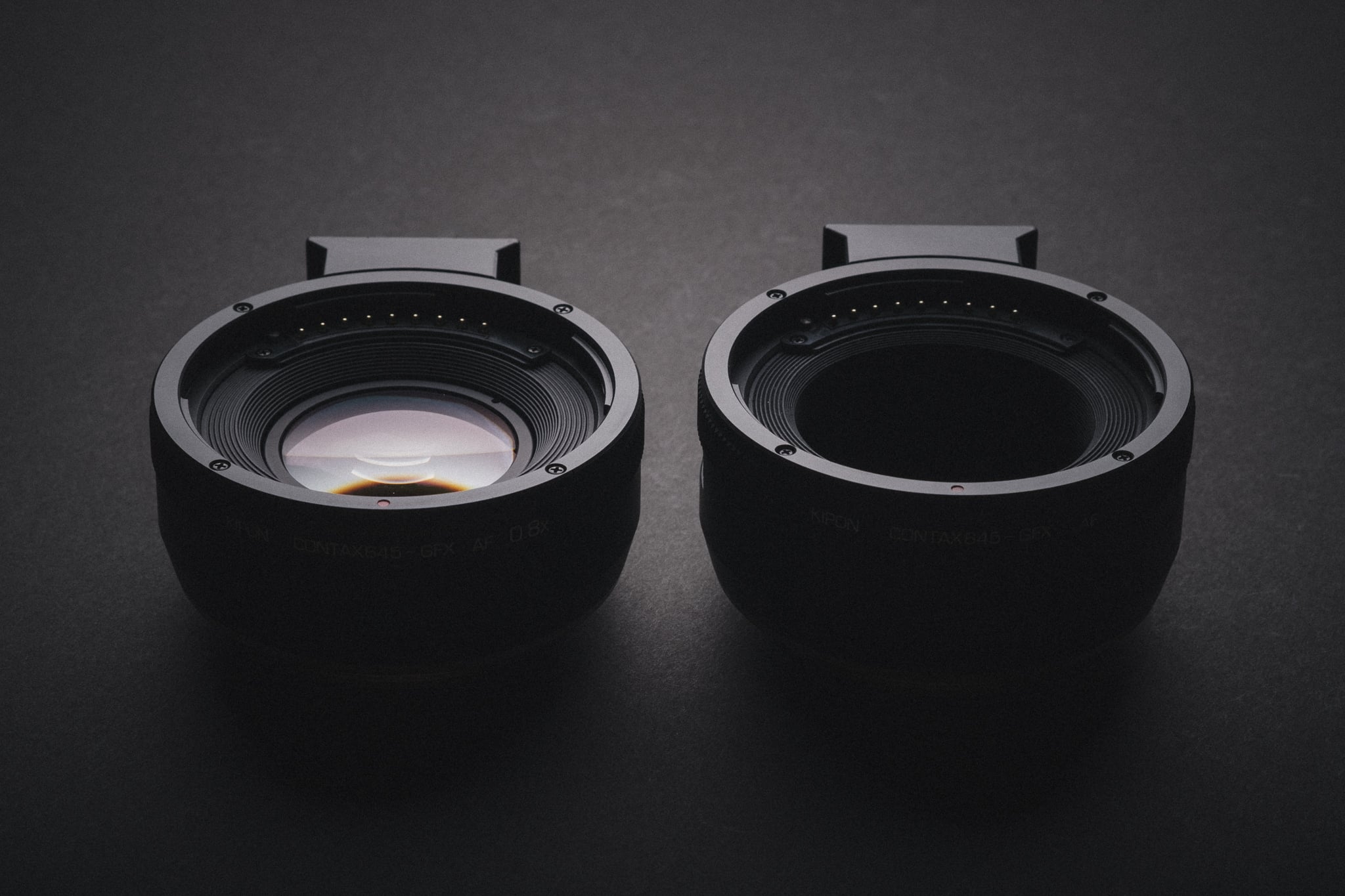
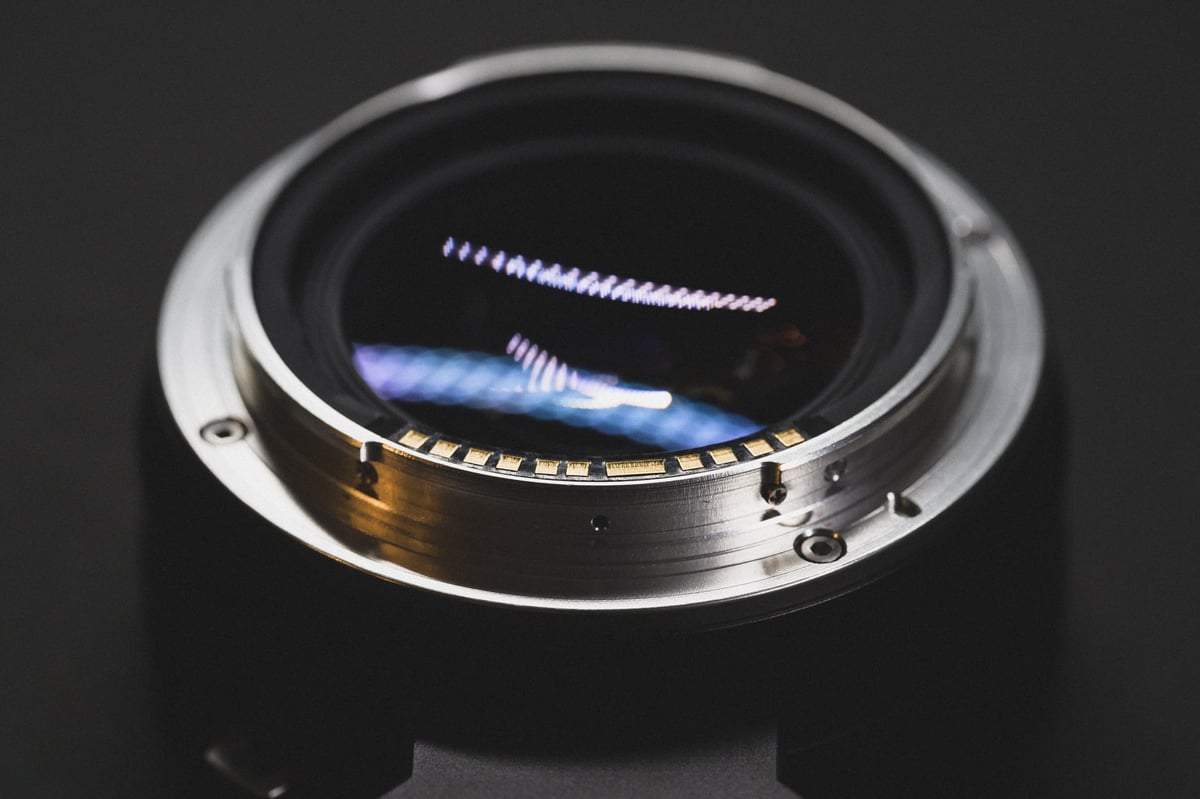
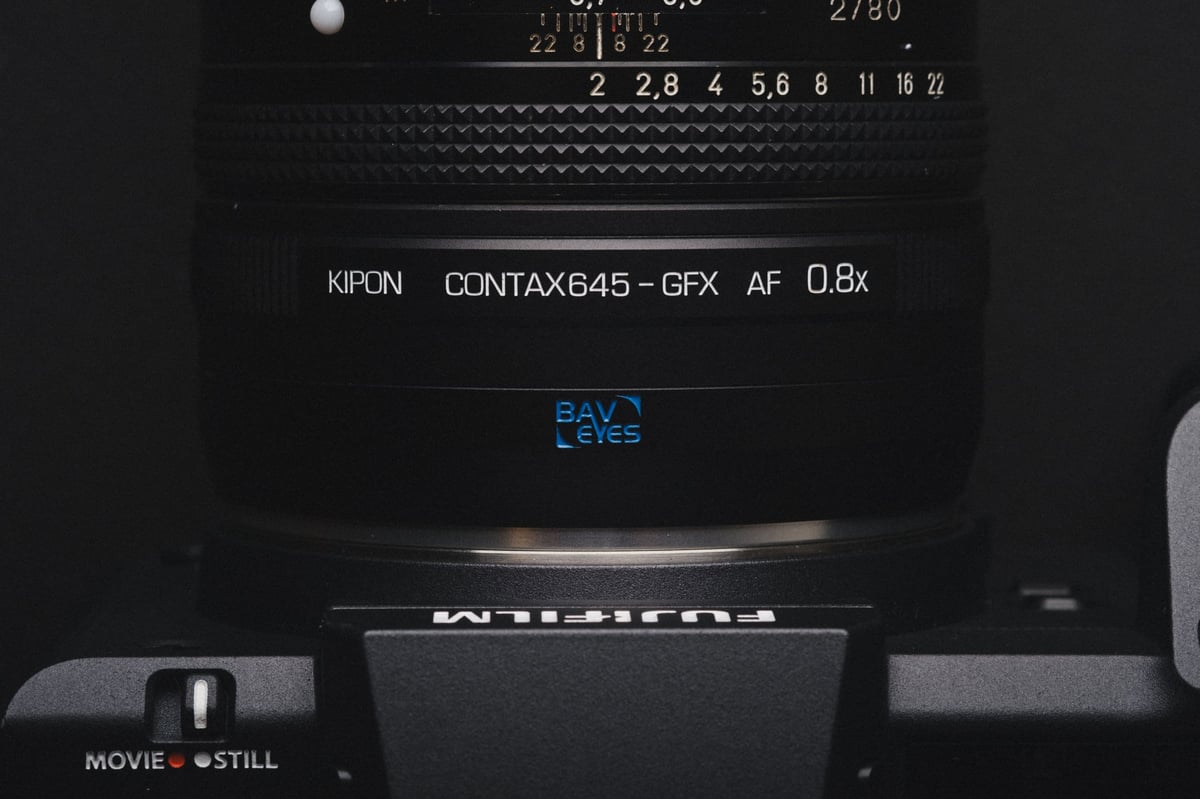
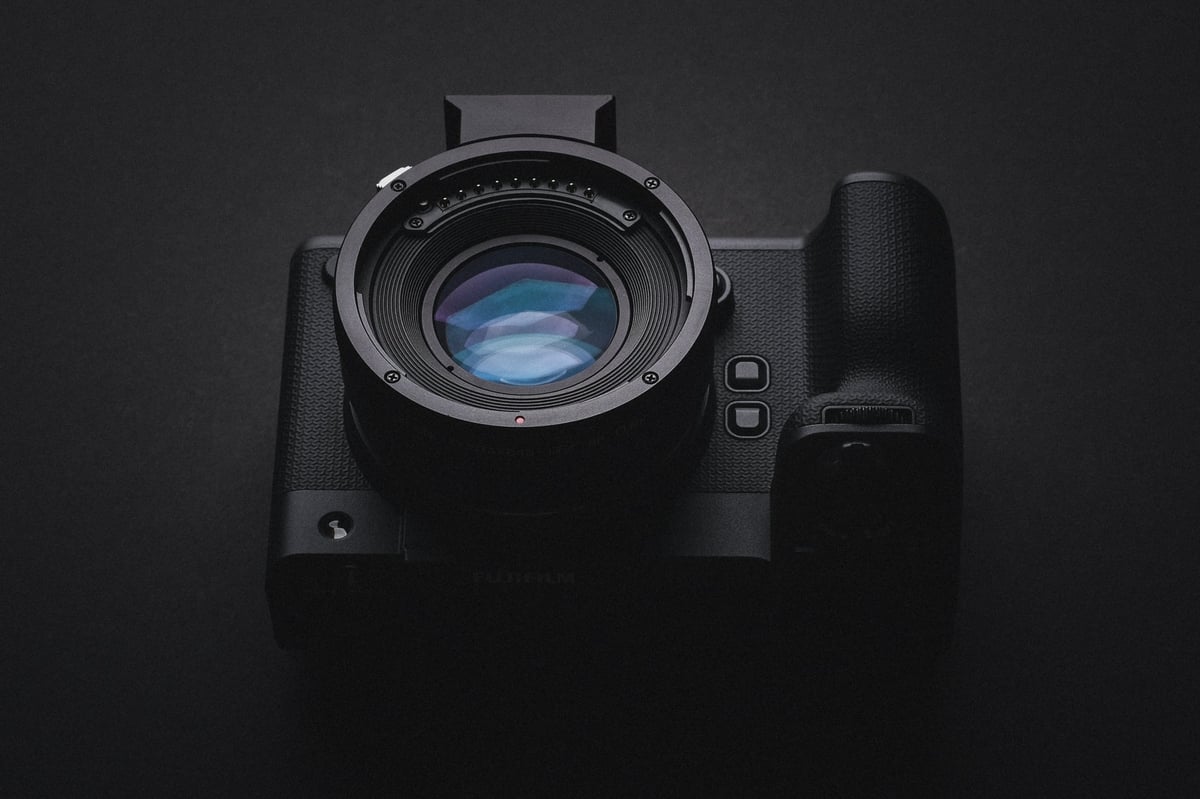
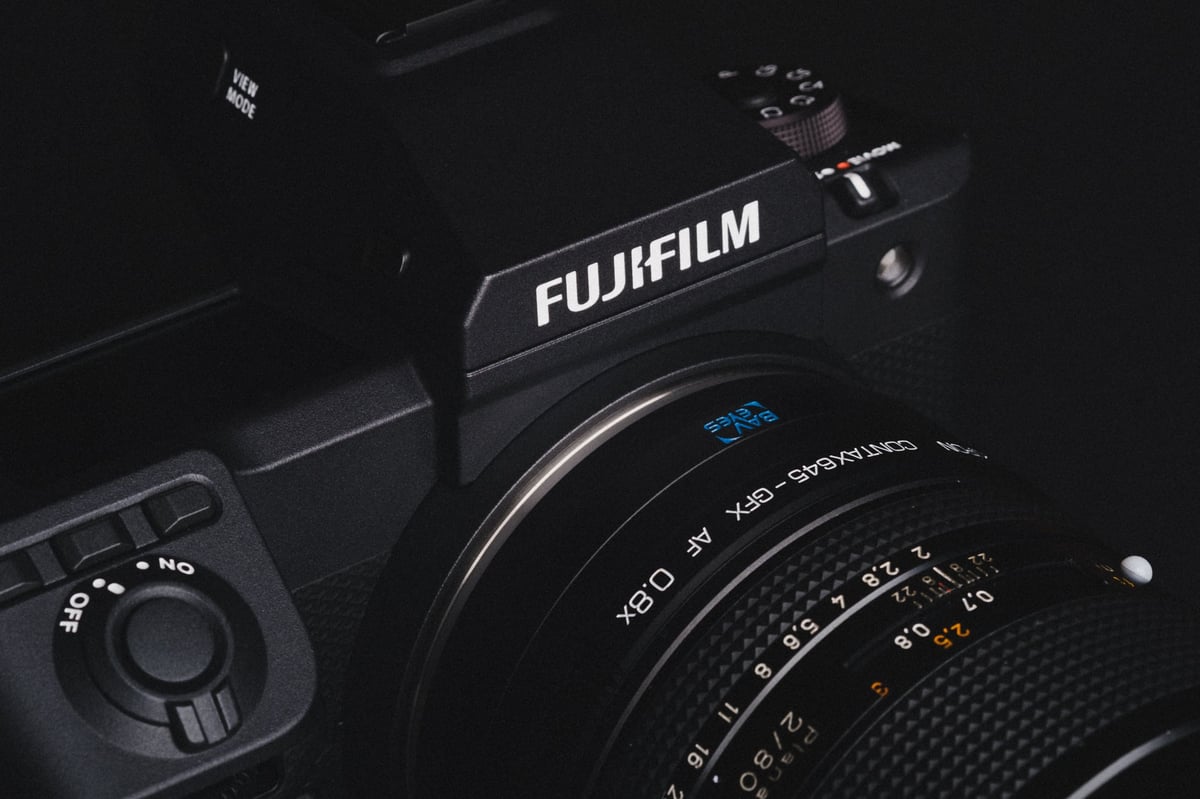
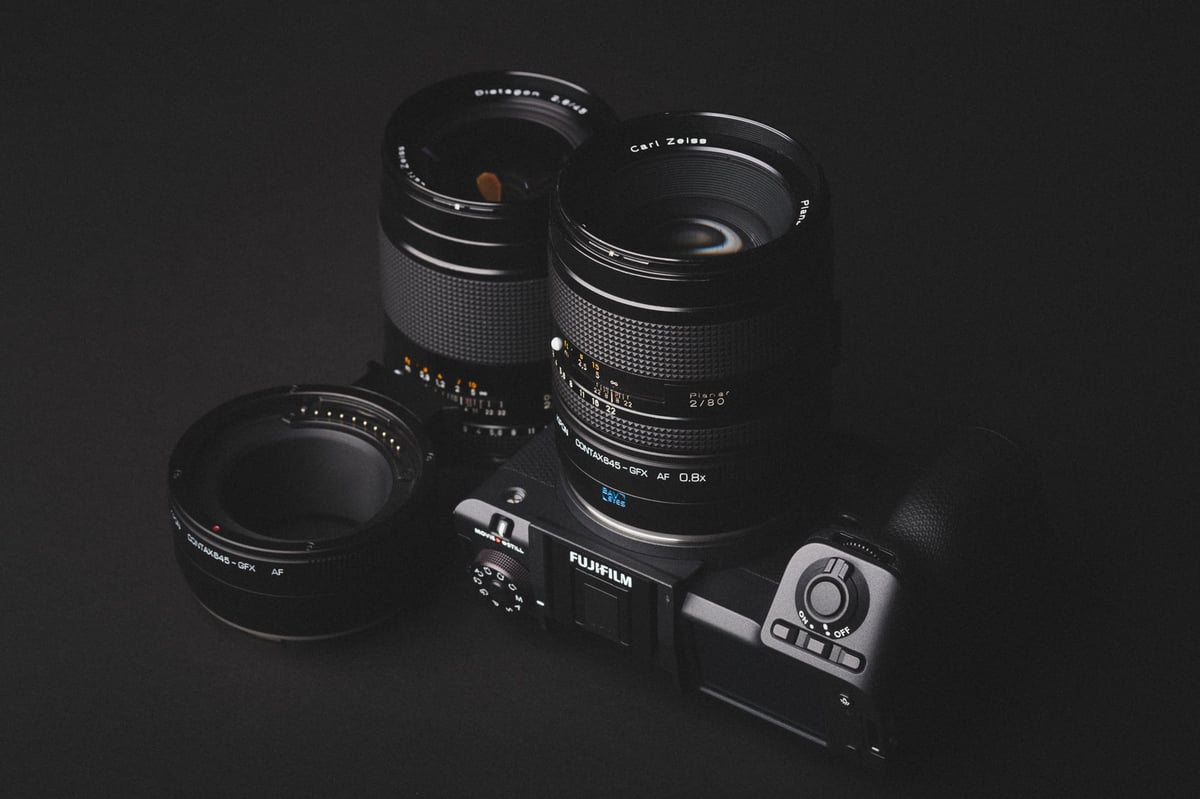
As mentioned above, Kipon makes two adapters for the Contax645 to the Fujifilm GFX system.
This regular adapter allows you to use Contax 645 lenses, and it is a 0.8x focal reducer adapter that they call Baveyes.
Both are smart adapters with official Fujifilm Protocols allowing for AF and Aperture controls. The Baveyes adapter features elements that reduce the full Contax 645 image circle down to the GFX system.
The build quality is very good, the lenses fit very well, and the adapters fit the body very well. They are very precise and very good quality. I have a few Kipon adapters for other systems, and they never disappoint.
The Baveyes adapter is a bit heavier than the standard adapter, so everything together can be a little heavy. Depending on the lens, this could cause some fatigue if you’re not used to it. I shot street photography, landscape photography, and some portraits with the system, which never bothered me. However, I wouldn’t want it really want to use the Baveyes with the GFX100 II as a primary street system where I might be walking around for several hours. If I knew it would be a long day, I would swap out to the standard adapter instead of the Baveyes just for the lighter build.

Kipon CONTAX645-GFX Baveyes AF 0.8x – The Technicals
The 0.8x adapter has built-in elements (I don’t know how many) to take the full Contax645 image circle and condense it down perfectly to the Fujifilm GFX sensor. This means you’ll get the true 645 crop factor of 0.62x.
Your 45mm lens will reduce to 36mm that the GFX sees, which is a 35mm equivalent to around 28mm. When using this adapter, you can multiply the lens’s focal length by 0.62x to get the Full Frame 35mm equivalent field of view – or close to it.
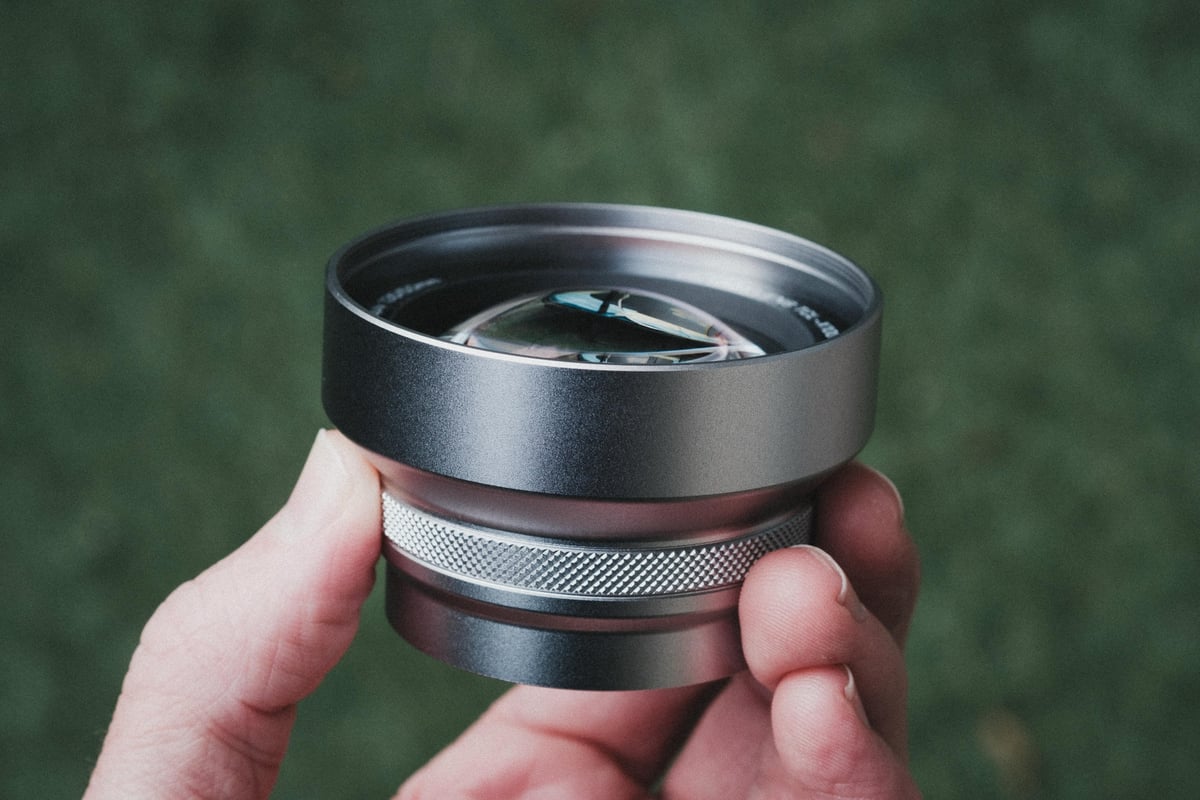
Some companies call these “speed boosters” or “accelerators,” but the technical term is a focal reducer. Kipon names their Focal Reducers “Baveyes,” and they also add about a full stop of light.
Full Electronic Controls – AF, Aperture, EXIF, IBIS
The adapter allows for full electronic passthrough for autofocus and aperture control and EXIF metadata passthrough. However, using the focal reducer will confuse the IBIS system slightly as it’s projecting or simulating a different focal length now because of the added elements.
The IBIS is still helpful for single shots, but you might see some big perspective warps between shots if you’re bursting, or it might be unusable with video.
I did struggle to get proper aperture control on the GFX100 II when shooting video. I imagine this could be corrected with some firmware. I’m not yet sure how it functions on the older GFX cameras.
Kipon actually let me borrow their GFX100 II before they ever got to use it or test with it. Now that it’s back in their hands, I imagine they’ll need some further testing and debugging for that particular camera.
Image Quality
The image quality of the Baveyes Focal Reducer is great. It will vary from lens to lens, but for the most part, the adapter and the extra elements don’t alter the bokeh or image in any significant way. For example, some other Focal Reducers I’ve had caused some issues with swirling bokeh; I don’t see that here.
You will have to be careful with some of the longer lenses since lenses with a really deep rear element don’t project the correct angles for the adapter, and you end up with a lot of vignetting and would need to shoot with 35mm crop mode. So, I would not use the Focal Reducer for long Contax lenses; I would just stick to the standard adapter for lenses like the 210mm.
Image Quality – Resolution
I don’t really see any drop in image quality in terms of resolution.
I can’t check the full image circle of a 645 lens since I don’t have a digital camera with that large sensor, but I did some tests with the Zeiss 80mm f2.
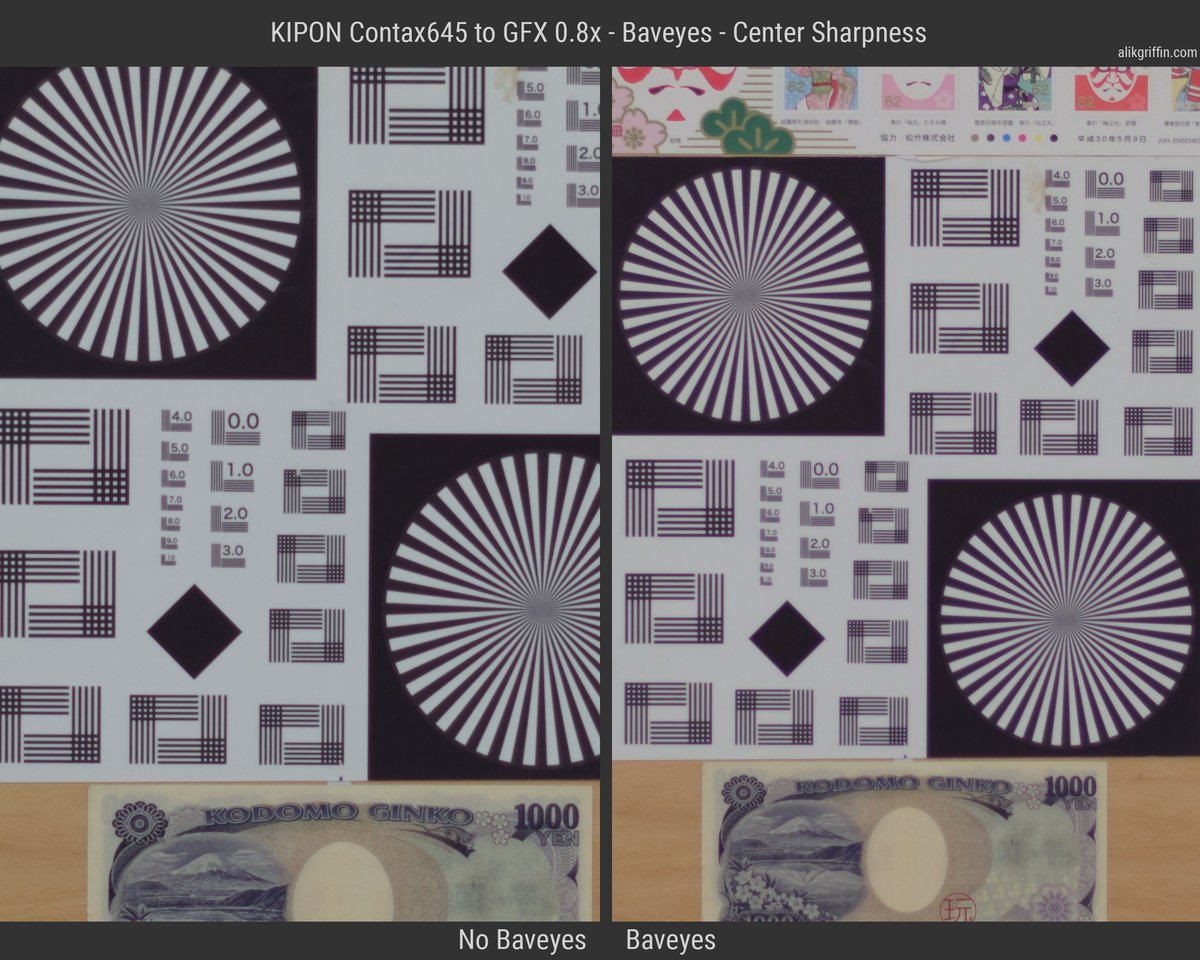
Resolution Chart – Center Sharpness
Here is a sample using the Standard Adapter with the full sensor on the left, then on the right, I use the Baveyes adapter in the 35mm mode. This projects a similar portion of the lens onto the sensor to get a general idea of performance on the same lens area. So, there is a resolution difference here, but it at least gives us an idea of what the adapter is doing.
The image has a slight haze or chroma color, but this happens when the focus is not the same. It’s hard to get it exact between the two samples with such a fast lens. You’ll get purple or green chroma if it’s even slightly front or back-focused. So, I’m not sure exactly how much of this color shift is from the adapter or my inability to get exact focus between the two.
Sharpness looks pretty comparable.
Corner Sharpness
This is focused on the center of the images, which looks at field curvature.
The corners again look great. The Baveyes adapter makes the corner perform a little better. However, even a slight difference in center focus can push these corners into noticeably different results due to the field curvature of such a fast lens.
The takeaway is that the Baveyes adapter doesn’t hurt the resolution significantly.
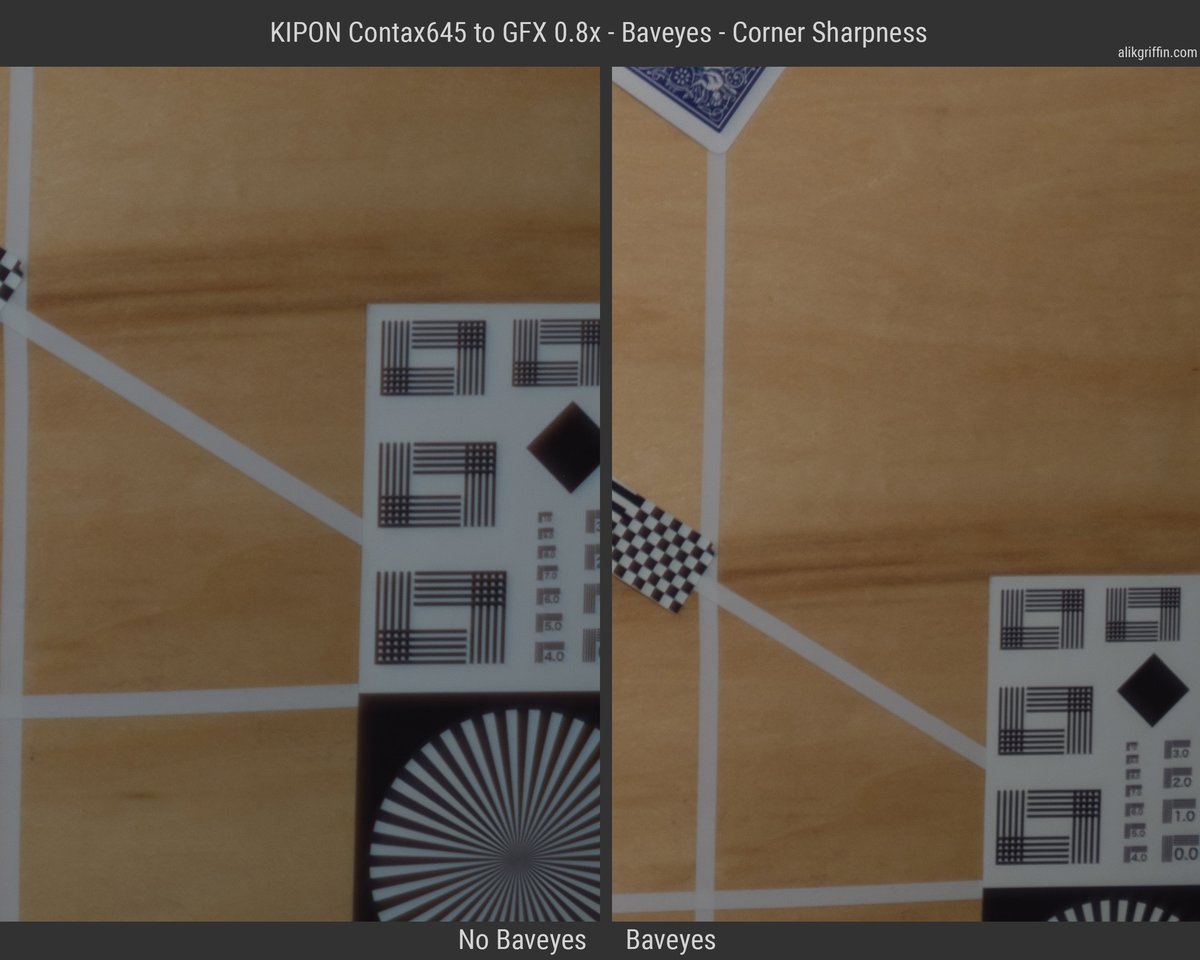
Image Quality – Aberrations
There are pretty much no extra chromatic aberrations with the lenses I had. However, occasionally, I did see some center blue flaring and sometimes some subtle additional glow in the image.
Here in these samples, you can see the blue flaring in the center, and these are a little glowy for straight-out-of-camera shots.


This blue glow wasn’t terrible; it only happened when I was shooting bright landscapes with a lot of bright skies or lighting coming from particular angles. Maybe an ND filter would fix this, but in general, the inner elements of the adapter were causing some inner light to scatter in some very bright situations, causing that little blue light in the center frame.
Here, it didn’t show up.

This image was taken with the Zeiss 40mm f2.8 with the focal reducer. This gives an image similar to a Full Frame 28mm f1.8 lens. It’s a shame you can’t experience the full beauty of the GFX files on YouTube or blogs like this because of compression limitations. Still, these files and images, in full size on my 4k monitor, are beautiful and full of life and color. It’s a different experience than what you see here. The GFX100 II is just amazing.


This image was taken on the Contax 80mm f2 lens without the focal reducer and just the standard adapter.

The camera does a great job of finding and focusing on the eye, but the lens won’t always be able to keep up with quick little monkey head movements. You must have some realistic expectations if you’re coming from used Quad Linear AF motor Fujifilm lenses to these older Contax designs.
Bottom Line
Today, there still isn’t really a way to get something like a 50mm f1.2 lens or other fast lenses on the GFX system, and the Kipon Baveyes adapter allows you to achieve that by using the Contax 80mm f2 with the GFX system. You could call it a game changer if you want that classic ultra-fast-medium format look.
This adapter seems to be mostly designed for wide to midrange lenses, up to about 80mm. I think when you get into the tele lenses, it doesn’t make as much sense to use an adapter like this as you often want more reach with a crop, not less from a focal reducer, unless you really want a slightly shallower dof and a touch more light.
Some of the Contax lenses are amazing, and some are just so-so, so your mileage will vary here depending on what lenses you have, but I did have a ton of fun with the system and hope one day to get a setup like this.

What else is great is that some of these Contax lenses are actually really good. As I’ve mentioned, the 45mm f2.8 is phenomenal, and the 80mm f2 is also pretty good in most situations for a lens with a more classic rendering. It’s just a ton of fun to use, and you get image quality and detail you could never really get before from any other system. It’s truly a unique experience with only a few limitations.
Fujifilm GFX100 II with Contax 645 Adapter Sample Images
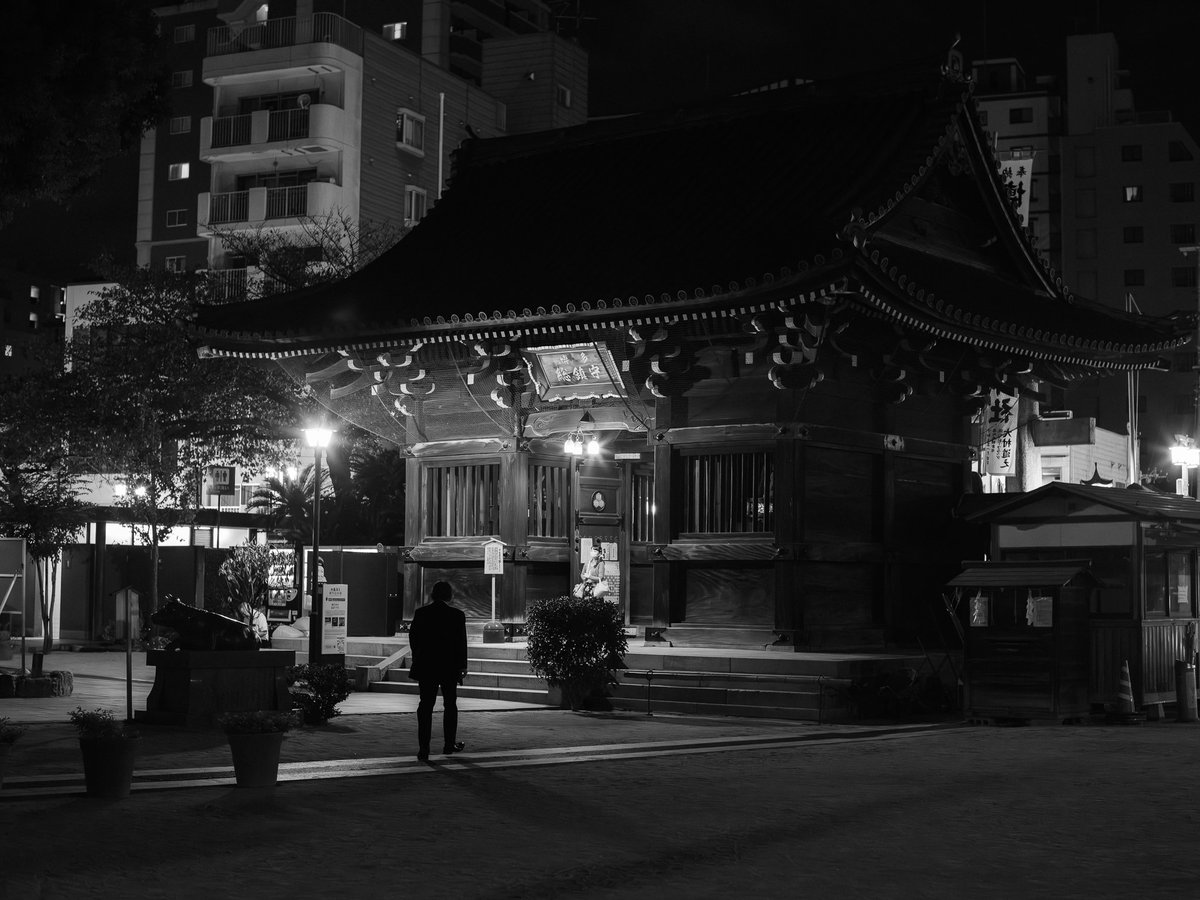
I believe most of these images were shot with the Baveyes adapter. There were a few days when I didn’t keep track, but I’m pretty sure almost everything here is Baveyes.
Images are colored with my presets.

























Leave a Reply