
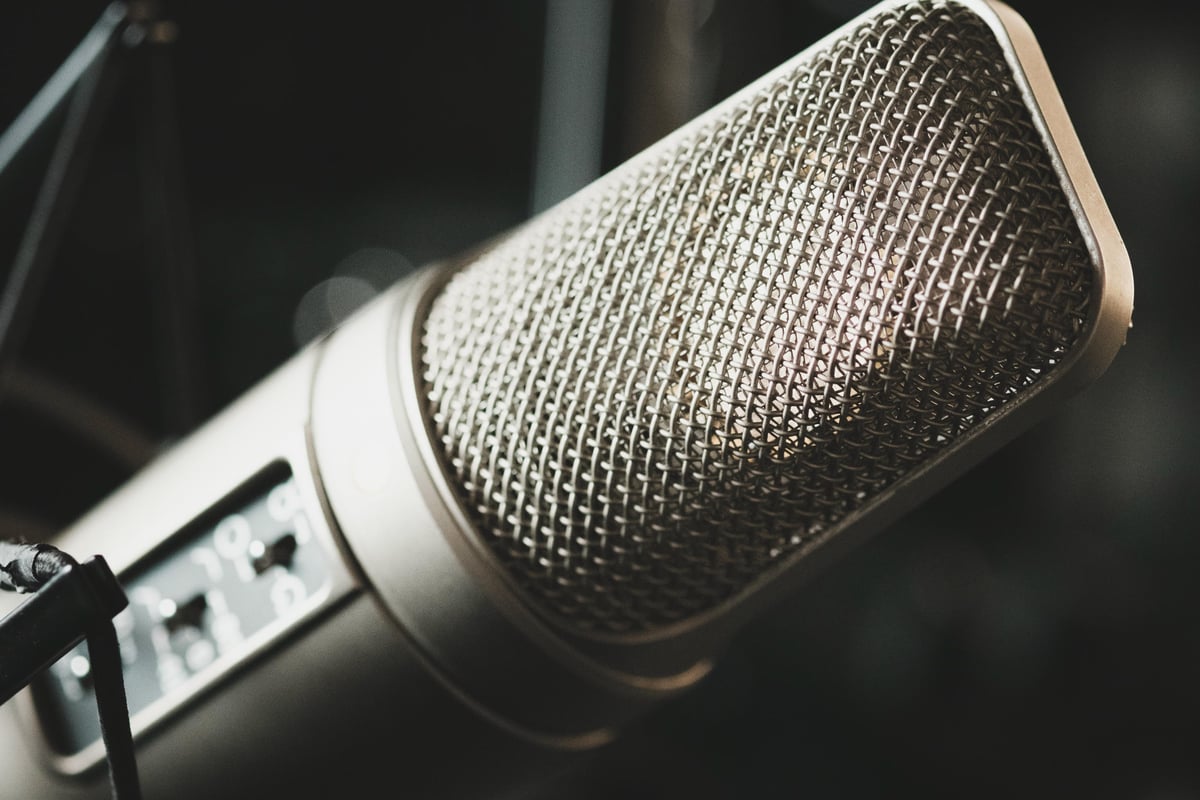
When considering condenser microphones for a podcast, gaming, streaming or just general content creation, there are almost limitless options. Still, there are a few key characteristics to consider when setting up a studio environment for recording human voices.
The type of mic you want is called a Condenser Mic or a Dynamic Mic. These different types of mics will have different form factors and diaphragm designs that might be better suited to recording scenarios other than spoken word.
You also need to consider whether you want the mic to be XLR or USB-powered and what type of interface you want to run through. For example, with a multi-mic setup, you’ll likely need to run through an interface, and you’ll likely want to use XLR mics. However, if it’s just you on a computer, you can skip the interface and run a USB mic directly into your computer.
Dynamic vs Condenser Microphones
A Condenser mic, like a Rode NT1 or NT2, requires phantom power. In contrast, a Dynamic Mic is self-powered but less sensitive and often requires a signal booster, such as the Cloudlifter, when used with a budget audio interface. This is usually why you see Podcast hosts constantly hounding their guests to get right up to the mic when using something like a Shure SM7B. The sensitivity of these mics is very low, and you need to be right up against them to get usable levels or for the mic to sound the way it’s supposed to.
You can, by the way, turn the sensitivity down on a Condenser mic like the Rode NT1 to get a similar volume. For some reason, most people don’t understand how the inverse-square law applies to sensitivity and distance, even among very successful microphone reviewers, and they think that Dynamic mics magically cut down on background noise, when, in fact, they are just less sensitive and are always running at a lower volume. If you match the volume and sensitivity of the two mic types, the volume and background noise should be the same. Although the Diaphragm mic has a heavier diaphragm mass, it will have a different character. Typically, this is why Condenser mics are often used to record studio instruments, vocals, and voiceover, where detail is essential. In contrast, Dynamic mics are used more in Broadcast and on Stage, where they have a nice, dare I say ‘baked-in’ sound, that’s really great for the human voice.
Don’t buy a Dynamic mic if you’re not going to use it properly. Meaning, it needs to be pointed directly at your mouth, and it should be close. I see this all the time, people spending a ton of money on the Shure SM7B, but then don’t use it correctly and don’t get the sound they are paying for.
If you want to get more loose with how your mic is set up, go with a Condenser Mic.
Recommended Podcast Mics
The most popular “good mic” used in most big podcasts is the Shure SM7B, or the SM7dB if you want a built-in Cloudlifter. They have a very familiar, iconic warmer sound that is great for male voices. Personally, I would lean more towards the Electro-Voice RE20.
For midrange budgets, I see the RODE PodMic or RODE Procaster Dynamic mics a lot. A lot of streamers are using these now as well, although I typically see streamers using Condenser mics a little more.
The form factor of the Dynamic mic just works a little better for multiple people in a podcast, since it lets you place the mic close to the guest’s mouth, where it can be run at a lower volume to cut down background noise. They are often a little better at rejecting off-axis sound.
Streamers often use condenser mics because they look cooler and can be placed farther away, so they do not block the camera as much while still delivering great sound. By moving the mic further away from your face, it will pick up more background sound, and you’ll likely want a sound-treated room.
| Mic Name | Type | Connection | Internal Windscreen | Foam Windscreen | Polar Pattern | Power Source | Controls | Frequency Range | Sensitivity (XLR) | Weight | Links | ||
|---|---|---|---|---|---|---|---|---|---|---|---|---|---|
| Dynamic | |||||||||||||
| Audio Technica AT2040 | Dynamic | XLR | 1 | Yes | Hypercardioid | None | None | 80 Hz to 16 kHz | 1.4 lb / 615 g | B&H | |||
| Electro-Voice RE20 | Dynamic | XLR | 3 | Yes | Cardioid | None | Low Cut/HPF | 45 Hz to 18 kHz | -56 dBV/Pa (at 1 kHz) | 26 oz / 737.1 g | B&H | ||
| Fifine K688 | Dynamic | XLR/USB | 1 | No | Cardioid | Bus Power | 70 Hz to 15 kHz | 11.4 oz / 323 g | Amazon | ||||
| RODE PodMic XLR | Dynamic | XLR | 1 | Yes | Cardioid | None | None | 20 Hz to 20 kHz | -57 dB (at 1 kHz) | 2.1 lb / 937 g | B&H | ||
| RODE PodMic XLR + USB | Dynamic | XLR/USB | 2 | Yes | Cardioid | Bus Power | 20 Hz to 20 kHz | -57 dB (at 1 kHz) | B&H | ||||
| RODE ProCaster | Dynamic | XLR | 2 | Yes | Cardioid | None | None | 75 Hz to 18 kHz | -56 dB (at 1 kHz) | 1.64 lb / 745 g | B&H | ||
| Samson Q9U XLR/USB | Dynamic | XLR/USB | 2 | Yes | Cardioid | Bus Power | High Boost, Low Cut/HPF, Mic Mute, Mid Boost | 50 Hz to 20 kHz | -57 dBV/Pa (at 1 kHz) | 2.13 lb / 0.97 kg | B&H | ||
| sE Electronics DynaCaster DCM6 | Dynamic | XLR/USB | 1 | No | Cardioid | Phantom Power | Gain/Sensitivity | 40 Hz to 18 kHz | 18.3 oz / 518 g | B&H | |||
| sE Electronics DynaCaster AM8 | Dynamic | XLR/USB | 1 | No | Cardioid | Bus Power | 20 Hz to 19 kHz | Amazon | |||||
| Shure SM7B | Dynamic | XLR | 3 | No | Cardioid | None | Low Cut/HPF, Mid EQ | 50 Hz to 20 kHz | -59 dBV/Pa (at 1 kHz) | 1.69 lb / 766.57 g | B&H | ||
| Shure SM7dB | Dynamic | XLR | 3 | No | Cardioid | 48 V (Phantom Power) | None | 50 Hz to 20 kHz | 1.7 lb / 764 g | B&H | |||
| Shure MV7+ | Dynamic | XLR/USB | 2 | No | Cardioid | Bus Power | None | 50 Hz to 16 kHz | -55 dBV/Pa (at 1 kHz) | 1.3 lb / 573.5 g | B&H | ||
| Shure MV7X | Dynamic | XLR | 2 | No | Cardioid | None | None | 50 Hz to 16 kHz | 1.21 lb / 0.55 kg | B&H | |||
| Zoom ZDM-1 | Dynamic | XLR | 1 | No | Supercardioid | None | None | 50 Hz to 18 kHz | 14.11 oz / 400 g | B&H | |||
| Condenser | |||||||||||||
| AKG C414 XLII | Condenser | XLR | 4 | No | Cardioid / Figure-8 / Hypercardioid / Omnidirectional / Subcardioid/Wide Cardioid | Phantom Power | Polar Pattern, Pad, Low Cut/HPF | 20 Hz to 20 kHz | -33 dBV | 10.6 oz / 301 g | B&H | ||
| Audio Technica AT2035 | Condenser | XLR | 2 | No | Cardioid | Phantom Power | 20 Hz to 20 kHz | -33 dBV/Pa | 14.2 oz / 403 g | B&H | |||
| Audio Technica AT2020USB-X | Condenser | USB | 2 | No | Cardioid | Bus Power | Direct Monitor Blend, Mic Mute, Headphone Volume | 20 Hz to 20 kHz | 13.2 oz / 373 g | B&H | |||
| Audio Technica AT2020 | Condenser | XLR | 1 | No | Cardioid | Phantom Power | 20 Hz to 20 kHz | -37 dBV/Pa | 12.1 oz / 343 g | B&H | |||
| Audio Technica AT4040 | Condenser | XLR | 3 | No | Cardioid | Phantom Power | Pad, Low Cut/HPF | 20 Hz to 20 kHz | -32 dBV/Pa | 12.7 oz / 360 g | B&H | ||
| Austrian Audio OC818 | Condenser | XLR | 4 | No | Cardioid / Figure-8 / Hypercardioid / Omnidirectional / Subcardioid/Wide Cardioid | Phantom Power | Polar Pattern, Pad, Low Cut/HPF | 20 Hz to 20 kHz | 12.7 oz / 360 g | B&H | |||
| Blue Yeti | Condenser | USB | 2 | No | Cardioid / Figure-8 / Omnidirectional | Bus Power | Direct Monitor Blend, Polar Pattern, Low Cut/HPF, Headphone Volume | 20 Hz to 20 kHz | 2.2 lb / 1 kg | B&H | |||
| Elgato Wave 3 | Condenser | USB | 2 | No | Cardioid | Bus Power | Gain/Sensitivity, Direct Monitor Blend, Mic Mute, Headphone Volume | 70 Hz to 20 kHz | 9.9 oz / 280 g | B&H | |||
| HyperX ProCast | Condenser | USB | 2 | No | Cardioid | Phantom Power | Pad, Low Cut/HPF | 20 Hz to 20 kHz | 0.82 lb / 0.37 kg | B&H | |||
| HyperX QuadCast 2 S | Condenser | USB | 2 | No | Figure-8 / Omnidirectional | Bus Power | 20 Hz – 20 kHz | 300g | Amazon | ||||
| HyperX Solo Cast | Condenser | USB | 1 | No | Cardioid | Bus Power | Mic Mute | 20 Hz to 20 kHz | 15.2 oz / 429.9 g | B&H | |||
| Mackie EM-91C | Condenser | XLR | 1 | No | Cardioid | Phantom Power | None | 20 Hz to 18 kHz | 0.46 lb / 0.21 kg | B&H | |||
| Neumann U 87 Ai | Condenser | XLR | 4 | No | Cardioid / Figure-8 / Omnidirectional | Phantom Power | Polar Pattern, Pad, Low Cut/HPF | 20 Hz to 20 kHz | 1.1 lb / 500 g | B&H | |||
| Neumann TLM 103 | Condenser | XLR | 4 | No | Cardioid | Phantom Power | None | 20 Hz to 20 kHz | -32.5 dBV (at 1 kHz) | 15.87 oz / 450 g | B&H | ||
| Lewitt LCT 440 Pure | Condenser | XLR | 3 | No | Cardioid | Phantom Power | None | 20 Hz to 20 kHz | -31.2 dBV/Pa | 10.9 oz / 309.02 g | B&H | ||
| Razer Seiren V3 | Condenser | USB | 1 | No | Supercardioid | Bus Power | 20 Hz to 20 kHz | B&H | |||||
| RODE NT1 5th Generation | Condenser | XLR/USB | 2 | No | Cardioid | Phantom Power | Compressor, EQ, Noise Reduction, Sound Preset | 20 Hz to 20 kHz | 10.9 oz / 308 g | B&H | |||
| RODE NT2-A | Condenser | XLR | 3 | No | Cardioid / Figure-8 / Omnidirectional | Phantom Power | Polar Pattern, Pad, Low Cut/HPF | 20 Hz to 20 kHz | -36 dBV/Pa (at 1 kHz) | 1.9 lb / 0.86 kg | B&H | ||
| RODE NT-USB+ | Condenser | USB | 2 | No | Cardioid | Bus Power | Direct Monitor Blend, Headphone Volume, Compressor, EQ, Noise Reduction, Sound Preset (via Software) | 20 Hz to 20 kHz | 1.2 lb / 540 g | B&H | |||
| Samson Go Mic | Condenser | USB | 1 | No | Cardioid / Omnidirectional | Bus Power | Polar Pattern | 20 Hz to 20 kHz | -47 dB | 3.7 oz / 105 g | B&H | ||
| sE Electronics DynaCaster sE8 | Condenser | XLR | 2 | No | Cardioid | Phantom Power | Pad, Low Cut/HPF | 20 Hz to 20 kHz | -32 dBV | 4.97 oz / 141 g | B&H | ||
| Sennheiser Profile USB | Condenser | USB | 2 | No | Cardioid | Bus Power | 20 Hz to 20 kHz | B&H | |||||
| Sennheiser MK4 | Condenser | XLR | 3 | No | Cardioid | Phantom Power | No | 20 Hz to 20 kHz | 1.07 lb / 485 g | B&H | |||
| Shure KSM32/CG | Condenser | XLR | 3 | Yes | Cardioid | Phantom Power | Pad, Low Cut/HPF | 20 Hz to 20 kHz | -36 dBV/Pa | 17.3 oz / 490.46 g | B&H | ||
| Warm Audio WA-97 R2 | Condenser | XLR | 3 | No | Cardioid / Figure-8 / Omnidirectional | Phantom Power | Polar Pattern, Pad, Low Cut/HPF | 20 Hz to 20 kHz | 5.51 lb / 2.5 kg | B&H |
I’ve listed some very high-end mics, like the Neumann, AKG, the Austrian Audio OC818, etc., for those who use mics for multiple projects, like Voice Over or Recordings or are just rich and want a mic that looks cool. But these would be overkill for a Podcast or streaming alone.
For a personal starter mic for a solo streamer or content creator, the Blue Yeti is by far the most popular. I also see the HyperX QuadCast a lot. If you’re just a guest on a podcast over camera, you could go cheaper with something like a Samson Go Mic or Razer Seiren V3. They are USB-powered and sound good enough for convenience.
For more popular streamers using Condenser mics, I see RODE a lot here. The RODE NT1 or NT2 gets used a lot by streamers. PewDiePie was on the NT1 a while back. At home, I use the NT2-A, but I also use it for recording since it’s multidirectional.
Generally, XLR mics seem to sound a little nicer than USB mics, but USB mics offer many features. The Shure MV7+ sounds great as an XLR mic, but the MV7 sounds a little nicer as a USB mic and has a few fewer features.







Leave a Reply