
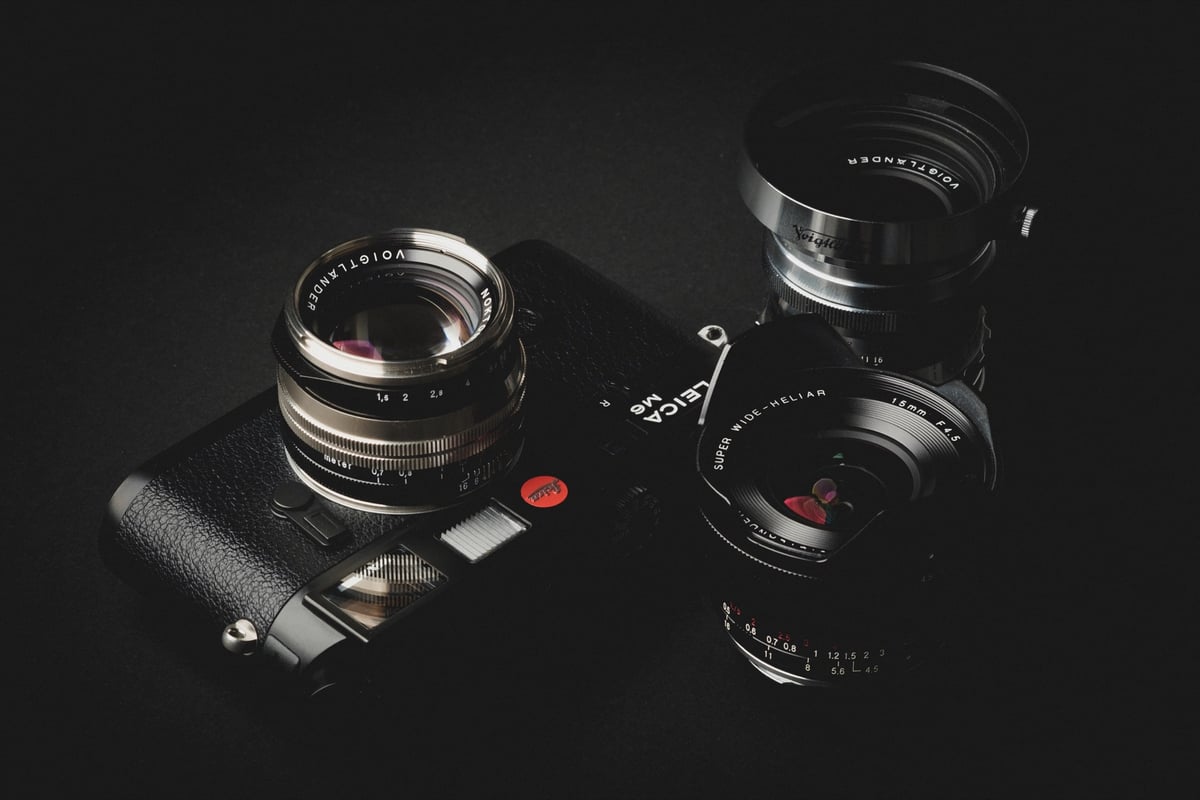
Voigtlander pumps out lenses faster than most people go through socks, so all these different names and designs can get a little confusing, especially when trying to figure out which lenses are good at what.
This guide will explain the Voigtlander lenses’ naming convention, what they mean, and some of the history behind them.
Ultron vs Heliar vs Nokton vs Lanthar vs Skopar
This will have to be a little bit of an open discussion because there is a lot of legacy with some of these lens names, and Voigtlander doesn’t always hold 100% to the historic naming.
You can check out all the M mount lenses Voigtlander makes in this list of all the Leica M Lenses. They are also now making lenses specifically for the Sony E Mount, the Fujifilm X mount, and the Nikon Z mount.
It’s unclear to me if Voigtlander is designing these lenses specifically for each brand’s sensor stack, which would optimize performance, but some of these lenses are passing electronic information like aperture information, and I believe they are even passing focus positions, which allows you to maintain 5-axis IBIS instead of dropping to 3-axis which is what happens when you mount M lenses to one of these mirrorless bodies. So it might not be ideal to adapt M lenses to mirrorless bodies anymore, especially with Sony FE cameras, which perform pretty terribly with a lot of M-Mount lenses because of the very thick sensor stack. If you still want to use M lenses on a full-frame mirrorless body, Nikon Z, Panasonic L, or Leica L mounts will give you the best performance. Sometimes Canon RF cameras are fine, but some lenses will still cast a purple vignetting on some of the bodies like the original Canon R – the R6 and R5 have adjusted the sensor stack, so this doesn’t happen as much.
What Does Nokton Mean?
Voigtlander Nokton lenses are similar to Noktilux or Noct. Most likely, this word is derived from Latin Noctis, meaning night.
These lenses are designed with fast apertures for low-light shooting.
These lenses might not be the best for bright daylight as sometimes they have issues with inner element light scattering, among other little glaring and blooming issues. Not always, but sometimes. Using ND filters during the day is sometimes helpful if you want to keep that fast aperture.
Today there are Ultrons and Heliar lenses that are just as fast as Noct lenses, so it’s not exactly clear what separates the Noct from these lenses optically other than Noct lenses are tuned to perform better at the faster apertures, using more elements or whatever grouping necessary to make it work best.
Whereas a 50mm f1.5 Classic Heliar lens will likely be married to a triplet configuration, and if it’s a Classic, it will be designed for that low element “classic” rendering, with higher micro-contrast but a lot more imperfections.
What Does Heliar Mean?
It’s often thought that Heliar lenses were your daytime lenses or your “shoot stopped down lenses.” Often smaller and lighter than Nokton or Ultron lenses. Heliar is derived from Helios, the Greek god for the Sun.
Usually, these lenses also have a slower max aperture, but that’s not always the case, especially with newer lenses coming out.
Now a 50mm f1.5 Heliar Classic has been released throwing a wrench into daytime lens theory since you can’t use an f1.5 in the daylight without an ND filter (unless you use an electronic shutter). So it’s obvious now that Heliar does not mean it’s a daytime lens.
It used to be that the Heliar lenses were a 5 element design, but that’s not the case anymore either.
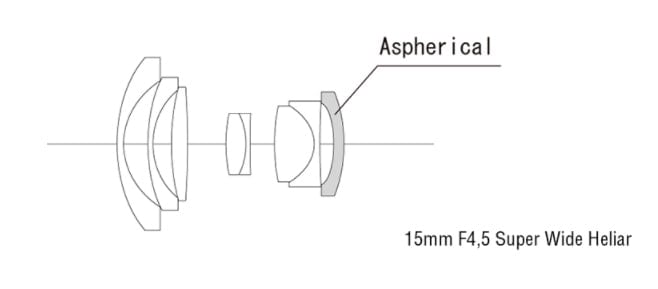
But it does look like Heliar lenses do mostly still hold to having a sort of triplet optical configuration. This means it’s a triplet design, but the elements are grouped with something like 5 elements in 3 groups, or groups of groups like with the 15mm Heliar, which you can still see has a triplet grouping.
Sometimes, the marketing team might just break the rules and call a lens Heliar because it’s a slower lens, and they didn’t know what else to call it like with the 10mm.
My take is that today, Heliar can mean it’s a slower lens for daytime shooting or some sort of triplet design.
What Does Skopar Mean?
Sometimes called Color-Skopar, these lenses are designed to be as compact as possible, but there is some history to these lenses.
Color-Skopar lens elements initially had coatings because lens coatings helped when shooting color. This is why they are now called Color-Skopar lenses.
Initially, these lenses were very similar to Zeiss Tessar lenses where there 4 elements in 3 groups. Today that’s no longer relevant since the Color-Skopar 35mm F/2.5 P II has 7 elements in 5 groups, which looks to still form 3 group clusters.
You typically buy these lenses for compact shooting or something like street photography in the day. They should not be the first pick for the image quality purist.
What Does Ultron Mean?
The Ultron name comes from the Roman god of war, Mars or Mars Ultor. Ultor means Avenger.
Creators of the first Ultron lenses possibly read a lot of comic books and thought the name was just cool since it is a name often used in comic fiction throughout history.
I’m not entirely sure why lenses get this moniker, but if you put all this together, Ultron lenses are workhorse lenses, which are the best lenses for most things. Kind of your mid-range jack-of-all-trades master of none lenses. They also tend to live somewhere between f1.7 and f2.
They do not use any special Heliar triplet design, are not optimized for low-light shooting, and are not made to be as small and light as possible.
Since they are not limited by any design constraints, sometimes the Ultron lenses come out to have really special characteristics like the 35mm f1.7 Ultron, which is a gem.
What Does Lanthar Mean?
Like with most Voigtlander lenses, there is a history of Lanthar lenses that is no longer relevant today.
Lanthar lenses used exotic elements made with Lanthanum. Lanthanum is toxic if inhaled, so like with lead and thorium, it’s been banned from the manufacturing process.
Old Lanthanum lenses might be radioactive since they are sometimes mixed with thorium, so be careful here if you are collecting vintage Lanthar lenses.
Today, Lanthar lenses are just a brand name, but Voigtlander tacks it onto lenses that are tuned to perfection and where there are no compromises.
Lanthar lenses often have a higher number of elements, which can be big or heavy. They also use an Achromatic design that eliminates color fringers and chromatic aberrations.
To get an idea of where Lanthar lenses sit in the lineup, we can look at two lenses: the Voigtlander 35mm f2 Ultron and the Voigtlander 35mm f2 Lanthar.
| Specs | 35mm f2 Ultron | 35mm f2 APO Lanthar |
| Elements | 8/5 | 11/9 |
| Aperture | 10 | 12 |
| Filter Size | 39mm | 49mm |
| Size | 52 x 28.1mm | 55.6 x 58.1 mm |
| Weight | 210g | 304g |
This should give you an idea of what today’s Lanthar lenses are all about. Bigger, better, and more expensive than Ultron.
Where Ultrons are your workhorse everyday lenses, Lanthar lenses are your Champions, but often these lenses are not as fast as Ultron’s or Noktons, which is fine for most people manually focusing with a range finder patch.
What Are Voigtlander Vintage Lenses?
Voigtlander has released a few new Vintage lenses with a few unique characteristics that make them a little different from the standard lenses.
Currently, the vintage lenses come in a few styles: Nickel, Painted brass, or just a simple Silver.
The painted brass lenses will eventually show the brass as the paint wears over the years and develop a unique retro patina.
What Are Voigtlander Classic Lenses?
Classic lenses have simpler optical configurations, sometimes single-coating instead of multi-coating.
Six or five elements are designed to give you a classic rendering with very high micro-contrast and some field curvature that often uniquely affects the bokeh. You’ll also get more negative characteristics, like more distortion, some vignetting, and CA. But if lens pop is your goal, the Classic lenses are designed for that very reason.
If you buy a classic lens, you’ll need to learn its strengths and weaknesses and work that into your style since they can often look terrible in the wrong situations but will look amazing in the right situations.
Voigtlander Single Coating vs. Multi-Coating
Some of the Voigtlander lenses come with the option of single coating or multi-coating. This often comes down to how much flare and bloom you like, which will affect the contrast.
A Single coating is going to be more fun with black and white or B&W film photography with often less contrast whereas multi-coating will be better suited for color and digital photography.
Summary of Voigtlander Lenses
Lanthar – Best Optically.
Ultron – Jack Of All Trades, generally good but not as optically perfected as Lanthar lenses.
Heliar – Slower lenses optimized for daytime shooters.
Nokton – Designed for Low Light.
Color Skopar – Pancake lenses.









Leave a Reply to Larry Miller Cancel reply