
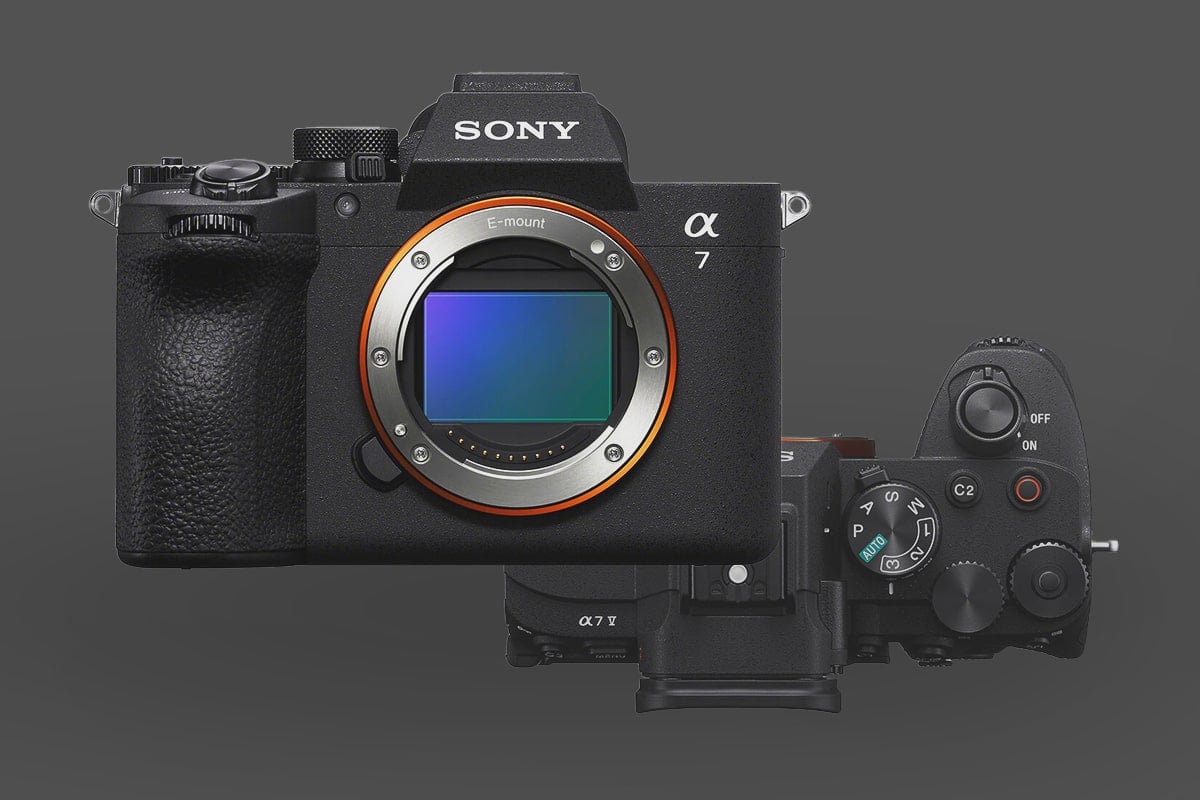
It’s been roughly four years since Sony released the A7IV. The Sony A7 series has always been their midrange body, and it was desperately in need of an update. At the time, with cameras like the Canon R6 or, later, the Nikon Z6 III, the Sony A7IV just felt outdated even at launch.
Now, Sony has really caught up and pretty much leapfrogged everyone with this new A7V.
It’s really exciting. Personally, I’ve always loved the Sony A7R series, and I’ve owned three of them. I never really loved the standard A7 series, but I really think this camera is incredible, and it’s the first one that has really captured my attention.
What’s new? What Makes The Sony A7V so good?
The main new feature of the Sony A7V is the partially stacked sensor. We saw this in the Nikon Z6 III and the Panasonic S1 II, but now we get it with a much higher-resolution sensor.
Partially Stacked Sensor
The main advantage of a partially stacked sensor is improved rolling shutter during video recording, as well as a more usable electronic shutter at faster shutter speeds. It’s a really nice upgrade for a midrange hybrid “do-it-all” camera like this. This might come at a small hit to the dynamic range, but it’s good enough for what people want in a camera like this.
Pre-Capture, New IBIS, New Screen
They’ve also added the pre-capture capabilities, which is a very nice feature for sports and wildlife shooters, and they’ve updated IBIS to be on par with the competition and added the multi-directional flippy screen we saw on the Sony A7rV. Very cool.
New Processor for Better Colors & AF
Another nice and welcome update is the new processor, which should continue to improve color science, so you’ll see better-balanced, more consistent auto white balance between shots. I never shot enough with the Sony A7IV to know where it stood, but when Nikon updated its processor with the Z8, it made a huge difference in color consistency compared to older camera bodies. Even the jump from my Sony A7rII to the A7rIII was a huge difference. So this new processor’s color engine will likely show some really nice improvements, especially if you’re shooting a lot in difficult lighting.
I also want to point out that the whole “Sony has bad color science” argument has been dead for a while now. All these cameras have phenomenal color compared to 10 years ago.
30fps Continuous Burst
Memory Card configuration, like with the Sony A7IV, is identical. However, this camera is now capable of shooting at 30fps, whereas the A7IV was limited to 10fps. This means you couldn’t truly take advantage of those CFexpress Type-A cards in the Sony A7IV because the camera couldn’t even come close to saturating the bandwidth those cards offered. With the Sony A7V, a faster CFexpress Type-A card will actually show some meaningful difference.
Will I buy A Sony A7V?
I obviously won’t be getting one. I have the Nikon Z8 and the Fujifilm X-E5, and I’m pretty much in love with those two systems, so that’s where I’ll stay. However, I will admit, the Sony system, to me, is pretty much perfect now. But so is Nikon’s, although I would love to see a higher-resolution ZF with some overall improvements. Fujifilm has absolutely nailed it with the X-E5, and even Canon is great.
It would be cool to see a top display from Sony one day. I don’t know why they keep omitting that from all of their cameras. I really love all the on-camera information you get from Nikon, Canon, and Fujifilm, whether that’s from a top display or physical dials. I even like the film-simulator dial on the Fujifilm X-E5. It would be really, really nice to see Sony get a little more creative with its designs for future camera bodies. The Next A7c needs to be more fun and more enthusiast-focused.
Sony A7V: The Competitive Weakness
While everyone will run out and talk about how this is the best hybrid camera, some of the competition still has a little more to offer when it comes to video.
But this is by design.
Sony has such an amazing video and camera system that they can’t just throw the whole kitchen sink into their mid-range hybrid cameras. Understandably, they have to protect the FX line and the A7s line just a little, and especially their more professional bodies.
What are they excluding?
They do not include any in-camera RAW video capabilities, and we’re still not seeing any ProRes video codec, which remains a reliable video solution for so many people. However, the XAVS-S, which is an intra-frame H.264-style codec at 600Mbps, should give you results very, very close to the standard ProRes 422.
What’s kind of a disappointment is that even though there is a partially stacked sensor, 4k120p is only offered with an APS-C crop.
I’m still trying to deep-dive into the specs, but it also looks like Sony is only offering 10-bit via HDMI out, which is in line with what the A7 series has traditionally offered, but a lot of their other cameras do 16-bit.
Where The Competition Has Them Beat
While many of the features are nice here, especially that 33MP sensor, as a more video-focused hybrid camera, the Nikon Z6 III really has them beat in video.
Not only does the Nikon Z6 III support internal RAW video, but it can also record externally in 12-bit RAW. However, like the Sony A7V, it is also limited to a 1.5x crop factor with 4k120p.
If RAW video isn’t important to you, then you would probably still want to lean more towards the Sony for two reasons. Their H.265 is 10-bit 4:2:2, while Nikon’s is only 4:2:0. You would have to record ProRes to get 4:2:2 with the Nikon Z6 III, which is overkill for most people.
Sony’s digital hotshoe, which works with their various mic systems, is unbeatable. However, the Nikon ZR is getting into this now as well, with the new Nikon ME-D10 shotgun mic and 32-bit internal audio recording.
What’s Next For Sony?
This will likely be the last A7 series camera for at least another 4 years, maybe even 5 years. Sony can’t really improve on this in any meaningful way. Aside from a few nitpicks, Sony’s whole lineup is pretty much perfect now; all that’s left to do is the sort of Nikon or Fujifilm thing and offer more bodies styled differently.
We can obviously expect a new A7cIII with the more classic rangefinder body. I’d love to see them push it even more classic, like a Nikon Zf, but that’s all that’s really left to do.









Leave a Reply