
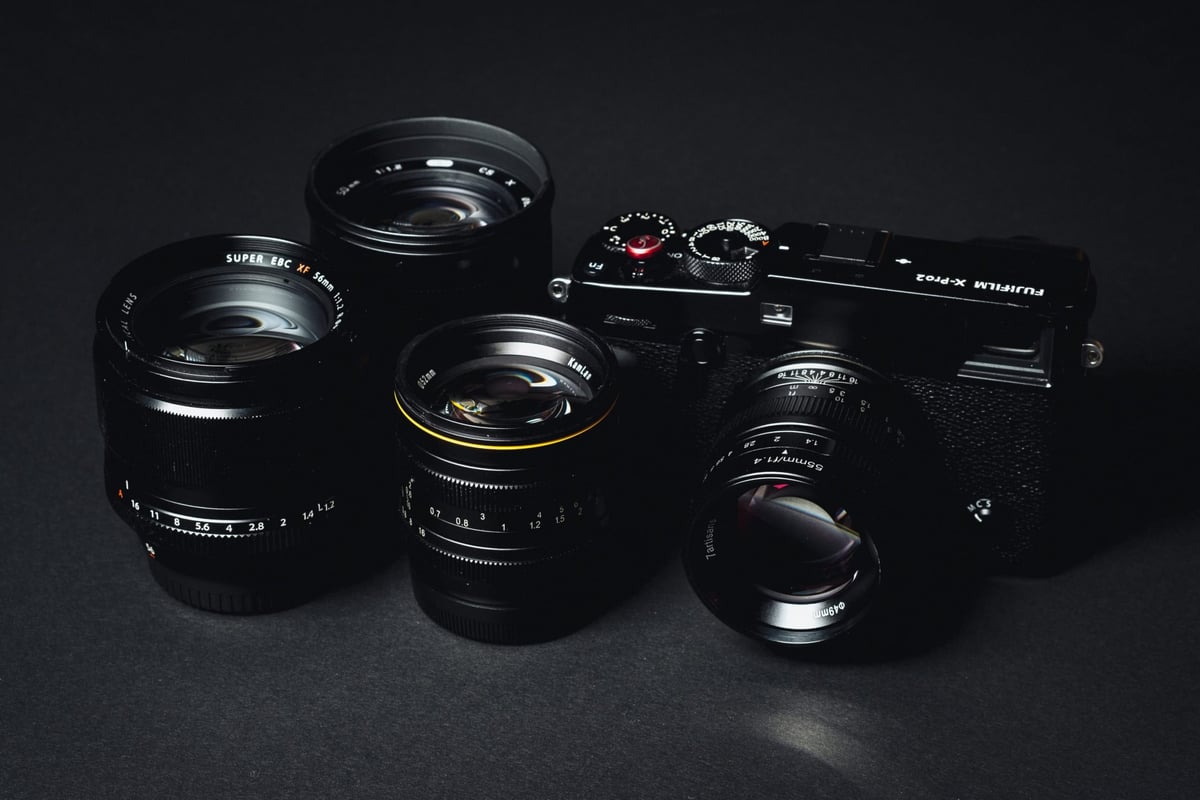
This is the largest, most comprehensive list of Fujifilm X-Mount lenses on the web. I have personally tested most of the original Fujifilm primes as well as many of the third-party lenses over the last decade—from the original ‘magic’ primes like the 35mm f1.4 to the modern, clinical perfection of the new LM WR series.
Whether you are shooting on the high-resolution 40MP X-T5 or the classic X-Pro3, this guide is designed to help you navigate the chaos of native and third-party options.
Table of Contents
Fujifilm’s Official Fujinon Lenses
Over the years, Fujifilm has updated its focus motors from slower DC High Torque motors to new STM stepping motors in some compact lenses, with some of the new primes and most of the zooms featuring a Linear Motor. There are a few exceptions, like the 50mm f1, which uses massive elements. Also, the pancake lenses are typically DC to keep the size down.
- LM (Linear Motor): Instant, silent, best for video/tracking. (e.g., 18mm f1.4, 90mm f2).
- STM (Stepping Motor): Smooth, quiet, good for video, but slower torque. (e.g., 23mm f2).
- DC (DC Coreless): The “Old Generation.” Noisy, externally moving elements feel “robotic.” (e.g., 35mm f1.4, 56mm f1.2 original).
List Of Fujifilm Prime Lenses
A list of all the Fuji Prime Lenses available for the X mount.
Fujifilm XC lenses are X-mount kit lenses for entry-level consumer cameras. They are often made in China and use cheaper materials, such as plastic mounts, which helps lower the price.
List Of Fujifilm Zoom Lenses
A list of all the Fuji Zoom Lenses available for the X mount.
Fujifilm has a comprehensive list of zoom lenses and several kit lenses.
Lens Codes, What Do They All Mean?
- WR: WR means weather-sealed. Rubber gaskets seal the lens and are resistant to dust and light weather effects. However, to be genuinely weather-sealed, you’ll often need a protective UV filter to seal the front element.
- OIS: Optical Image stabilization. The IBIS system and the lens stabilization will work together intelligently to provide enhanced stabilization.
- APD: One of Fujifilm’s lenses uses an anodization filter. This clear internal filter gradually darkens towards its edges, helping improve the Bokeh.
- LM: The LM stands for linear focus motor. This differs from the ultrasonic autofocus or stepping motors found in some lenses.
- R: This means your lens will have an aperture ring. Most Fujinon lenses now have aperture rings.
- Macro: The lens’s ability to focus close-up. You’ll also need to pay attention to the macro lens’s magnification, such as 2:1 or 1:1, to gauge its capabilities.
Cheat Sheet: Top Picks/Legendary Lenses
Here are the lenses I recommend.
- The “Magic” Lens: Fujinon XF 35mm f1.4 R. It’s noisy, slow, and focuses externally, but it has a rendering “soul” that the modern lenses can’t quite replicate. It remains my favorite lens for slowing down. I also still really love the original 56mm f1.2 for similar reasons.
- Best for Street (The Pancake): Fujinon XF 27mm f2.8 R WR. The only lens that truly makes the X-T series pocketable. It’s sharp, weather-sealed, and essential for that ‘everyday carry’ vibe. The TTArtisans 27mm f2.8 is also a solid option for a more affordable third-party lens with very few compromises.
- The “Hidden Gem”: Fujinon XF 90mm f2 LM WR. arguably the sharpest lens in the lineup. It doesn’t get enough hype, but for portraits and compression, it is flawless. I highly recommend it.
- Best for 40MP Sensors (X-T5 / X-H2): XF 33mm f1.4 LM WR. If you need to resolve every single pixel of the new high-res sensors, these ‘New Generation’ primes are mandatory.
Lens Comparisons
- Fujifilm 23mm f1.4 vs. Fujifilm 23mm f2 Lens Comparison
- Fujifilm 35mm f1.4 vs Fujifilm 35mm f2 Lens Comparison
Third-Party Autofocus Lenses
Third-party options are available if you’re looking for autofocus lenses for your Fuji X-Mount camera. While some lens manufacturers, such as Tokina, have partnered with Fujifilm to provide official, licensed autofocus protocols, other brands may deliver inconsistent results. So be sure to check reviews before investing in one of these lenses.
Many brands are now making autofocus Fuji XF lenses, so I’ll have to figure out a new way to organize this. Watch 7Artisans, TTArtisans, and Meike to see if they have more autofocus options.
Meike Autofocus Lenses
Meike has introduced several APS-C X Mount autofocus lenses and offers a broader range for other systems, such as the Full Frame E mount and Nikon Z systems, indicating its commitment to expanding its autofocus lens lineup.
Samyang Autofocus Lenses
Samyang has expanded its line of autofocus lenses for the Fujifilm X mount. The list below displays options for purchasing a Samyang lens for your Fujifilm camera.
Optically, I find Samyang to be very good. They use great glass and have good coatings, but their tolerances are not quite as good as those from Fujifilm. This may lead to some copy-to-copy variation. However, most companies are continually improving and investing in new equipment.
Sigma Autofocus Lenses
Sigma’s Website: Sigma-Global.com – You can learn more about Sigma lenses at the official Sigma website
With the addition of fully electronic autofocus lenses for the Fujifilm X Mount, Sigma now caters to Fujifilm shooters.
Sigma is a Japanese company whose lenses and cameras are generally considered high quality. Sigma takes a more modern approach to lens design by improving optical IQ as much as possible. Some photographers love Sigma lenses, while others find them too clinical.
Here is the list of all the available Sigma lenses for Fujifilm.
Sirui Autofocus Lenses
Sirui makes a few nice APS-C autofocus lenses for the Fujifilm X mount system.
Tamron Autofocus Lenses For Fuji
Tamron’s Website: Tamron-USA.com – Check their website for any additional information.
Tamron’s autofocus XF lenses for Fuji are now available with AF protocols. These lenses offer users a range of interchangeable options to suit their shooting needs.
Tamron lenses are generally well-received and good enough for Nikon to use their OEM lenses for its own brand. In other words, sometimes Nikon uses rebadged Tamron lenses. Build quality is not quite up to the level of the Fujifilm X-mount lenses, but these lenses get the job done.
Tokina Autofocus Lenses For Fuji
Tokina’s Official Website: TokinaLens.com
Tokina has a line of atx-m lenses for Fujifilm. While these share the same optical formulas as the Viltrox lenses, the lenses themselves are slightly different. They have better builds and Tokina’s coatings, and may have better AF since they use the official Fujifilm XF Lens protocols.
Viltrox Autofocus Lenses
Viltrox Official Website: Viltrox.com. You can check the official Viltrox website for new products and current deals, and use code ALIKGRIFFIN for 5% off.
Viltrox has been making autofocus lenses for Fujifilm and other brands for a while now. Some early models were not as good as the official Fujifilm lenses, but they have improved. I’ve enjoyed shooting on some Viltrox lenses and would never hesitate to buy one.
Some of their lenses are specifically designed for APS-C, and some are made for Full Frame. So, for APS-C shooters, you can sometimes end up with a lens slightly larger than it needs to be.
Zeiss Autofocus Lenses
Zeiss is one of the top German lens manufacturers, with build quality that’s just about up there with Voigtlander and Leica. They make some fantastic lenses, but unfortunately, only three are available for Fujifilm. Of course, you can always buy Zeiss M-Mount lenses and adapt them to your Fujifilm, but you won’t get autofocus like with Touit lenses.
third-party Fujifilm x mount lenses
This list shows all the companies that make Fuji third-party lenses. These lenses are mostly manual-focus, though more companies are now making Autofocus lenses, such as Viltrox, Tokina, Zeiss, 7Artisans, and Meike.
American Lens Companies
Lensbaby XF Lenses
Lensbaby is an American company founded in 2004. They make these cool little specialty lenses with bellows, balls, and sockets. Their lenses are designed chiefly for fun or photographic artistry because of the unique looks they produce.
German Lens Companies
Meyer Optik Görlitz Lenses for Fujifilm
Meyer Optik Görlitz has been in the lens-making business since 1896. They make some of the finest German-built lenses; some would say they are equal to Zeiss. These lenses are all manual.
Some of their lenses, like the 100mm f2.8 and 58 f1.9, produce the most beautiful soap-bubble bokeh you’ll ever see.
Korean Lens Companies
Samyang / Rokinon XF Lenses
I own several Rokinon or Samyang lenses and have had a great experience with them. I use that 10mm on my X-T3 as an ultra-wide landscape lens, which works well. It is better than the 10mm end of the Fujifilm 10-24mm, but it does have some color cast and vignetting, which is typical with Rokinon Lenses.
If you’re looking for the best, fastest, manual-focus Fuji X lenses, Rokinon/Samyang has some great options.
The 85mm f1.4, 100mm f2.8, 135mm f2, and 300mm f6.3 are full-frame lenses, so they are rather large.
Swiss Lens Companies
Irix Cine Lenses
Irix is a Swiss-based manufacturer of lenses. It works closely with Korean optics companies to produce some excellent lenses. Its website says, “Swiss Precision with Korean Ingenuity.”
A collection of professional cine lenses created for video production and filmmaking is among its products. These lenses are excellent substitutes for more expensive, big-brand products and offer similar quality at a lower cost.
Japanese Lens Companies
Voigtlander Lenses for Fujifilm
The Voigtlander lenses are designed for the Fujifilm APS-C sensor and provide electronic information to the camera body. This means that if you have IBIS, you won’t need to tell the camera the lens’s focal length. It could also mean that it passes the focus position, allowing you to use a 5-axis IBIS instead of a 3-axis, but that has yet to be confirmed. You can also use the camera’s focus check function.
Overall, Voigtlander lenses are great; stick with lenses that have been around for a while, as they will likely have more refinement than those that come out for a year and are discontinued soon after. I’ve generally had more quality-control issues with Voigtlander lenses than with official Fujifilm lenses, so be sure to inspect the lens to ensure everything is in order while within the return window.
Chinese Third-Party Lens Companies
7Artisans Lenses for Fujifilm
7Artisan is a Chinese company that makes inexpensive third-party lenses for the Fujifilm X-Mount. Like many of these third-party lens companies, they’ve continued to improve their designs and tolerances over the years, and some of their lenses are nice.
When I first started using prime lenses, I liked 7Artisans because it let me test a specific focal length as a prime before buying the more expensive official Fujifilm lens.
Astra Labs
Astra Labs has a few interesting designs for the Fujifilm FX mount. Some of these seem pretty similar to what Pergear or 7Artisans is offering, like the 12mm f2, which looks like the older Pergear 12mm f2, and that 60mm macro. They all use a similar optical formula, with different housings, either 10/7- or 11/8-element designs. Astra Labs uses the 10/7 design, identical to the Brightin Star.
Astra Labs also has some unique full-frame and retro-style lenses that might be fun for the Fujifilm APS-C system, since you’re primarily using the center of the lens.
These lenses are all manual focus with no electronic controls or exif data passed to the camera.
AstrHori Lenses
AstrHori is another Chinese lens company that makes some interesting lenses with unique properties, such as their macro tilt-shift and probe lenses. They’ve won a few awards for some of their designs and are doing a pretty good job of making an impact in what is a very crowded space.
The AstroHori probe lens also comes in two variants: a standard barrel and a 90-degree barrel.
Brightin Star Lenses
Brightin Star has a few interesting lenses. I’ve reviewed the 50mm f1.4, a full-frame lens, and so far, so good. These are also sold and distributed by Pergear and share some of the same characteristics as other lenses by 7Artisans and Pergear. Even though they now have an AF lens, their lenses seem more complicated to find, and I no longer see Pergear offering them.
Funleader
For the Fujifilm APS-C mount, Funleader only has their cap lenses, both the Pro and the standard versions. They have some interesting Leica M lens offerings, so if you’re into adapting M-mount lenses, check them out.
Kase XF Lenses
Kase’s standout offering for the system is the 85mm f/1.4 AF, a fast portrait lens with a unique magnetic front mount that makes it incredibly easy to swap filters on the fly. For landscape photographers using wide-angle lenses like the XF 8-16mm f/2.8, Kase’s Clip-In Filter system is an essential “problem solver,” as it mounts directly over the sensor to allow for ND or light pollution filtration without bulky external holders. They also offer the 200mm f/5.6 Reflex lens, providing X-series shooters with a lightweight, manual-focus telephoto option that fits the “compact travel” ethos while delivering their signature stylized bokeh.
KamLan XF Lenses for Fujifilm
Their lenses can be challenging to find, so check their official website for availability.
It does look like they’ve been slowly phasing out their lenses. They’re fairly difficult to find, and they only offer a few on their site for the Fujifilm FX mount.
Kipon X-Mount Lenses For Fujifilm
Kipon’s Website: Kipon.com
Kipon started as a German-Chinese joint venture. These lenses are designed in Germany and then mass-produced in China with German-level quality control. They are constantly working on some new projects and a new factory in Japan, so expect some exciting new lenses or accessories from them.
These lenses are made with high-quality anodized aluminum, brass, and stainless steel. They are great because they combine classic lenses with modern precision.
The Handevision 40mm f0.85 is known as the fastest lens in the world, and they don’t cheat their stats.
Kipon is now making cine lens builds out of its Iberit lens designs. These have classic renderings similar to the Cooke Classics, and Kipon now has very high build quality with some of the best machines, making them a great option for classic cine lenses.
Meike Lenses
Meike now offers many different types of lenses for various camera mounts, including primes, zooms, cine lenses, and autofocus lenses. Their lenses are fun and cheap, and for a long time I had a lot of fun with the 35mm f/1.7.
Mitakon / ZY Optics Lenses
Mitakon/ZY Optics is one of the major lens providers in China.
The Mitakon 35mm f0.95 is a very popular lens. It’s a lot of fun, and for the price, it’s fantastic.
NiSi Lenses
NiSi, a popular third-party lens company known for its ND and UV filters, has started making standard lenses.
They also have a line of Cine lenses in the PL, E, and EF mounts that can be adapted to Fujifilm X-mount cameras.
Opteka Lenses
Samyang owns Opteka, but many of its lenses are also made in China. Meike and Opteka lenses seem to share similar builds.
Pergear Lenses
PerGear has released a few lenses for the X-Mount. Their 25mm f1.8 is not the same as the ever-so-popular 7Artisans because their website says this lens has 5 elements in 3 groups, but the 7Artisans has 7.
The Pergear 35mm f1.6 is very nice, with a great build and image quality that matches.
All the Pergear lenses come with a lens hood.
Sirui XF Lenses
Sirui is a Chinese camera & accessories company that produces interesting anamorphic lenses for APS-C mounts.
They now make some nice AF, standard Cine, and Anamorphic lenses. Their Anamorphic lenses can be ordered with different-colored coatings for flares of different colors.
SLR Magic Cine Lenses
Based in Hong Kong, SLR Magic makes some pretty nice lenses for the amateur cinematographer. We’re not seeing anamorphic lenses for the Fujifilm X-Mount yet, but hopefully they come soon.
TTArtisan Lenses
TTArtisan, founded in 2019, makes many fun lenses with a high-quality build. I’ve reviewed several of their lenses and have enjoyed shooting with them.
I compared the autofocus TTArtisan AF 27mm f2.8 to the Fujifilm 27mm f2.8. The results are interesting. Both lenses are great in their own way.
Thypoch FX Lenses
Although made for full-frame cameras, Typoch has released some designs in the FX mount.
Use code ALIKGRIFFIN for an extra 5% off when ordering from their website: Thypoch
Venus Optics Laowa Lenses For Fujifilm
Venus Laowa has started making some APS-C lenses, and they finally have one available for Fujifilm that is getting nothing but praise. What’s supposedly so great about these Venus lenses is that they have zero distortion, which is very friendly and rare for ultra-wide lenses.
Using Leica Lenses On Your Fujifilm
If you already have Leica lenses or would prefer to invest in full-frame lenses, you can adapt them to your Fuji camera. Not all lenses work correctly with the Fujifilm adapter, so I’ve included only a list of working lenses that Fuji has listed on its M-mount compatibility lens chart.
This doesn’t mean other lenses will not work. I’m sure most of the Voigtlander and new Leica lenses would work fine, but with that Fuji adapter, there is some risk that the rear element will not have enough clearance. The alternative is to try some other adapters. I’ll list a few that I’ve seen people mention on the forums.
Leica M Mount Lens Adapters
I’ve researched and found the best Leica M-to-Fujifilm X-mount adapters.
Some adapters don’t allow clearance on some lenses. It’s hard to know unless you own many Leica lenses and can test them. From my research on the subject, I’ve seen most people say that even the Fuji adapter is great for most lenses, despite what Fuji says about its compatibility list. Still, some lenses, like the Voigtlander 35mm f1.2, have a protruding rear element and will not adapt.
Fujifilm M-Mount Adapter For X-Mount
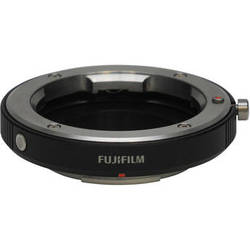
I use the Fujifilm M-Mount adapter to mount my Leica M lenses. It has a very nice construction and is a perfect fit for both the camera and the Leica M lenses. The adapter also has a button that instantly sends you to the Mount Adapter Settings, so you can quickly select which lens you’re using for the EXIF data. – Amazon / Adorama / B&H
FotodioX Leica M Pro to Fuji X Adapter
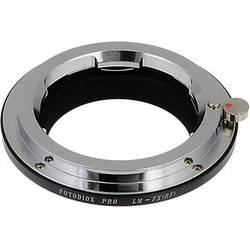
It’s a great adapter at half the price of the other adapters. I believe it works on most, if not all, of the lenses. It is built with brass and a stainless steel finish. – B&H
Novoflex Leica M To Fuji X Adapter
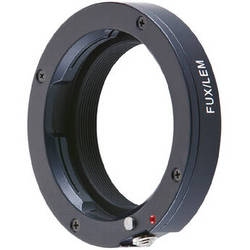
Novoflex makes one of the best adapters for Leica M lenses. However, it is expensive. The matte black interior is supposed to reduce internal flaring. To release the lenses with this adapter, you must push the release button, not pull it. – Adorama / B&H
Leica M Mount Lenses
Visit the Leica M-Mount Lens List to see all available M-Lenses.
Using Vintage Lenses With Fujifilm
I have quite a few vintage lenses for my Fujifilm cameras, and they work very well on these APS-C bodies compared to my other full-frame cameras.
It seems modern lenses are better designed to work with our flat sensors, with microlens arrays, so you typically get better resolution in the corners and edges with new lenses than with some vintage lenses. Still, because Fujifilm uses APS-C sensors, most unwanted characteristics are already cropped off. So, vintage lenses work very well on Fujifilm bodies.
To use M42 lenses, you need to get an adapter.
Top 3 Best M42 to Fujifilm X Adapters
Here are the top three best M42 Mounts for the Fujifilm X-Series camera. I’ve listed these three because they come at different quality levels and prices.
Fotasy M42-Mount to Fujifilm X-Mount Adapter
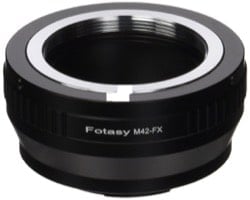
This is the adapter I use. It’s very inexpensive, so occasionally, you’ll need to tighten up the inner screw mount with a hex key, but it works. – Amazon
FotodioX M42 Screw-Mount To Fujifilm X-Mount Adapter – Helicoid
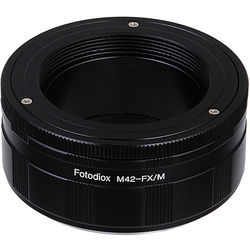
This is a much higher-quality M42 Screw-Mount lens for your Fujifilm. It has an extendable helicoid for closer focusing.
It’s an all-metal construction with a chrome base plate. – B&H
Novoflex M42 Mount To Fujifilm X-Mount Adapter
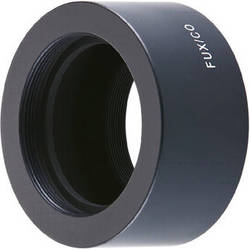
This is the most expensive and beautiful adapter, with a matte-black internal finish to reduce flaring. It also features precise infinity focus for these M42-mount lenses. – B&H
One thing to be careful of—If you remember being a kid and burning things with a magnifying glass, many of these old 35mm lenses will do that if you leave them in the sun wide open on your camera body without a lens cap. Even some new lenses will do it; burning your sensor or the area around it takes a few seconds.
If you’re not using your lens cap, stop down the lens to at least f/5.6 to f/8. This typically reduces the burning effect.
Generally, never leave your camera out in the sun without a lens cap. I’ve burnt the interior of my X-Pro2 a little, and my friend has burnt his X-T1. The sensor was not damaged, but these were close calls.
Some cool M42 lenses that work great with Fujifilm
I have four Helios lenses now. The 44M, 44-2, 44-4, and 44-7.
I like the 44-4 and the 44-7 the most. I really don’t love the 44-2, but it does have a de-clicked aperture preset that could be interesting for video folk. I think the 44-2 is not great wide open unless you’re shooting video and are okay with a little softness.
The Helios lenses are based on the Zeiss Biotar design. You’re probably better off buying a Zeiss Biotar, but they’re harder to find and a little more expensive.
Industar 50mm f3.5 50-2 Review
I also have the Jupiter 9, which isn’t sharp at all.










Leave a Reply