
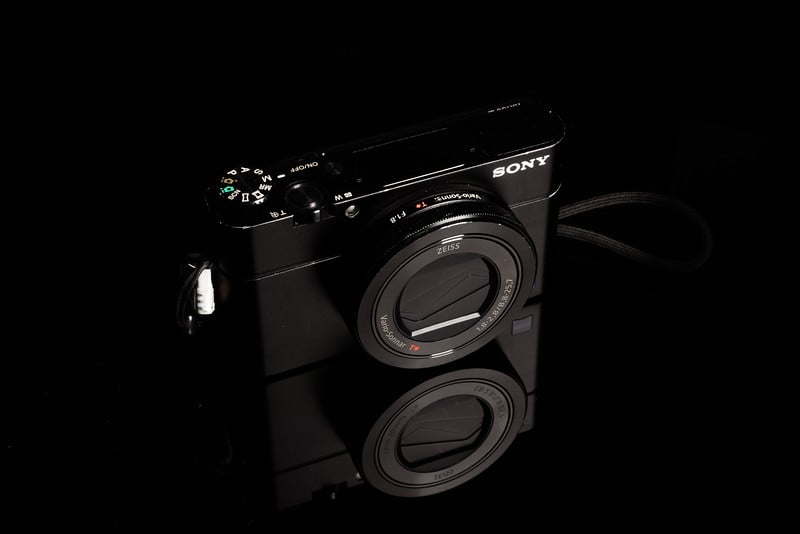
Recommended Memory Cards Sony RX100 III
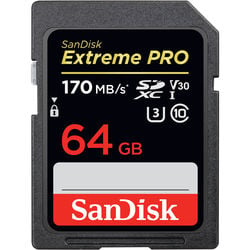 The RX100 III has one SD card slot that supports UHS-I speed class. Sony cameras from this era also had a 1080p video bitrate of around 50Mbps, which means you need a card that can support 6.25MB/s to record videos. You can use U3 or even U1 SD memory cards with this camera without any issues.
The RX100 III can handle memory cards up to 128GB in capacity. As a precaution, I’d recommend a 64-128GB memory card to prevent any compatibility problems.
These suggestions should help you find some of the best cards for this camera today.
The RX100 III has one SD card slot that supports UHS-I speed class. Sony cameras from this era also had a 1080p video bitrate of around 50Mbps, which means you need a card that can support 6.25MB/s to record videos. You can use U3 or even U1 SD memory cards with this camera without any issues.
The RX100 III can handle memory cards up to 128GB in capacity. As a precaution, I’d recommend a 64-128GB memory card to prevent any compatibility problems.
These suggestions should help you find some of the best cards for this camera today.
| Recommended SD Cards | Speed Class | USB Write | USB Read | Links |
|---|---|---|---|---|
| SD UHS-II V60 | Hide | |||
| Sony E v60 128GB | UHS-II v60 | 142 | 252 | Amazon / B&H |
| Sony E v30 64GB | UHS-II v30 | 73 | 247 | Amazon / B&H |
| UHS-I U3 | Hide | |||
| Sandisk Extreme Pro 64GB | UHS-I | 137 | 175 | Amazon / B&H |
| Kingston Canvas Go! Plus 256GB-1TB | UHS-I | Amazon / B&H | ||
| Prograde Cobalt CF2.0 165/325/650GB | CFx-B | 1429 | 1029 | Amazon / B&H |
Sony RX100 III Memory Card Speed Test
Here are some buffer and speed tests from back in 2014. This will give you an idea of how this camera buffer performs. While cards today are faster, don’t expect to see improved performance with the latest cards.| SD Memory Cards | UBS 3.0 Read | USB 3.0 Write | Sony RX100III Write |
| Sandisk Extreme Pro 64GB U3 | 89.0 MB/s | 84.7 MB/s | 33.19 MB/s |
| Kingston 64GB U3 | 88.1 MB/s | 74.3 MB/s | 32.93 MB/s |
| Sandisk Extreme Plus 64GB U3 | 88.9 MB/s | 62.0 MB/s | 32.92 MB/s |
| Sandisk Extreme 64GB U3 | 71.3 MB/s | 52.1 MB/s | 32.79 MB/s |
| Samsung Pro 64GB U1 | 86.8 MB/s | 77.2 MB/s | 32.36 MB/s |
| Lexar 600x 64GB U1 | 85.6 MB/s | 60.1 MB/s | 31.94 MB/s |
| PNY 64GB SDXC U1 | 86.1 MB/s | 54.5 MB/s | 31.88 MB/s |
| Transcend 64GB SDXC U3 | 87.7 MB/s | 64.1 MB/s | 31.53 MB/s |
| Sony 64GB SDXC U3 | 87.2 MB/s | 71.9 MB/s | 31.18 MB/s |
SDXC vs SDHC
I only use SDXC cards now because they are needed to record video on most of the Sony cameras. I strongly advise you to avoid the 32GB cards if you have a Sony camera because you can’t use the XAVC S codec that many Sony cameras have. You need SDXC to use XAVC, which means a 64GB card or more.U1 vs U3
You won’t see any difference in speed by using a U3 card instead of a U1 card. But on newer cameras, you might. U3 cards have a minimum write speed of 30MB/s, while U1 cards have a minimum write speed of 10MB/s.Sony RX100 III Memory Card Conclusions
The brand of the card is not very important for this camera. But if you think you might change your camera soon, you should get the cards I suggested so they work well on any device. The RX100III does not really need a fast card for shooting. And all the cards I mentioned are good cards, so you can compare the prices and get the cheapest one if you want to save some money.What the Benchmark Numbers Actually Mean
The benchmark table above makes one thing clear: every card in this camera writes at roughly 31–33 MB/s regardless of how fast the card itself is. The SanDisk Extreme Pro (which can write at 84 MB/s externally) hits 33 MB/s in the RX100 III. The PNY U1 card (54 MB/s external) hits 31 MB/s. The camera’s interface is the bottleneck, not the card. This means buying a “faster” card genuinely doesn’t help in-camera performance here — any reputable U3 card from a name brand delivers effectively identical results.
Where a faster card does help: transferring files from the card to your computer. If you shoot a lot and value quick offloads, a card with a higher external write speed is worth having — even if the in-camera speed is the same.
Can I Use a microSD Card in the Sony RX100 III?
The Sony RX100 III uses a full-size SD card slot. MicroSD cards work with an adapter, but from experience they can lose connection inside the adapter — I wouldn’t use one for anything critical. See the microSD memory card guide if you need to use one.
Frequently Asked Questions
Why is the RX100 III limited to 128GB cards?
This is a firmware-era limitation from 2014. Cameras from this period weren’t always tested with very large cards, and Sony specified 128GB as the verified maximum. In practice, many users report larger cards working fine, but Sony’s official spec caps at 128GB. If you want guaranteed compatibility, stay at 128GB or under.
Do I need a U3 card or will U1 work for video?
The RX100 III’s 1080p video runs at around 50 Mbps (6.25 MB/s required), which any U1 card handles easily. U3 is a safe choice for future-proofing if you move to a newer camera, but the RX100 III itself doesn’t require U3 for any of its recording modes. A good U1 card from SanDisk, Samsung, or Kingston is perfectly sufficient.
Can I use the XAVC S codec on the RX100 III?
The RX100 III does support XAVC S, but it requires an SDXC card (64GB or larger). 32GB SDHC cards use the FAT32 file system which is incompatible with XAVC S recording. Stick with 64GB or larger cards to access all of the camera’s recording formats.
Is this camera still worth using in 2026?
The RX100 III is a 2014 camera with a 20.1MP 1-inch sensor and a sharp 24–70mm equivalent Zeiss lens. It’s genuinely limited by today’s standards — no 4K video, no RAW in full burst mode, and a card interface that tops out at ~33 MB/s. But for casual carry, travel, and street photography on a tight budget, it’s still a capable compact with a lens quality that hasn’t aged. For the money on the used market, it punches well.












Leave a Reply