
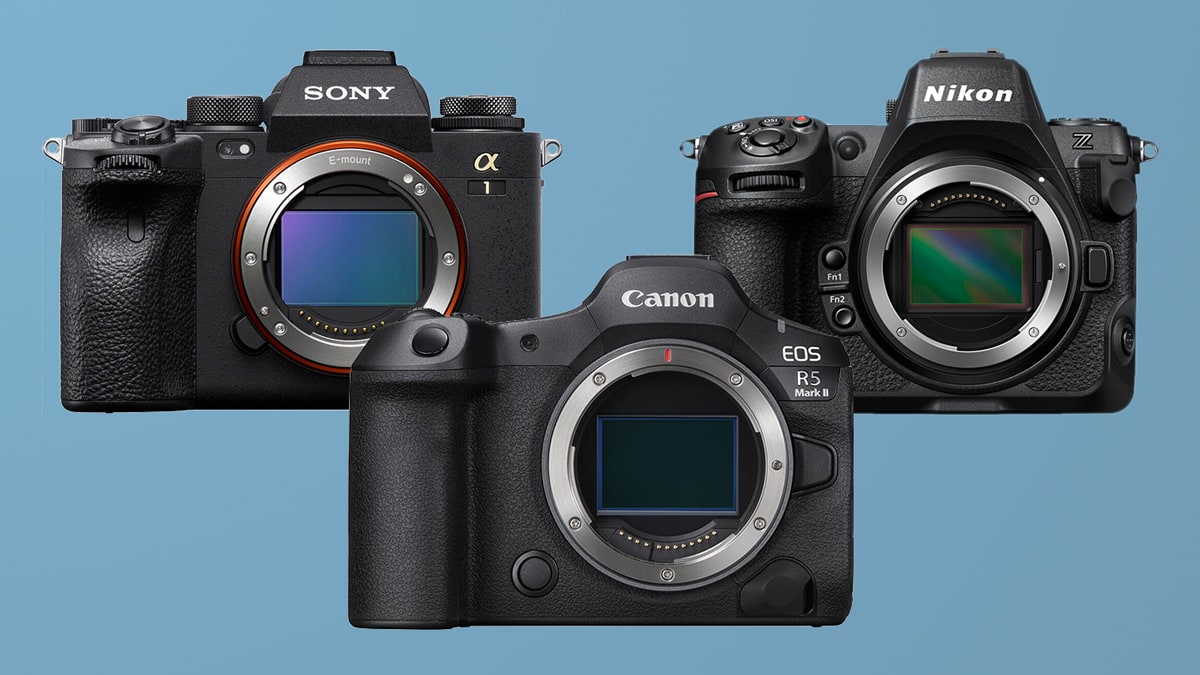
Several amazing high-resolution stacked full-frame sensor cameras are now on the market, and the Canon R5 II could be the new king.
But let’s first look at the specs to see how it compares to the Sony A1 and Nikon Z8.
Canon R5 II vs. Nikon Z8 vs. Sony A1 General Overview
These cameras have similar capabilities, but some are better at specific niches than others. I’ll highlight some of the big features.
Technology
Sensor Readout Speeds
All these cameras now use a stacked full-frame BSI CMOS sensor.
The Canon R5 II has the slowest sensor, rated at 6.3ms, whereas the Sony A1 is rated at 5ms, and the Nikon Z8 can do 4ms. A mechanical shutter will do about 3.5ms by comparison.
If you often shoot at ultra-fast frame rates, the Nikon Z8 or Sony A1 might be your better option. It won’t matter which camera you choose if you’re shooting under 12fps with a mechanical shutter. However, with the Nikon Z8, you’ll never have to worry about your shutter dying since it does not have one.
Stills Features
Aside from the ultra-fast read-out speeds, there isn’t a huge difference between these cameras on the photo side. They all have amazing autofocus capabilities. However, the Sony A1 lacks a few things, like focus stacking and pre-capture, which can be found in both the Nikon Z8 and the Canon R5 II.
Pre-capture – This is when the camera starts taking photos when the shutter is half-pressed. It is a game-changing feature for wildlife photographers, so the Sony A1 might not be your first choice for shooting wildlife since you cannot pre-capture it.
Focus stacking is pretty game-changing for macro photography, so again, if you’re shooting a lot of macro work, the Sony A1 may not be your first choice.
Sensor-Shift is when the sensor moves slightly, combining several shots into one high-resolution photo. The Nikon Z8 and the Sony A1 have this capability, but the Canon R5 Mark II does not. Instead, it uses AI image upscaling limited to JPG or HEIF images.
IBIS or Sensor Shift-IS is rated at 8.5 stops in the Canon R5 II, compared to only 5.5 stops on the Sony A1 and Nikon Z8. Remember that IBIS can be calibrated to work differently in different situations. Some say the Sony IBIS is better with wider lenses, and the Nikon Z8 IBIS is better with longer lenses. So, you must test each camera’s capabilities to see how it functions with your use case.
AI Features
The Canon R5 II introduces new camera technology: Neural Network Upscaling, as mentioned above, and Neural Network Noise Reduction.
The Canon R5 II also introduces an Active Priority focus system that prioritizes ball and player movement with Football, Basketball, and Volleyball.
The Canon R5 II also features an Eye Control pointer in the EVF that tracks eye movement for autofocus area selection. In other words, it will focus on what you’re looking at with the EVF.
Video Features
Video specs get very tricky with these cameras as the processors often have hardware limitations to frame rates and chroma subsampling.
You can check the Canon R5 Mark II Specifications to verify what I’m saying. I assume it’s inaccurate, as some strange video limitations don’t make sense. I’m assuming there is just some bad information printed by Canon, and I won’t know for sure what the camera can do until it has been tested.
Shooting RAW
Both the Canon R5 II and the Nikon Z8 feature in-camera RAW video recording. The Sony A1 does not have this functionality; however, Sony does allow for a 16-bit HDMI output, which will allow you to record RAW to an external recorder with this capability.
The Canon R5 II can shoot RAW standard at a max frame rate of 8k at 30fps and a data rate of 325MB/s. To shoot 8k at 60fps, you will have to switch to RAW light, which will also have a data rate of 325MB/s at 60fps. So, it looks like the camera’s data limit is around 325MB/s, and with only a 10-bit HDMI port, it seems that’s the best you’ll be able to get with the Canon R5 II – 8k video with only 325MB/s data rate.
The Nikon Z8 can shoot NRAW at 8k60p with a data rate of 722.5MB/s. So it almost looks like the Canon R5 II has a potential bottleneck with how fast it can write to cards, similar to what we saw in the original Canon R5 memory card tests.
The bottom line is that for video capabilities, the Nikon will be the better option for RAW internal video recording. The Nikon Z8 can also shoot ProRes RAW and ProRes HQ. I’m guessing the Canon R5 II does not offer this because it potentially has a slow bus speed.
For professional video, the Nikon Z8 is the best option. However, the Sony A1 could be better if you get a Ninja V+ 8k recorder that can take ProRes RAW. The Sony A1 also has a digital hot shoe, which gives you some better on-camera mic options. But this whole package would come at a significantly higher cost.
There is also a situation with S-Log vs. N-Log; people don’t love N-Log, whereas S-Log is very good. But that could all change with a firmware update. There are also other little features and quirks, such as Nikon shooting RAW at different resolutions but introducing some color shifts in the shadows with the different resolutions.
Casual Video Features Using HEVC (H.265)
On the casual side of the 8k video, the Nikon Z8 is the worst 8k30p option since it only offers 10-bit at 4:2:0. Both the Canon and the Sony offer 10-bit 4:2:2 video but are limited to 30fps at 8k.
However, while the Sony A1 and Nikon Z8 are limited to Long GOP, the Canon R5 II will give you an 8k 24p or 25p with a 10-bit 4:2:2 intra-compression at 1920Mbps (240 MB/s) and 30p with the Standard Intra, which runs at 1800Mbps.
The Canon does not offer 8k60p with the HEVC (H.265) codec, or with an AVCHD (h.264) codec, and neither does the Nikon Z8 or the Sony A1. You need to record to RAW for 8k60p in the Nikon Z8, and Raw Light with the Canon R5 II, and the Sony A1 is limited to 8k30p.
However, the Canon outputs an H.265 codec with an intra-compression, which is an amazing feature.
Casual Video Features Using High Bitrates at 4k
If you want to move to higher bitrates at 4k, the Sony A1 offers a 600Mbps XAVC S-I H.264 with a 10-bit 4:2:2 intra-recording, similar to ProRes 422. On the Nikon side, you would have the option to record ProRes HQ. But you’re locked with HQ, which is around 700Mbps at 4k, and you cannot move down to ProRes 422 or LT.
On the Canon R5 II, you can shoot AVC S (H.264) at 10-bit 4:2:2 with a 600Mbps data rate, but it is again limited to 30fps. You will need to use the Long GOP compression for 60fps or the other higher frame rates.
For some reason, the Canon only does the XF-HEVC S compression with 8k but drops you down to XF-AVC S for 4k if you want the intra-recording.
On the Sony, you can just shoot 4k at 600Mbps with the 10-bit 4:2:2 H.264 compression and always get great results. On the Nikon Z8, you have the option for ProRes HQ, which is slightly better.
Video Features -Bottom Line
Video settings are a little confusing here; each camera is catered to different uses, and there is always the argument of C-Log 2 vs. S-Log 3 and N-Log. Nikon also allows you to record NRAW at 4k, which samples the whole sensor. So, each system has some advantages and disadvantages.
One thing I like about the Canon is the more compressed RAW video options, and it can be used with Final Cut Pro and Premiere, whereas NRAW is still limited to Resolve.
Canon also gives us Intra H.265 compression at 8k, which should be amazing. But Nikon gives you 4k ProRes straight out of the camera, which is also very nice, but I’m just not sure it’s all that much better than an H.264 at 600Mbps that you can get with the Canon or Sony cameras.
Canon R5 II vs. Nikon Z8 vs. Sony A1 Comparison Chart
| Canon R5 II | Nikon Z8 | Sony A1 | |
| Price At Launch | |||
| Camera Only + Included Battery | $4,299.00 | $3,996.95 | $6,498.00 |
| Weight | |||
| Body Only | 588 g | 820 g | 652 g |
| + Battery & Memory | 670 g | 910 g | 737 g |
| GPS | |||
| GNSS | No | No | No |
| EVF | |||
| EVF Type | OLED | OLED | OLED |
| EVF Size | 0.5″ | 0.5″ | 0.64″ |
| EVF Resolution | 5,760,000 Dot | 3,690,000 Dot | 9,437,184 Dot |
| EVF Eye Point | 24 mm | 21 mm | 25 mm |
| EVF Magnification | 0.76x | 0.8x | 0.9x |
| EVF Brightness | no spec | 3000cd/m2 | no spec |
| EVF Refresh Rate | unspecified | 120Hz | 120Hz |
| EVF Blackout Free | Yes | Yes | Yes |
| LCD | |||
| LCD Size | 3.2″ | 3.2″ | 3.0″ |
| LCD Resolution | 2,100,000 Dot | 2,100,000 Dot | 1,440,000 Dot |
| Adjustability | Articulating | 4-Axis Tilting | Articulating Hinge |
| Memory Cards | |||
| Accepts SD Cards | Yes | Yes | Yes |
| CFx Type B vs Type A | 1710 MB/s | 1710 MB/s | 700 MB/s |
| Battery Power | 2130mAh | 2280mAh | 2280mAh |
| Battery Wattage | 16 Wh | 16.4 Wh | |
| Max Power With Grip | 4260mAh | 4560mAh 32Wh | 4560mAh 32.8Wh |
| Battery Performance | 640 shots LCD | 740 shots LCD | 530 shots LCD |
| Shutter | |||
| Mechanical Shutter | Yes | No | Yes |
| Shutter Life | unknown | — | 500,000 cycles |
| Flash Sync Speed | 1/250 | 1/200 – 1/250 | 1/400 |
| Max Shutter Speed | Humans, Animals, Birds | 1/32000 | 1/32000 |
| Operating Temperature | |||
| Operating Temperatures | 32 to 104°F / 0 to 40°C | 14 to 104°F / -10 to 40°C | 32 to 104°F / 0 to 40°C |
| Sensor Resolution | |||
| Sensor Size | 36 x 24 mm | 35.9 x 23.9 mm | 35.9 x 24 mm |
| Actual Resolution | 50.3 Megapixel | 52.37 Megapixel | 50.5 Megapixel |
| Effective Resolution | 45 Megapixel | 45.7 Megapixel | 50.1 Megapixel |
| Sensor Pixel Pitch | unkown | 4.35µ | 4.16µ |
| AA Filter | Yes – unconfirmed | No – unconfirmed | No – unconfirmed |
| Micro Lens Design | Standard | Standard | Aggressive |
| Sensor-Shift | no | 180 megapixels | 200 megapixels |
| AI Upscale | 179 megapixels | No | No |
| Mechanical Shutter Scan Time | unknown | — | 3.5 ms |
| Sensor Readout | 6.3ms | 4ms | 5ms |
| Readout Speed 8k | — | 14.3ms | — |
| Readout Speed 4k120p | — | 5ms | — |
| Photo Bit Depth | |||
| 14-Bit Raw | Yes | Yes | Yes |
| 10-Bit HEIF | Yes | No | — |
| 8-Bit JPG | Yes | Yes | Yes |
| Continuous Burst | |||
| Pre-Release | Yes 15 shots | Yes | No |
| 30fps RAW Lossy | Yes | No | Yes |
| 20fps RAW Lossless | Yes | Yes | Yes |
| 120fps 11MP | Yes | No | |
| Buffer Size | untested | 2GB Est. | 4GB Est. |
| Lenses That Support 30fps | unknown | 100+ | 40+ |
| IBIS | |||
| 8.5 Stops | Yes | No | No |
| 5.5 Stops | Yes | Yes | Yes |
| Focus | |||
| Phase Detection Points | 1053 | 493 | 759 |
| Contrast Detection Points | unknown | unknown | 425 |
| Autofocus Sensitivity | -7.5 to +21 EV | -8.5 to +20 EV | -4 to +20 EV |
| Detection Modes | Humans, Animals, Birds, Vehicles | Humans, Animals, Birds, Vehicles | Human, Animals, Birds |
| Action Priority | Football, Basketball, Volleyball | No | No |
| Focus Bracketing | Yes | Yes – unconfirmed | No |
| Eye Control Focus | Yes | No | No |
| ISO Performance | |||
| Base Performance | 100 to 51,200 | 64 to 25,600 | 100 to 32,000 |
| Extended | 50 to 102,400 | 32 to 102,400 | 50 to 102,400 |
| Video | |||
| 8k60p Internal | Yes (Raw Only) | Yes (Raw Only) | No |
| 8k30p Internal | Yes | Yes | Yes |
| External HDMI | 10-bit | 10-bit | 16-bit |
| Raw Internal | Yes 14-bit | Yes 12-bit | No |
| ProRes 422 HQ Internal 10-bit | No | Yes | No |
| ProRes Raw 12-bit Internal | No | Yes | No |
| H.265 10-bit Internal 4:2:2 | Yes | 4:2:0 only | Yes |
| 4k120p | Yes | Yes | Yes |
| 1080p240 | Yes | No | Yes |
| 8k Record Limit | Unlimited | 125 minutes | Unlimited |
Canon R5 Mark II Vs. Nikon Z8 vs. Sony A1
These cameras are all great and mostly comparable in features. The Canon R5 II and the Nikon Z8 do outperform the Sony A1 now, with many features and options, but in terms of overall output, they should all be pretty comparable.
The Canon R5 II has a few nice high-tech features, but at the price, I would say the Nikon Z8 is probably the better value, since none of the new features of the Canon R5 Mark II are game-changing.
But what Canon does have going for it is that RAW video can be used in FCP and Premiere, and I like that it comes in lower bitrates. Canon, like Nikon, also has some amazing color science, and their C-Log 2 is great, and it looks like it technically has a more dynamic range. With Nikon, there is something about N-Log that I don’t love. It does something strange with the saturation that I don’t like, but this could all change with a firmware update.
The Sony A1 continues to be overpriced, but Sony keeps it high because many news agencies, like the Associated Press, have pledged to Sony, so they can price gouge them on purpose while pushing the Sony A7rV at the consumer market.
Also, with the lack of pre-capture, focus-stacking capabilities, and internal RAW video, the Sony A1 is no longer a viable competitor to the Canon R5 II and Nikon Z8 when factoring in price and what you get for that price with the Canon and Nikon systems.











Leave a Reply to Alik Griffin Cancel reply