
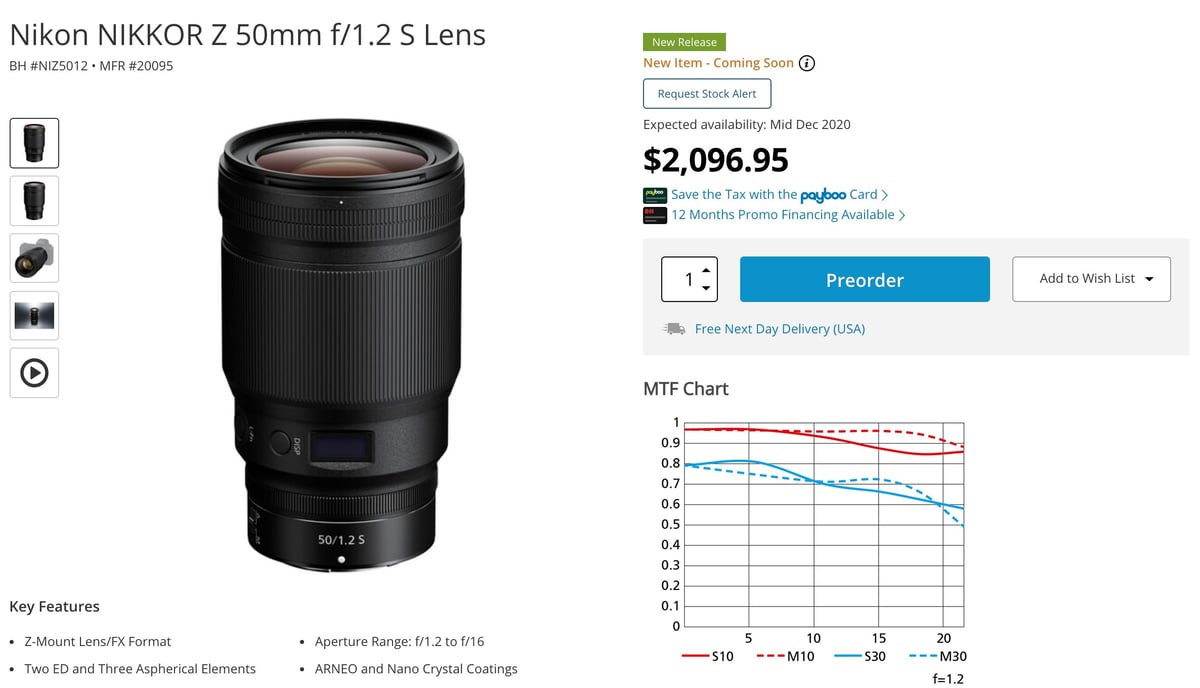
Nikon has officially announced the 50mm f1.2.
Nikon 50mm f1.2 – Adorama / B&H
Add to the list of all Nikon Z lenses.
Lens Specs
| Focal Length: 50mm Aperture: f1.2 – f16 Aperture Blade: 9Rounded Optical Design: 17 Elements in 15 Groups Elements: 2 ED and 3 Aspherical Elements Coatings: ARNEO and Nano Crystal Coats, Super Integrated Coating Autofocus: 2 stepping motors | Internal Focus IF VR: No Weather-Sealed: Yes Minimum Focus Distance: 1.5′ / 45 cm Filter Threads: 82 mm (Front) Weight: 2.4 lb / 1090 g |

Official Nikon Z 50mm f1.2 S Page
See the official Nikon page for all the specs and technology of the lens.
And this is their announcement page.
Here are the highlights.
Lens Highlights
The NIKKOR Z 50mm f1.2 has a few unique features that set it apart from the competition.
An OLED information panel so you can quickly glance to check settings, and an L.Fn button that lets you make exposure adjustments on the lens. While these features don’t seem that useful at first, once you incorporate them into your process and build your muscle memory around them, they can be very useful. Since it’s a large lens, you’ll likely always be bracing it with your left hand, so having those controls right there and always available could be convenient.
IF Focusing allows the lens to focus internally, so there is no change in the lens’s physical dimensions.
Multi-FS. This is technology that Nikon has built into a few of its lenses. Essentially, it’s two focus elements, each driven by a different focus motor. This allows for faster, more precise autofocus, but it also reduces aberrations. This improves close focusing.
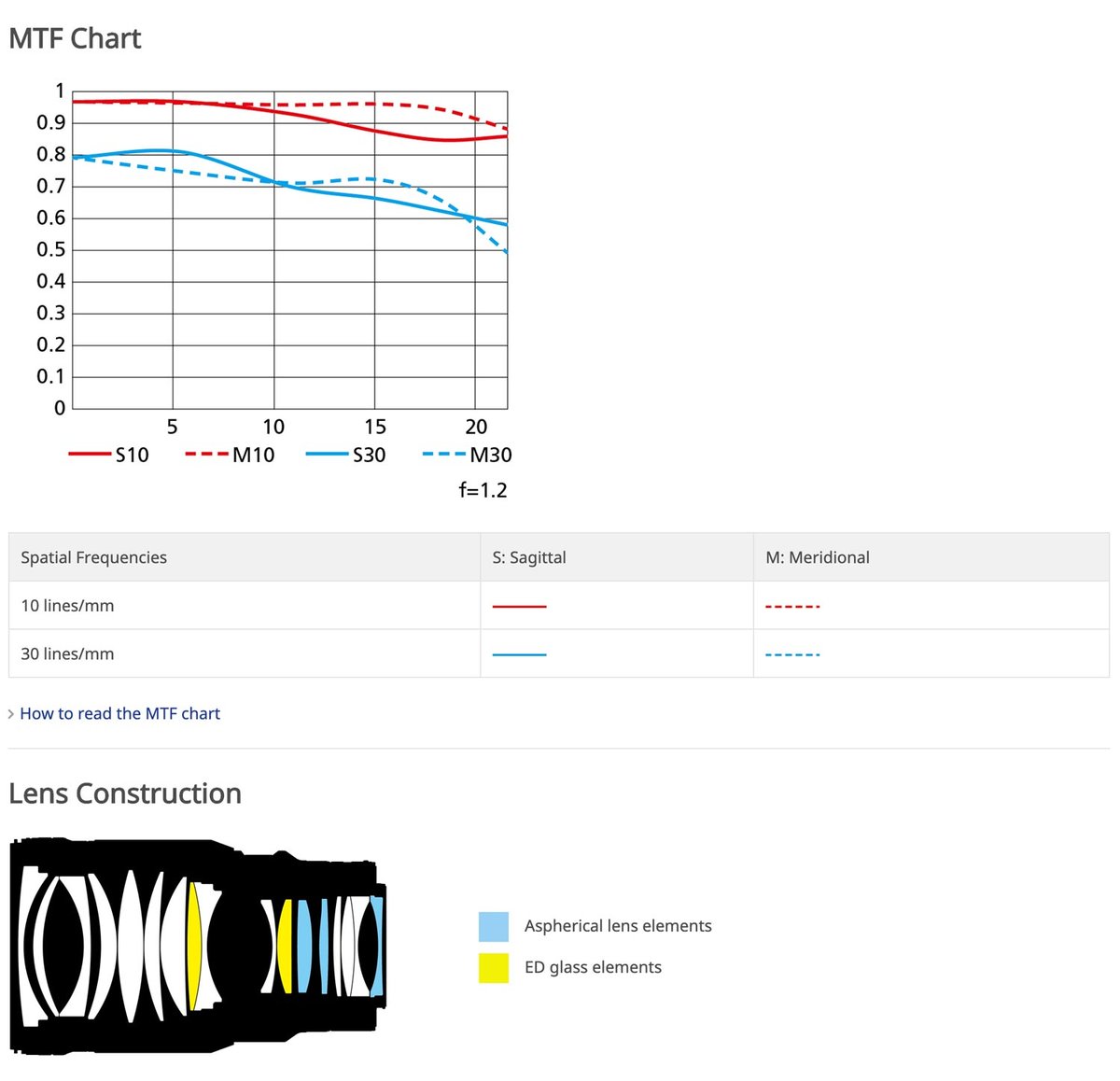
These MTF charts are really good for an f1.2 lens.
The center frame sharpness should be comparable to the Z 50mm f1.8 S, which is a very good lens in terms of sharpness. I’ll still stand by what I say about the NIKKOR Z 50mm f1.8 S being the best 50mm ever made (in terms of overall performance and features). I highly recommend it.
Compared to the Canon RF 50mm f1.2, it performs similarly in the center, slightly better, actually, but it should noticeably outperform the Canon along the edges.
Canon RF 50mm f1.2 MTF Charts

Compared to the Sony 50mm f1.4, midframe sharpness will be better on the Nikon, but the Sony will outperform at the edges. This compares an f/1.2 lens to an f/1.4 lens. Keep that in mind. The Sony MTF chart shows you spatial frequencies of only 10mm, 20mm, and 40mm, not 30mm, so you can only do a 1-to-1 comparison on 10mm – the red line.

NIKKOR 50mm f1.2 vs Canon 50mm f1.2 vs Sony 50mm f1.4 Price & Spec Comparison
Here is a quick chart showing how this lens compares to the competition on some key features. I know I should start including Panasonic on this list, as their cameras and lenses are incredible. But for now, we’ll just do the big players.
| Lens | NIKKOR Z 50mm f1.2 | Canon 50mm f1.2 R | Sony 50mm f1.4 |
| List Price | $2,100 | $2,300 | $1,500 |
| Weight | 2.4 lb / 1090 g | 2.09 lb / 950 g | 27.5 oz / 780 g |
| Elements | 17 Elements in 15 Groups | 15 Elements in 9 Groups | 12 Elements in 9 Groups |
| Aperture | 9R | 10R | 11R |
Looking at the breakdown, you can see the NIKKOR is priced very aggressively. Although it has quite a bit more glass than the Canon or Sony. That probably means it’s more expensive to make.
Sony is a Zeiss design, and you know Zeiss, they like to keep their element count down in favor of that signature Zeiss Pop. This usually comes with a performance hit, unless you’re using some of their bigger lenses, like the Distagon.
Expect the Nikon 50mm f1.2 to have the least amount of micro-contrast of the three, unless they have some glass or coating advantage, which I don’t think they do. Although it’s probably very difficult to distinguish between 17 and 15 elements.
It’s just important to pay attention to these things so you can balance out your kit and get the best performance for your style.
The Nikon also uses a 9-bladed aperture, the Canon a 10-bladed aperture, and the Sony a 11-bladed aperture. Sony should technically give you a smoother bokeh shape when stopped down, especially since it’s stopping down from f1.4.
The NIKKOR is also the heaviest of the three, but only slightly heavier than the Canon. This is probably fine too, considering the vast majority of Nikon shooters are Grizzled men, not skinny jean-wearing hipster kids, so the weight here won’t be an issue for the Nikon photographer.
My Thoughts On Fast Lenses | Who They Are For
I have some opinions about ultra-fast lenses like this that aren’t really in line with the rest of the community, so I will share what I think.
First off, these lenses are tools designed for low-light or a specific look. Fast lenses, although more expensive, don’t automatically mean you’re getting a better image or even a better lens. It’s up to the lens designers to decide how good they want a lens to be at a given aperture. Traditionally, DSLR lenses were built more cheaply and considered entry-level primes. Today, lens designers are throwing the kitchen sink at even f1.8 lenses, so you can find incredible performance and builds like with the NIKKOR Z f1.8 lenses and some of the Sony f1.8 lenses.
Now that our systems are aimed at hybrid shooters, having higher quality, slower lenses is a must for videographers who can’t shoot everything wide open all the time. They need lighter, slower lenses so they don’t have to stack 4-inch ND filters over the front glass.
In terms of image quality and capabilities, while having f1.2 is useful, overusing shallow depth of field, in my opinion, can make the image worse, not better, and is one of the telltale signs of an amateur, especially with filmmaking.
My favorite reference for how to do it right is Ex Machina. This film was shot using a Super 35mm Sony camera (similar to APS-C), at f2.8-f4 throughout. In full-frame comparisons, this would be closer to f4 to f5.6. Of course, it’s not exactly the same because of the anamorphic lenses. Generally, having a beautiful background and production design is important to a film, and the storytelling and professional cinematographers are careful to preserve this in their shots. Controlling the depth of field and the background look is an important part of the craft.
Professionals should be careful about buying ultra-fast lenses and using them wide open for everything. Almost always, you get more tonal depth with a slower lens with fewer elements, and the bokeh often looks significantly worse when stopping down these ultra-fast lenses compared to slower lenses. Sure, a 50mm f1.2 is often sharper at f1.8 than a 50mm f1.8, but usually at the cost of some pop and bokeh smoothness. Sometimes, even contrast.
Unless you need that extra stop in low light performance or often shoot in situations where you need to calm the background with shallow depth of field, you’ll be almost better off with a slower lens, like an f1.8, which in my opinion is the sweet spot in terms of versatility for a 50mm.
That being said, f1.2 is incredibly useful for the wedding photographer who has little control of the scene; the large aperture gives them a tool that can solve more problems. The shallow depth of field will allow you to hide busy backgrounds, and it will also expand your low-light capabilities when shooting in poorly lit cathedrals or receptions.
I personally don’t always like the ultra-shallow look in headshots, but I think for full-body shots, f1.2 will produce really nice subject separation, and f1.2 on a 50mm is great for this.
My favorite part about the NIKKOR 50mm f1.2 is that it’s only $2,100, which is cheaper than the Canon 50mm f1.2 R, which lists at $ 2,300.









Leave a Reply to Alik Griffin Cancel reply