
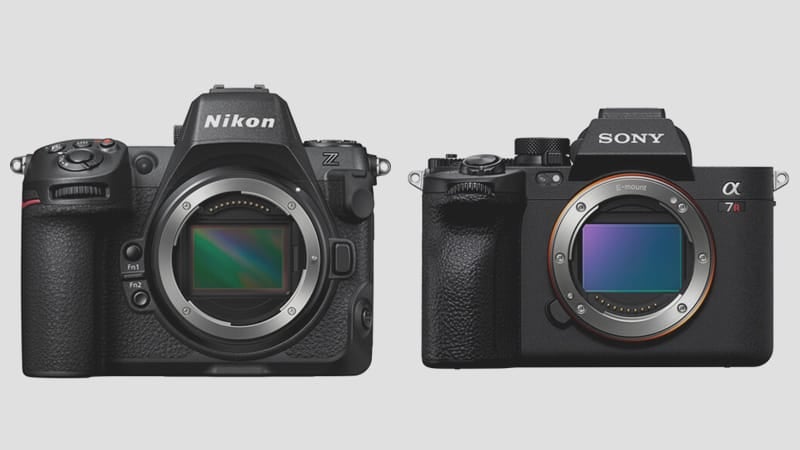
Since Nikon has released its latest do-it camera, we’ll compare it to the Sony A7rV, a camera in a similar price range.
I don’t fully understand why everyone keeps comparing these two cameras; they are different and directed at totally different audiences. You’re supposed to compare two products with the same consumer focus rather than on price; in this case, a proper comparison would be the Sony A1. If you want to see how the Nikon Z8 compares to the Sony A1, I have a full comparison here that compares the Nikon Z9 vs Sony A1. I know the Z8 is not the Z9 but the features are pretty much identical.
With a lot of the specs, the Sony A7rV is similar to the Sony A1, except there is a new screen on the A7rV, and it does not have a stacked sensor.
Nikon Z8 – Amazon / Adorama / B&H
Sony A7rV – Amazon / Adorama / B&H
Nikon Z8 vs Sony A7rV – The Ultimate Comparison
The Sony A7rV has a much smaller, more compact body than the Nikon Z8. The Z8 really caters more to the photographer who wants a bigger body that feels more like a DSLR. There are a lot of little differences here, but both cameras do an excellent job of allowing customizable controls, and they both have pretty good user interfaces via buttons and dials.
Of course, some things bug me about the Sony bodies and menus, as well as some things that bug me about the Nikon buttons and menus. However, there are also some things I love about each system.
Nikon Z8 vs Sony A7rV Spec Chart
I don’t have information like the brightness of the Sony EVF and the various readout speeds in the different video modes, and I haven’t found the readout speed of the Sony A7rV sensor yet. I think the sensor of the A7rV might be the same as the A7rIV, which is 50ms compressed and 100ms uncompressed for stills.
| Nikon Z8 | Sony A7rV | ||
| Price | |||
| Launch Price (subject to change) Camera Only + Included Battery | $3,996.95 | $3,898.00 | Sony A7rV |
| Price of Vertical Grip | $350 | $398 | — |
| 2x 160GB CFx Cards | Type-B $$ | Type-A $$$ | |
| Weight | |||
| Body Only | 1.8 lb / 820 g | — | Personal Preference |
| + Battery & Memory | 2.0 lb / 910 g | 1.6 lb / 723 g | Personal Preference |
| GPS | |||
| GNSS | No | No | — |
| EVF | |||
| EVF Type | OLED | OLED | |
| EVF Size | 0.5″ | 0.64″ | Sony A7rV |
| EVF Resolution | 3,690,000 Dot | 9,437,184 Dot | Sony A7rV |
| EVF Eye Point | 21 mm | 25 mm | — |
| EVF Magnification | 0.8x | 0.9x | — |
| EVF Brightness | 3000cd/m2 | no spec | Nikon Z8 |
| EVF Refresh Rate | 120Hz | 120Hz | Nikon Z8 |
| EVF Performance Throttling | No | Yes | Nikon Z8 |
| EVF Blackout Free | Yes | No | Nikon Z8 |
| LCD | |||
| LCD Size | 3.2″ | 3.2″ | Tie |
| LCD Resolution | 2,100,000 Dot | 2,095,000 Dot | Tie |
| Adjustability | 4-Axis Tilting | Articulating Hinge | Personal Preference |
| Memory Cards | |||
| Accepts SD Cards | Yes | Yes | Tie |
| CFx Type B vs Type A | 1710 MB/s | 700 MB/s | Nikon Z8 |
| Battery Power | 2280mAh | 2280 mAh | Tie |
| Battery Wattage | 16 Wh | 16.4 Wh | — |
| Battery Performance | 340 shots LCD | 440 shots LCD | Sony A7rV |
| Shutter | |||
| Mechanical Shutter | No | Yes | Nikon Z8 |
| Shutter Life | — | 500,000 cycles | Nikon Z8 |
| Flash Sync Speed | 1/200 – 1/250 | 1/250 | — |
| Max Shutter Speed | 1/32000 | 1/8000 | Nikon Z8 |
| Sensor Shield | Yes | No | Nikon Z8 |
| Operating Temperature | |||
| Operating Temperatures | 14 to 104°F / -10 to 40°C | 32 to 104°F / 0 to 40°C | Nikon Z8 |
| Sensor Resolution | |||
| Sensor Typed | Stacked BSI CMOS | BSI CMOS | Nikon Z8 |
| Sensor Size | 35.9 x 23.9 mm | 35.9 x 24 mm | — |
| Actual Resolution | 52.37 Megapixel | 62.5 Megapixel | Sony A7rV |
| Effective Resolution | 45.7 Megapixel | 61 Megapixel | Sony A7rV |
| Sensor Pixel Pitch | 4.35µ | — | — |
| AA Filter | No – unconfirmed | No – unconfirmed | |
| Micro Lens Design | Standard | Aggressive | Nikon Z8 |
| Sensor-Shift | No | 240.8 megapixels | Sony A7rV |
| Mechanical Shutter Scan Time | — | 3.5 ms? | Sony A7rV |
| Sensor Readout | 4ms | 100ms | Nikon Z8 |
| Readout Speed 8k | 14.3ms | — | |
| Readout Speed 4k120p | 5ms | — | |
| Photo Bit Depth | |||
| 14-Bit Raw | Yes | Yes | — |
| 12-Bit Raw | Yes | Yes | — |
| 10-Bit HEIF | Yes | Yes | — |
| 8-Bit JPG | Yes | Yes | — |
| Continuous Burst | |||
| 30fps RAW Lossy | No | No | — |
| 30fps JPG | Yes | No | Nikon Z8 |
| 20fps RAW Lossless | Yes | No | Nikon Z8 |
| 120fps 11MP | Yes | No | Nikon Z8 |
| Buffer Size | 2GB Est. | 4GB Est. | Sony A7rV |
| Lenses That Support 30fps | 100+ | 40+ | Nikon Z8 |
| IBIS | |||
| 8 Stops | No | Yes | Sony A7rV |
| 5.5 Stops | Yes | Yes | — |
| Focus | |||
| Phase Detection Points | 493 | 693 | Sony A7rV |
| Contrast Detection Points | unknown | unknown | — |
| Autofocus Sensitivity | -9 to +19 EV | -4 to +20 EV | — |
| Detection Modes | Humans, Animals, Vehicles | Humans, Animals, Birds | — |
| Focus Bracketing | Yes – unconfirmed | No | Nikon Z8 |
| ISO Performance | |||
| Base Performance | 64 to 25,600 | 100 to 32,000 | — |
| Extended | 32 to 102,400 | 50 to 102,400 | — |
| Video | |||
| 8k60p Internal | Yes | No | Nikon Z8 |
| 8k30p Internal | Yes | Yes | — |
| External 16-bit | unknown | Yes | Sony A7rV |
| ProRes 422 HQ Internal 10-bit | Yes | No | Nikon Z8 |
| ProRes Raw 12-bit Internal | Yes | No | Nikon Z8 |
| HDMI Out | 10-bit | 16-bit | Sony A7rV |
| H.265 10-bit Internal 4:2:2 | No | Yes | Sony A7rV |
| H.265 10-bit Internal 4:2:0 | Yes | Yes | — |
| 4k120p | Yes | Yes | — |
| 1080p240 | No | No | — |
| 8k Record Limit | Unlimited | Unlimited | — |
I know I listed the Sony A7rV as not being blackout-free with the EVF, but Sony does offer blackout-free when shooting live view, which is a low-resolution line skipped view.
Nikon Z8 vs Sony A7rV Conclusions
Both of these cameras are incredible.
Sensor Performance
The Nikon Z8 shows superiority mostly with the speed of using a stacked CMOS sensor. However, the Sony A7rV will have more resolution and it should technically have more dynamic range.
With video, the Z8 will have a lot less rolling shutter. Nikon is still improving its LOG settings, whereas Sony is still showing superiority.
Autofocus
Both cameras should be pretty competitive with Autofocus. I see some comparisons where the Nikon Z8 outperforms the Sony cameras, but it also sometimes looks like the Nikon Z8 can make more mistakes. It’s really hard to know since Youtubers who do the AF comparisons let their bias creep into the reviews.
Also, as a Sony shooter and a Nikon shooter, the Nikon AF controls and the ability to switch between AF modes are a lot smoother and a better experience because Nikon allows you to very quickly fix focus false positives or redirect focus with the Fn1 and Fn2 buttons, so it can give you exactly what you want.
Memory Cards
The smaller Sony body also uses CFexpress Type-A cards, which are considerably slower than the Type-B cards used by Nikon.
However, while CFexpress type B memory cards are technically faster than CFexpress type A memory cards, in benchmarks, cameras like the Nikon Z8 with its memory card speed, or the Panasonic GH6 or the Fujifilm X-H2s and especially the Canon R5 memory card speeds, none of these cameras are using CFexpress type B cards to their full potential. Sony cameras are running the CFexpress Type A cards at very similar speeds. Maybe we’ll see better performance from the CFxB cameras in the future, but these cameras seem to run these cards at around 600-700MB/s.
Looking at some samples, the fastest CFexpress type B card (the Lexar Dimaond) runs in the Nikon Z9 at 728 MB/s – See the Nikon Z9 memory card speed test.
When I benchmarked the memory cards for the Sony A1, it ran CFexpress type A cards at a speed of 602.03 MB/s with the prograde card. I haven’t even tested the Lexar cards, which are slightly faster than the Sony and Prograde cards.
The Sony cameras also have a much bigger buffer which can help with bursting. With the difference between 600MB/s in the Sony A1 or likely A7rV compared to the Z8 running cards at 700MB/s, there really is no advantage here to CFexpress Type B cards other than price – they are way cheaper, and technically they are more future-proof having a dual bus, with the potential to run twice as fast, which I don’t think any camera takes advantage of yet.
You can find memory card benchmarks in this Sony A7rV Memory Card Recommendation Guide. They will be posted soon.
Viewfinder
When looking at the EVF, at first, it seems like the Sony EVF is the clear winner. 9.4m Dots with 120Hz, it’s also bigger at 0.64″ vs Nikon’s 0.5″, which is nice, and the Nikon EVF also now does 120Hz but is also much brighter.
Real-world performance is never the same as specs with Sony cameras. In this case, they often throttle the resolution and overall quality of the displays when focusing or shooting video.
The Nikon Z8 does not throttle the performance of the EVF or display, plus it’s the brightest EVF we’ve ever seen in a camera. The Nikon Z8 sensor has a slightly faster readout speed, translating into slightly less lag between subject movement and what you see in the display. Also, it has a blackout-free display.
So, while it seemed like Sony had a better EVF on spec, in real-world applications, the Nikon Z8 has some really nice and useful features that might be better for many photographers. However, it likely uses more battery power.
LCD Display
Nikon again went with their 3.2″ display with over 2m Dots. Sony finally updated its display to be competitive with all the other pro-level full-frame mirrorless cameras. Finally, in 2022, they did it.
So the new Sony A7rV also has a 3.2″ display with 2m Dots.
Both brands took a different approach to the articulating screen. Sony offers a full flip-out screen to satisfy the vlogging market looking to spend $3900 on a camera to take selfies. Nikon offers a more traditional 4-axis tilt screen, similar to what we saw on older Sony DSLRs or some Fujifilm cameras, making shooting from lower angles more convenient.
IBIS
A big breakthrough we are seeing with the Sony A7rV is the 8-Stop IBIS. While it doesn’t seem like there is a huge difference between 5.5 stops and 8 stops, the Sony IBIS does work a little differently. Sony IBIS almost acts as a tripod mode that really tries to lock the sensor still and in place; this can result in little hops as the IBIS breaks. The Nikon IBIS works more like the Sony IBIS used to work, where they always allow some slight drift, which I actually prefer in video since it’s smoother and more natural, but I like a stronger IBIS from Sony for stills.
Third-Party Adapted Lenses
I want to share my experience using third-party lenses on both cameras. If you plan on adapting lenses or if you like using third-party lenses not designed exclusively for the Sony sensor, you will get better performance on the Nikon sensor.
All my Leica M lenses perform better with the Nikon sensor. The reason is, the Sony mount is fairly small and it uses a fairly aggressive micro-lens design to compensate. We also see this with the Leica L mount. Nikon and Canon don’t have this issue so their micro-lenses are more relaxed. The Leica M11 recently got around this some more by producing one of the thinnest sensor stacks, but, that camera has a much deeper flange distance.
Sony sensors have improved here over the years, but you still get better corner and edge performance with adapted lenses on the Nikon bodies.
This does not mean Sony lenses designed for Sony bodies are inferior. The microlens design and the sensor stack can be worked into the optical formula, and if the lenses are properly designed, they can provide just as good performance as that of another camera.
Video NLog vs. SLog
Nikon is still fairly new to delivering professional-grade video profiles and doesn’t have the same pedigree as Sony.
While Nikon updated their NLog in 2022, many videographers are still unsatisfied with it compared to what Sony offers with S-Log3, so many videographers are turning to custom-made Log profiles. We will continue to see firmware updates and improvements here. For example, when shooting RAW, Nikon allows the Z9 to record LOG at ISO 64 instead of limiting it to 800. It was silly, considering the Z9 is not a dual ISO output camera; there was no reason for this limitation. Hopefully, this update will roll over to the Z8, which should also boost Dynamic Range when shooting RAW video, which was only 10-11 stops when shooting RAW at ISO 800. ISO 800 doesn’t have amazing DR when reading RAW sensor information, so like with Sony, if you want good DR, you’ll need to shoot LOG with H.265 and only shoot RAW if you want to push the colors around a lot and get sloppy with exposure.
Bottom Line
The Sony A7rV will be a better camera for resolution work, whereas the Nikon Z8 is a much better hybrid camera overall for faster-paced shooting and video. It’s nice to see Sony finally improving its screen and matching the competition here.
What we need to wait for is to see what Nikon does with the Z7 III, that will likely be a more accurate comparison considering the Z7 series is Nikon landscape resolution and a studio camera similar to the Sony A7rV. However, I feel Nikon will go with a higher resolution sensor of greater than 61MP when they decide to upgrade the Z7. My guess is something in the 90MP range so that the Z8 and Z7 are segmented much further apart. I also doubt Nikon will load up the Z7 III with as many video features (which often sit behind expensive patents), to keep the camera’s cost down.
If I missed anything or got anything wrong, let me know in the comments. Thanks!









Leave a Reply to Alik Griffin Cancel reply