
A comparison testing in-camera all the most popular memory cards of the time so we could find the best memory cards for the Nikon D5500.
The Nikon D5500 has only a single UHS-I slot that performs at a top speed of about 28 MB/s. With this camera, UHS-II cards can work, but you will not see the speed advantage that you get from using a UHS-II card with a UHS-II camera since this camera is a UHS-I camera.
Here you can see how each memory card performs when the buffer was tested in the Nikon D5500.

The fastest UHS-II card for the Nikon D5500 is the Lexar 2000X UHS-II or Sandisk Extreme Pro UHS-I.
As mentioned earlier, you don’t need a UHS-II memory card for this camera.
Best UHS-I Memory Cards
For the D5500, all you need is a UHS-I memory card. The fastest UHS-I memory card is the Sandisk Extreme Pro 64GB. In a close second is the Kingston card.
Here are the two memory cards I recommend.
SanDisk Extreme Pro UHS-I 128GB SD Card
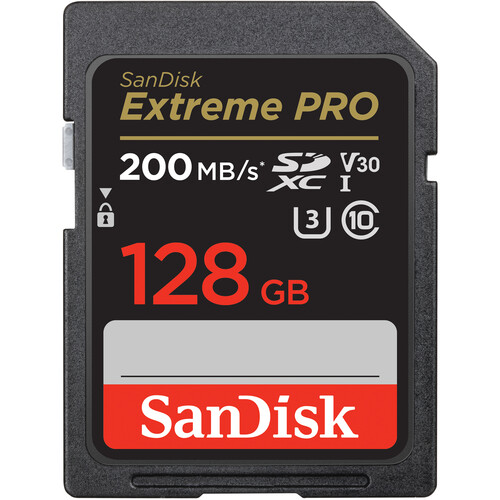
The Sandisk Extreme Pro UHS-I SDXC Memory Card at 128GB is rated with a 90MB/s write speed. The 256GB and larger cards are rated at 140MB/s.
Rated Write Speed: 90MB/s
Rated Read Speed: 200MB/s
Rated Sustain: 30MB/s
Kingston Canvas Go! Plus UHS-I 128GB SD Card
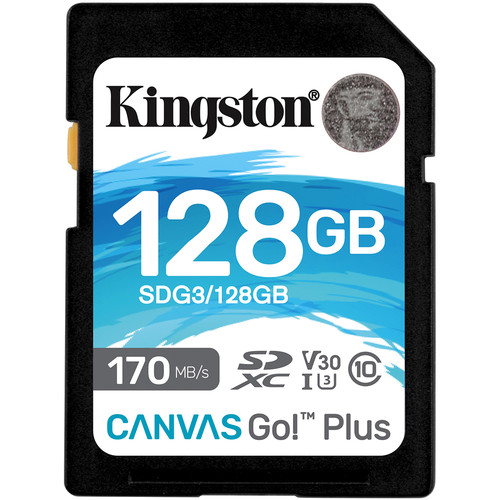
Kingston CanvasGo! Plus SDXC UHS-I SD cards 128GB or higher have a rated write speed of 90MB/s and a rated read speed of 170MB/s.
Rated Write Speed: 90MB/s
Rated Read Speed: 170MB/s
Rated Sustain: 30MB/s
Nikon D5500 Camera Specs
Sensor: 24.2MP / Processor: EXPEED 4 Image Processor
Sensor SD Memory Card Type: UHS-I
Continuous Burst: 5fps
Size of Buffer: 256 MB
Shots Till Buffer Fills 11 depending on the card.
Est. Time Taken To Clear Buffer: – 11.5 seconds (Lexar 2000x UHS-II)
Do you need a U3 memory card for the Nikon D5500?
The key difference between U1 and U3 memory cards has to do with minimum write speeds. With a U1 card, the minimum performance of the card is 10MB/s. With a U3 card, this number goes up to 30MB/s.
What might look strange is that U3 memory cards are still performing slower than 30MB/s with the Nikon D5500. This is a misconception and not the card’s fault. Because the Nikon D5500 does not have a dual processor, it must first process each shot before writing to the memory card causing a delay between each time it writes to the card, slowing down the results.
The time it takes to write to the card is likely bottlenecked by what the camera can do, which in this case is probably somewhere around 32MB/s because the D5500 does not have a very fast bus. Because of this processing time and this bottleneck, the camera is not always writing to the card resulting in speeds that appear to be slower.
Best SD Memory Card Nikon D5500 Conclusions
While memory card write speeds are not very fast, there is a significant advantage to buying one of the faster cards especially if you do a lot of bust photography. While the difference between 21MB/s and 28MB/s doesn’t look like a big deal, it can help clear the buffer quicker so you can get back to shooting or reviewing your photos sooner.
If you don’t do a lot of burst shooting and own the D5500 for casual shooting, then any of the modern cards listed will perform great.
What the 11.5 Second Clear Time Means
The D5500’s 256MB buffer holds about 11 RAW frames at 5fps — that fills in just over 2 seconds of continuous bursting. The 11.5-second clear time (tested with the Lexar 2000x UHS-II) reflects how long the camera takes to write that full buffer to card. During that time you’re not locked out — single shots still work — but a second full burst immediately after the first will stack the buffer and extend the wait. The D5500’s 28 MB/s internal bus ceiling is the constraint here, not the card. Even the fastest UHS-II card in the test couldn’t push beyond what the camera’s interface allows.
Video and Card Size for the D5500
The D5500 records 1080p video only — no 4K. The maximum bitrate is approximately 48 Mbps (6 MB/s), which any U3 card handles easily. For video recording, a 64GB card gives you well over 2 hours of 1080p footage. A U1 card technically covers the D5500’s video bitrate, but U3 is the better habit to have and the price difference is minimal. Use 64GB or larger SDXC cards to avoid the 4GB file fragmentation limit that affects 32GB SDHC cards.
Can I Use a microSD Card in the Nikon D5500?
The Nikon D5500 uses a full-size SD card slot. MicroSD cards work with an adapter, but from experience they can lose connection inside the adapter — I wouldn’t use one for anything critical. See the microSD memory card guide if you need to use one.
Frequently Asked Questions
Is there any reason to buy a UHS-II card for the D5500?
Only for transfer speeds to your computer. In-camera, the D5500 caps at roughly 28 MB/s regardless of card tier — UHS-II cards hit the same ceiling as a fast UHS-I card. If you have a UHS-II card reader and value fast offloads, a UHS-II card still makes sense for that workflow. For in-camera performance, a good UHS-I U3 card is all you need.
Does the D5500 have two card slots?
No — single SD slot only. There’s no backup or overflow option. Carry a spare card if you’re shooting anything where losing footage would be a problem.
What card size is right for the D5500?
For stills, a 64GB card holds roughly 2,500 RAW files at 24.2MP — more than enough for a full day. For video, 64GB covers well over 2 hours at 1080p. Unless you’re shooting extended events or trips without access to a computer to offload, 64GB is the practical choice. Go to 128GB if you prefer not to think about it.







Leave a Reply