
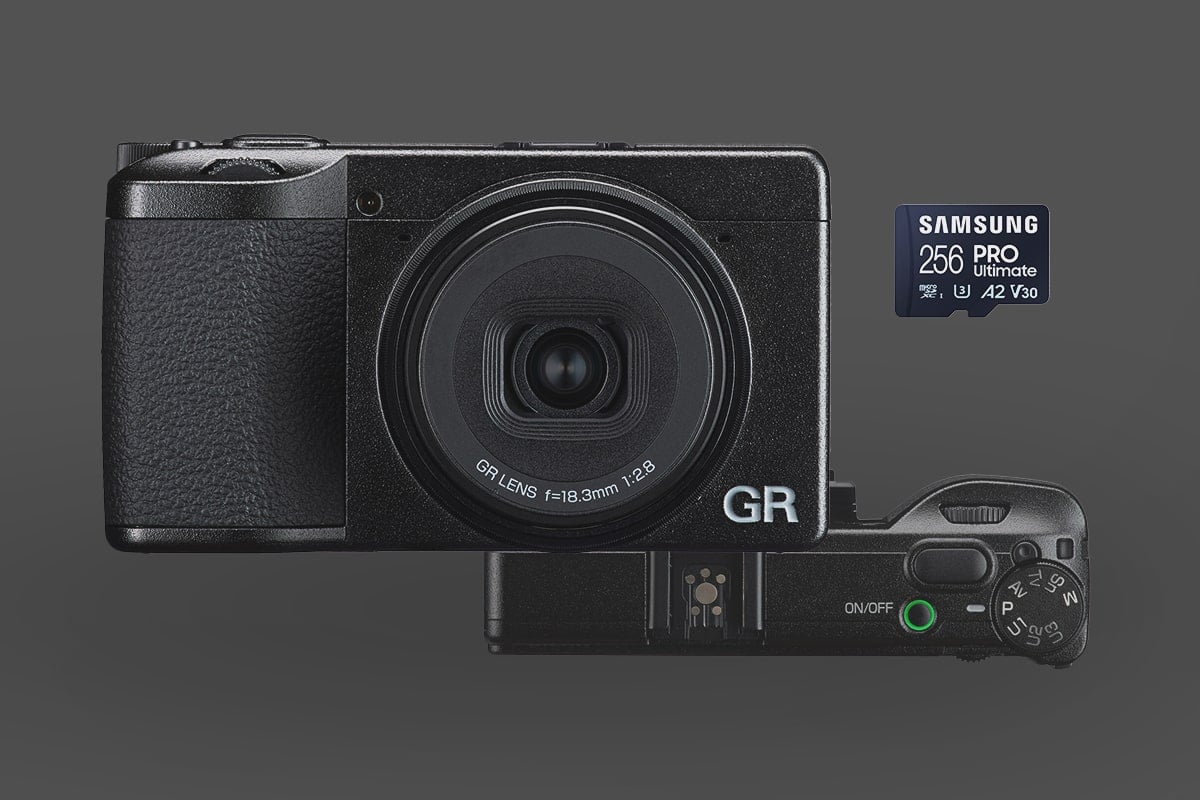
The Ricoh GR IV has officially landed, and with the shift to a MicroSD slot and a massive bump to 53GB of internal storage, the way we handle memory for this snapshot king has changed.
While the internal memory is incredibly fast (and honestly, enough for most day-trips), you’ll still want a reliable card for backup or for those long weekends when you’re shooting 14-bit DNGs.
Despite the 2026 release, the GR IV and its siblings—the GR IV HDF and the GR IV Monochrome—still utilize a UHS-I interface. This means buying a V90 UHS-II card is a waste of money; you won’t see any in-camera speed benefits.
Top Recommended MicroSD Cards for Ricoh GR IV
Since the GR IV caps out at UHS-I speeds, these are the cards that offer the best stability and value.
| Recommended Cards | USB-C Write | USB-C Read | Check Price | |
|---|---|---|---|---|
| MicroSD Express | ||||
| Lexar PLAY PRO EX 256/512GB / 1TB | Amazon | |||
| Sandisk EX 128GB/256GB/512GB | Amazon | |||
| Sandisk EX 1TB | ||||
| Samsung EX 256GB | Amazon | |||
| PNY EX 128GB/256GB/512GB | Amazon | |||
| Adata Premier Extreme EX U3 | Amazon | |||
| Patriot EP EX V30 | Amazon | |||
| TeamGroup APEX EX V30 A1 128GB-1TB | Amazon | |||
| Transcend USD710S EX V30 A1 256GB/512GB | ||||
| UHS-II | ||||
| Lexar Gold V60 A1 | 103 | 280 | Amazon / B&H | |
| ProGrade V60 | 137 | 198 | Amazon / B&H | |
| Delkin Power V90 | 275 | 287 | Amazon / B&H | |
| Angel Bird A1 V60 | 142 | 267 | Amazon / B&H | |
| UHS-I | ||||
| Sandisk Extreme Pro U3 A2 | 96 | 173 | Amazon | X |
| Sandisk Outdoors 4k V30 A2 | 97 | 175 | Amazon / B&H | |
| Sandisk Extreme U3 A2 256GB-1TB | 124 | 175 | Amazon / B&H | |
| Sandisk Extreme U3 A2 128GB | 96 | 160 | Amazon / B&H | X |
| Sandisk Ultra U1 A1 – 0ld | 50 | 93 | B&H | |
| Sandisk Nintendo Switch V30 A1 | 95 | 158 | Amazon / B&H | |
| Sandisk High Endurance V30 | 82 | 92 | Amazon / B&H | |
| Sandisk Max Endurance V30 | 49 | 92 | Amazon / B&H | |
| Samsung Pro Ultimate v30 A2 | 130 | 179 | Amazon / B&H | |
| Samsung Pro Plus V30 A2 | 127 | 176 | Amazon / B&H | X |
| Samsung EVO Plus V30 A2 | 123 | 127 | Amazon / B&H | |
| Samsung EVO Select V30 A2 | 124 | 126 | Amazon / B&H | |
| Samsung Pro Endurance V30 | 61 | 93 | Amazon / B&H | |
| Kingston Canvas Go! Plus V30 A2 256GB-1TB | ||||
| Kingston Canvas Go! Plus V30 A2 64GB-128GB | ||||
| Kingston Canvas Select Plus V30 A1 | 80 | 93 | Amazon / B&H | |
| Kingston Industrial V30 A1 | Amazon / B&H | |||
| Lexar Silver Plus V30 A2 | 151 | 177 | Amazon / B&H | X |
| Lexar Silver1066x A2 | 118 | 146 | Amazon / B&H | |
| Lexar Blue 633x V30 A1/A2 | 82 | 94 | Amazon / B&H | |
| Lexar FLY V30 A2 | 124 | 152 | Amazon / B&H | |
| Lexar PLAY U3 A2 512GB-1TB | Amazon / B&H | |||
| Lexar PLAY U3 A1 256GB | 102 | 152 | Amazon / B&H | |
| Lexar PLAY U1 A1 128GB | 20 | 144 | Amazon / B&H | |
| Lexar E-Series Plus U3 A2 | Amazon | |||
| Lexar E-Series U3 A1 | Amazon | |||
| Delkin Black V30 | 86 | 93 | B&H | |
| Delkin Hyperspeed V30 | 80 | 93 | Amazon / B&H | |
| Delkin Dashcard V30 | Amazon / B&H | |||
| Transcend 500S U3 | Amazon / B&H | |||
| Transcend 350V High Endurance U3 | Amazon / B&H | |||
| Transcend 340S Ultra Performance V30 A2 | Amazon / B&H | |||
| Transcend 330S High Performance V30 A2 | Amazon / B&H | |||
| Transcend 300s V30 A1 | 47 | 94 | Amazon / B&H | |
| PNY Premier-X A2 V30 | 84 | 93 | Amazon / B&H | |
| PNY PRO Elite U3 A2 | 83 | 93 | Amazon / B&H | |
| PNY PRO Elite U3 | 31 | 91 | Amazon / B&H | |
| PNY Elite-X V30 A1 | 48 | 94 | Amazon / B&H | |
| Patriot EP PRO U3 | Amazon | |||
| Patriot EP A1 V30 | 49 | 94 | Amazon / B&H | |
| Patriot High Endurance U3 | ||||
| Silicon Power Superior Pro | B&H | |||
| Silicon Power Superior V30 A2 | 41 | 94 | Amazon / B&H | |
| Silicon Power Superior V30 A1 | 60 | 94 | ||
| Silicon Power 3D NanD V30 A1 | 54 | 94 | Amazon / B&H | |
| Silicon Power GAME V30 A1 | 89 | 94 | Amazon / B&H | |
| Silicon Power High Endurance U3 | 87 | 94 | Amazon / B&H | |
| TeamGroup A2 Pro+ 256GB-1TB | Amazon | |||
| TeamGroup A2 Pro+ 128GB | Amazon | |||
| TeamGroup Go V30 A1 | Amazon | |||
| TeamGroup High Endurance V30 | Amazon | |||
| TeamGroup Ultra A2 V30 512GB-1TB | ||||
| TeamGroup Ultra A2 V30 256GB | ||||
| TeamGroup Ultra A2 V30 128GB | ||||
| TeamGroup ACE 8K V30 A2 256GB-1TB | ||||
| TeamGroup ACE 8K V30 A2 128GB | ||||
| Third-Party / OEM | ||||
| Amazon Basics V30 A2 | Amazon | |||
| Ritz Gear V30 A1 | 82 | 93 | Amazon | |
| Gigastone 4k Camera Extreme Max | Amazon | |||
| Gigastone 4k Camera Extreme | Amazon | |||
| Gigastone 4k Camera Pro Max V30 A2 | Amazon | |||
| Gigastone 4k Camera Pro V30 A2 | Amazon | |||
| Gigastone Camera Plus V30 A1 | Amazon | |||
| Gigastone 4k Game Turbo A2 U3 | Amazon | |||
| Gigastone Game Pro Max V30 A2 | ||||
| Gigastone 4k Game Pro V30 A2 | Amazon | |||
| Gigastone Gaming Plus A1 V30 | Amazon | |||
| Gigastone 10x High Endurance V30 | Amazon | |||
| Amplim 667X V30 A1 | 86 | 92 | Amazon | |
| Netac Pro A1 U3 | 50 | 92 | ||
| Addlink EX U3 | Amazon | |||
| Dato EX V30 A1 | Amazon | |||
| Gigastone EX V30 A1 256GB | Amazon | |||
| Discontinued | ||||
| Lexar 1800x V60 | 120 | 290 | ||
| Lexar 1000x V60 | Amazon | |||
| Sandisk Extreme Plus U3 A2 | 107 | 174 | Amazon / B&H | |
| Delkin Select V30 64GB | 83 | 93 | Amazon / B&H | |
| Kingston Canvas Go! Plus V30 A2 | 128 | 173 | Amazon / B&H | X |
1. Sandisk Extreme Pro v30 UHS-I
This remains the gold standard for Ricoh cameras. Even though the card’s tech can handle more, it plays very nicely with Ricoh’s controller. It’s consistent, it doesn’t overheat, and the “Pro” build quality offers some peace of mind for travel.
2. Sandisk Extreme V30 A2 UHS-I
One of Sandisk’s most popular cards that works flawlessly in just about any device that takes MicroSD memory cards, and is very popular among cameras like the Nikon Zf or GoPro Hero13.
3. Samsung PRO Ultimate
Samsung has been killing it lately with controller stability, and when it comes to MicroSD cards, they’re among the best, and I even frequently recommend them for various non-camera devices like the Retroid Pocket 5 or the Kindle.
4. Kingston Canvas Go! Plus
If you don’t want to overthink it, buy the Kingston. In my testing across various UHS-I bodies, Kingston often matches or beats Sandisk in actual “burst to buffer” clearing times.
5. Lexar Silver Plus V30 A2
This is one of my fastest cards that I’ve been testing. Lexar is a legendary brand like SanDisk, and they consistently make some of the best memory cards available.
Also check out the Best accessories for Ricoh GRIV.
Important: The Internal Memory Strategy
With 53GB of internal memory, the GR IV gives you a “safety net” we haven’t seen in this series before. Really, the only other mainstream camera doing something like this right is some of the Leica cameras, like the Leica M11.
- Pro Tip: Set your camera to record to the SD card first, but keep the internal memory empty. If your MicroSD card fails or you leave it in your laptop (we’ve all been there), you still have about 1,500+ RAW files worth of space built into the body.
- MicroSD vs SD: Remember, the Ricoh GR III used a full-sized SD card. The GR IV uses MicroSD. Don’t accidentally buy the big ones!
Which capacity should you get?
Stick to 128GB or 256GB. While the GR IV supports up to 1TB, larger cards can sometimes slow down the initial “handshake” when you turn the camera on. Since the GR is all about that 0.6-second start-up time, you don’t want a massive card slowing you down.
Card Speed and the GR IV’s Shooting Style
The GR IV is built around street photography and fast, reactive shooting — not sustained burst fire or high-bitrate cinema recording. The UHS-I interface is appropriate for that use case. For 14-bit DNG files, card speed matters most when you fire a quick sequence and want the buffer to clear before your next shot. In my testing of other UHS-I Ricoh bodies, the SanDisk Extreme Pro and Kingston Canvas Go+ consistently clear the buffer faster than budget alternatives — the gap is small but real when you’re shooting quickly in succession.
The 53GB of internal storage effectively gives you a second card slot that can’t fail mechanically. The most practical workflow: shoot to the MicroSD card normally, keep internal memory as an emergency overflow or backup. If the card fills or fails mid-shoot, the camera keeps writing to internal. When you get back to a computer, offload both.
Frequently Asked Questions
Does the GR IV use MicroSD or full-size SD?
MicroSD — this changed from the GR IIIx and GR III, which used full-size SD cards. If you’re upgrading from a GR III, your existing SD cards will not fit the GR IV slot without an adapter, and that’s going the wrong direction (the GR IV needs a MicroSD, not a full-size card). The internal storage partially offsets the switch by reducing how much you rely on the card slot.
Will a UHS-II MicroSD card make the GR IV faster?
No. The GR IV’s slot is UHS-I only. A UHS-II MicroSD card will work physically but operate at UHS-I speeds — the camera can’t use the UHS-II interface. Don’t pay the UHS-II premium for this body.
Can I shoot to internal memory and MicroSD simultaneously?
The GR IV allows you to set recording priority between internal memory and MicroSD. The recommended approach is to shoot to the MicroSD first and use internal as overflow — that way internal memory acts as a backup if your card fills up unexpectedly, rather than filling internal first and losing the card as a safety net.
What’s the largest MicroSD card the GR IV supports?
The GR IV supports up to 1TB MicroSD cards. However, as noted above, very large cards can slow down the camera’s startup handshake — and the GR is famous for its near-instant readiness. For most users, 128GB or 256GB is the right balance of capacity and speed. Between the MicroSD and 53GB of internal storage, that’s ample capacity for a full day of street shooting with 14-bit DNGs.










Leave a Reply